
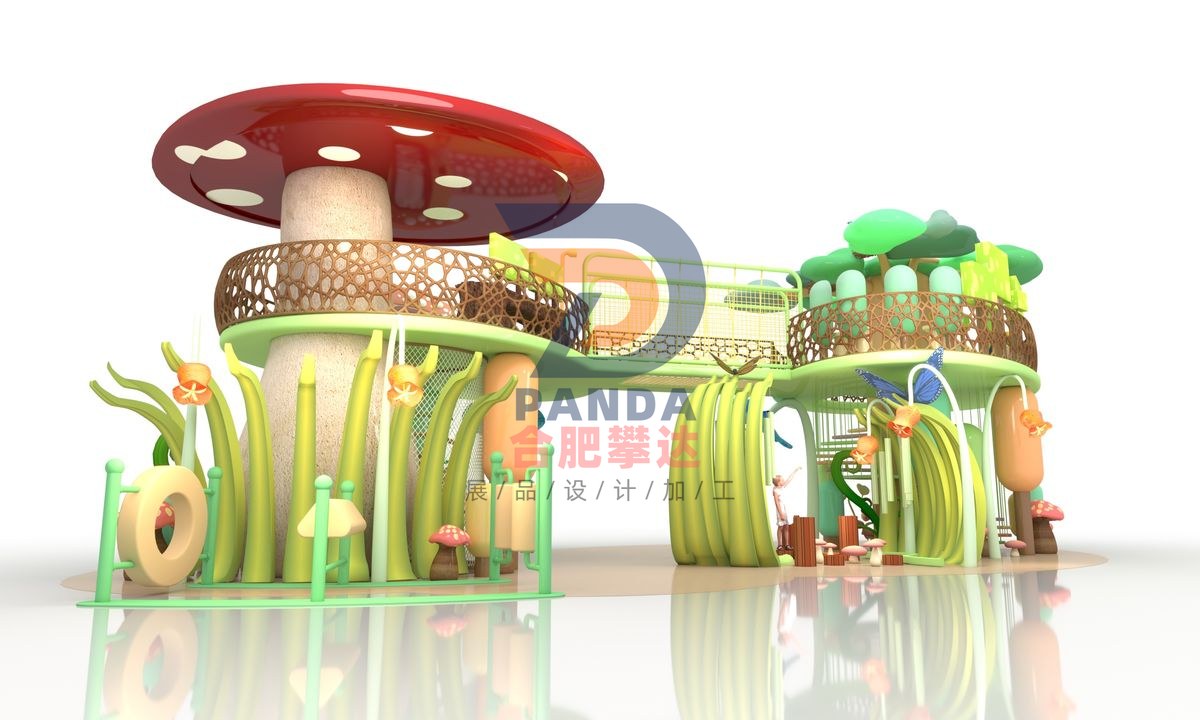
Forest House
Kids' Zone · Interactive
- DimensionsSubject to on-site plan
- PresentationInteractive
- PricingQuoted by manufacture spec
Purpose & Scientific Principle
The exhibits are displayed through real scenes, allowing the audience to understand the construction of forest tree houses, explore the characteristics of animals and plants in the forest, and cultivate hands-on, body movement, and natural cognitive skills.
How to Operate
The exhibits are mainly composed of tree house shapes and sub-exhibits.
The exhibition item uses architectural columns to create a large-scale immersive dreamy forest scene. A large number of plant shapes are set up on the first floor. Climbing passages and musical stairs are designed around the architectural columns to enter the second-floor platform. Plant growth diaries, animal research institutes, new clothes of plants, musical notes in life and periscopes are set up on the second floor. Multiple bird's nest models are set up on the third floor. The audience can watch the bird's nest model on the third floor through the periscope.
Forest ecosystems are distributed in humid or relatively humid areas. Their main characteristics are a wide variety of animals, complex community structures, and the population density and community structure can be stable for a long time.
The plants in the forest are mainly trees, with a small amount of shrubs and herbs. There are also a wide variety of animals in the forest. Since it is easy for animals in the forest to find abundant food and habitat in trees, there are many species that live in arboreal and climbing habitats, such as hornbills, frogs, tree frogs, squirrels, minks, loris, tarsiers, and gibbons.
Forests not only provide humans with a large amount of wood and forest by-products, but also play an important role in maintaining the stability of the biosphere and improving the ecological environment. For example, forest plants consume a large amount of carbon dioxide and release a large amount of oxygen every day through photosynthesis, which is of great significance for maintaining the balance of carbon dioxide and oxygen content in the atmosphere. For another example, when it rains, the tree layer, shrub layer and herbaceous plant layer can intercept part of the rainwater, greatly slowing down the erosion of the rainwater on the ground, and minimizing surface runoff. The litter layer is like a thick sponge, able to absorb and store large amounts of rainwater. Therefore, forests play an important role in conserving water sources and maintaining soil and water, and are known as "green reservoirs".
Related Exhibits



Need a quote for this piece or a full exhibit configuration? Tell us your venue area, theme direction, and budget range.