
Quantum Long Jump Competition
Quantum Technology · Interactive
- DimensionsSubject to on-site plan
- PresentationInteractive
- PricingQuoted by manufacture spec
Purpose & Scientific Principle
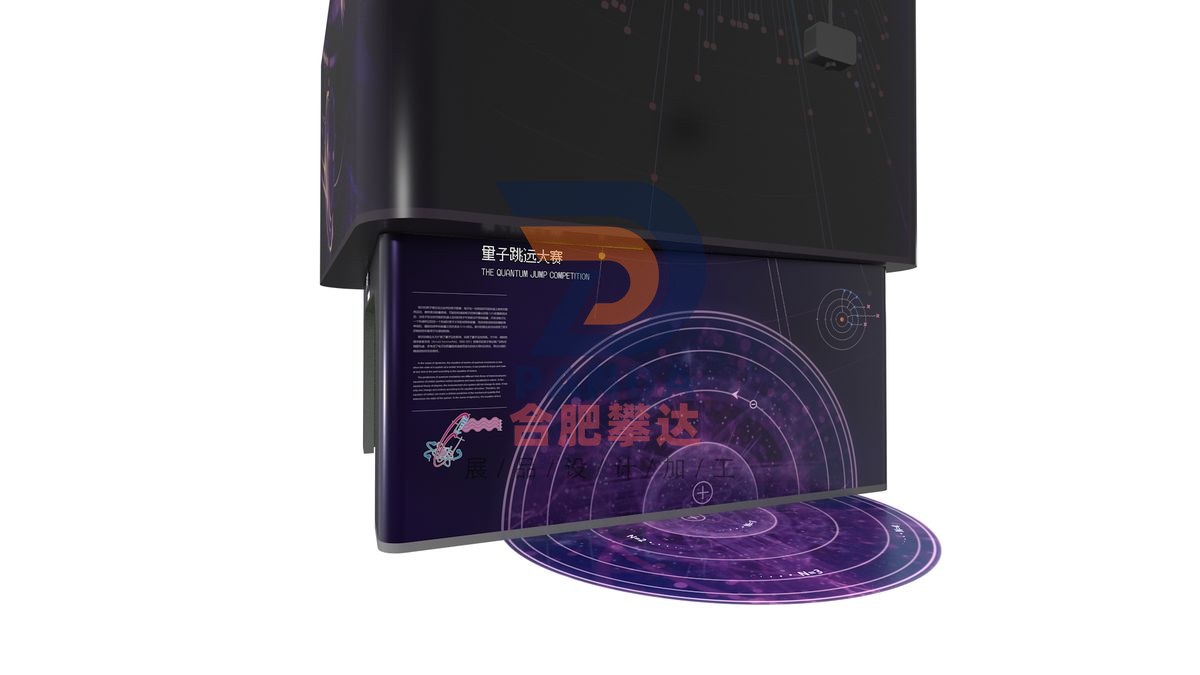
The exhibition projects the electron orbit of hydrogen atoms through projection, allowing the audience to understand the shape of Bohr's atomic model and the process of electron transition in the orbit through the game. Bohr's atomic model is an explanation of the atomic model by quantum theory.
How to Operate
The device consists of ground projection, motion capture cameras, etc. The projector projects the atomic quantized orbit model on the ground. The audience stands on the track, surrounded by apertures to simulate electrons. If they jump from different excited state orbits to other low energy state orbits, when they jump from the 2nd, 3rd, 4th, and 5th excited states to the first excited state, red, green, blue, and purple electromagnetic wave flashes will be emitted correspondingly. When jumping from other high-level orbits to lower-level orbits, different colors of light are emitted, representing the invisible spectrum. If you jump from a low-energy orbit to a high-energy orbit, the brightness of the aperture under your feet increases, which means the energy becomes stronger.
According to the Bohr model, for the simplest atom, the hydrogen atom, when the electrons jump from a high energy level back to a low energy level, they will emit photons with energy equal to the energy difference between the two high and low levels, forming an atomic spectrum. Among them, four of the spectral lines that jump back to the first excited state from a higher orbit (called the Balmer line system) are visible light, with wavelengths of 410.12 nanometers (purple), 434.01 nanometers (purple), 486.07 nanometers (blue-green), and 656.21 nanometers (red). Transitions between other orbits will emit ultraviolet, infrared and other invisible light. The exhibition uses radar to sense the jumping and landing positions of tourists, calculates whether it complies with the jump rules, and creates corresponding light effects on the ground.
Related Exhibits

Need a quote for this piece or a full exhibit configuration? Tell us your venue area, theme direction, and budget range.