
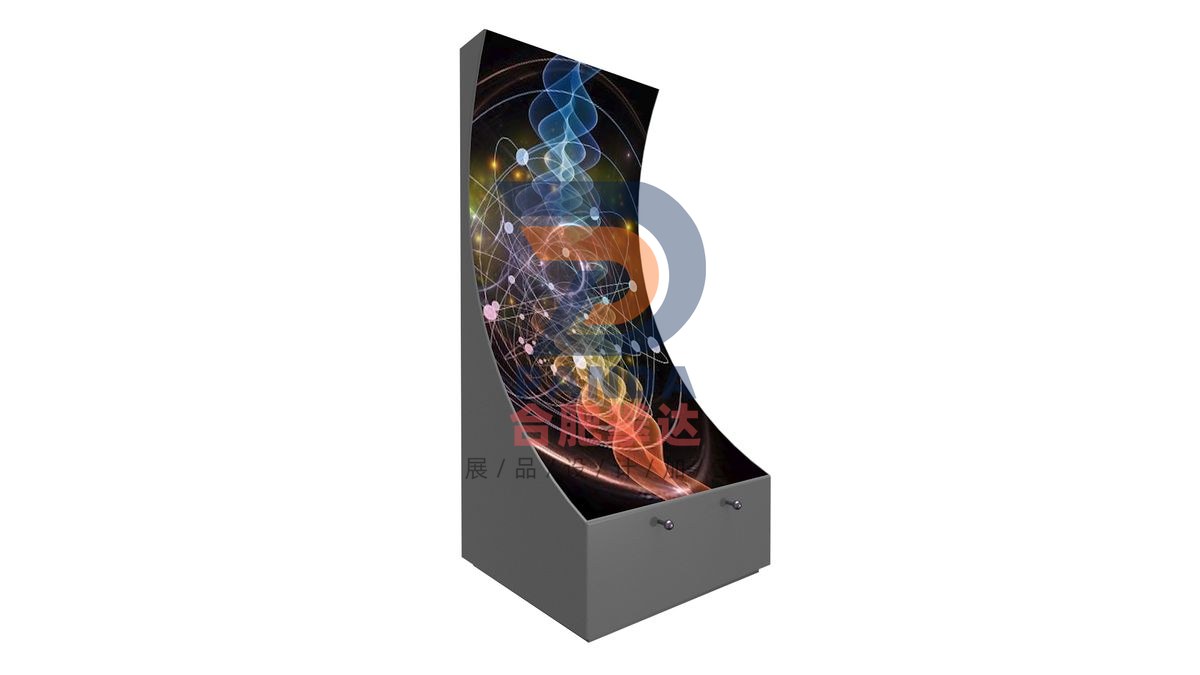
Photo Pinball Machine
Quantum Technology · Interactive
- DimensionsSubject to on-site plan
- PresentationInteractive
- PricingQuoted by manufacture spec
Purpose & Scientific Principle
The exhibition allows the audience to intuitively understand that photons are also particles through the form of games, simulating the phenomenon of American physicist Compton’s X-ray experiment. This experiment confirmed the particle nature of light and proved the correctness of quantum theory.
How to Operate
The design of this exhibition is similar to a pinball machine, consisting of a projector, projection surface, pull rod device, etc. The audience turns the lever to align it with the electrons set on the projection screen, pulls and releases, emitting colored photons, which are simulated by the screen. If a photon hits an electron set on the projection screen, the scattering effect after the collision between the photon and the electron will be displayed. The color of the photon changes and the direction of movement changes. The wavelength of the photon changes after the simulated collision. The changes in wavelength and direction of movement indicate that the photon also has momentum, thus indirectly proving that the photon has particle nature.
From 1922 to 1923, Compton studied the components of light after X-rays were scattered by lighter substances (graphite, paraffin, etc.) and found that in addition to components with the same wavelength as the original wavelength, the scattered spectral lines also had components with longer wavelengths. This scattering phenomenon, called Compton scattering or the Compton effect, is another important experiment that demonstrates the particle nature of light. This exhibition uses multimedia interactive simulation of the Compton scattering process to demonstrate the interaction between photons and electrons.
Related Exhibits



Need a quote for this piece or a full exhibit configuration? Tell us your venue area, theme direction, and budget range.