
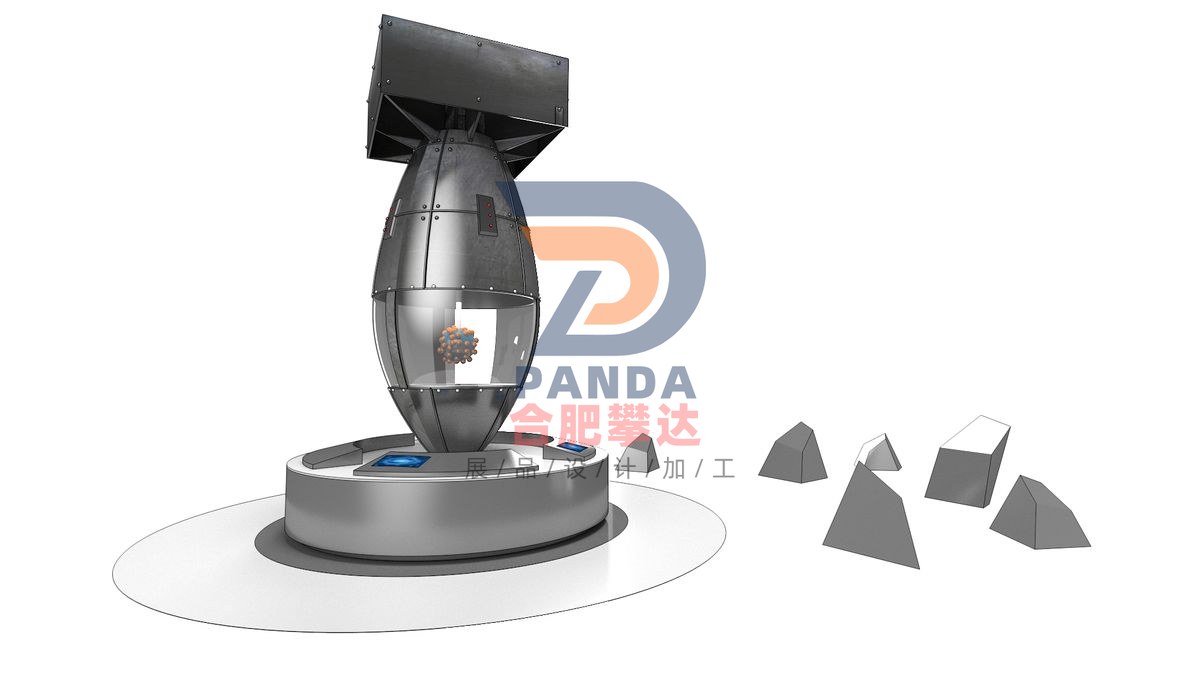
Nuclear Fission
Quantum Technology · Interactive
- DimensionsSubject to on-site plan
- PresentationInteractive
- PricingQuoted by manufacture spec
Purpose & Scientific Principle
This exhibition shows the process of nuclear fission through a vivid chain reaction. It uses analogy and uses electromechanical interaction to show the changes in the internal state during the nuclear fission process.
How to Operate
The core of the exhibition is the atomic bomb model. The model is upright. The middle part of the shell of the single body is made of transparent acrylic material, revealing the spherical fission reaction center at the core of the atomic bomb. A strobe light is installed inside the shell. The reaction center sphere has evenly distributed hemispherical depressions on the outside, and a small hole in the middle leads to the internal pipeline. Negative pressure can be generated in the pipeline to absorb the table tennis balls in the depressions. During operation, the pipeline can also be switched to high pressure to eject the table tennis balls. There are air holes inside the atomic bomb, and more ping pong balls are stored there. When the system is reset, the internal ping pong balls can be blown up through the air holes, and the ping pong balls will automatically be adsorbed on the central sphere shell. After pressing the start button, a ping-pong ball simulating neutrons is shot towards the reaction center sphere and hits the ping-pong ball on the outer shell of the sphere. At this time, the interior switches to high pressure, ejecting all the ping-pong balls in the sphere and cavity. The ping-pong balls jump around, simulating a self-sustaining fission nuclear reaction, and the strobe light flashes, simulating the flash of a reactor implosion.
Fission chain reaction refers to a self-sustaining fission reaction maintained by neutrons as a medium. When a neutron causes the fission of a uranium nucleus, 2 to 3 neutrons are released at the same time. If these neutrons cause other uranium nuclei to fission, the fission reaction can continue. This reaction is called a chain reaction. According to the average number of reactions directly caused by a reaction is less than, equal to or greater than 1, chain reactions can be divided into three types: subcritical, critical or supercritical. This exhibition uses the motion linkage of small balls to intuitively simulate the chain reaction process in nuclear fission.
Related Exhibits
Need a quote for this piece or a full exhibit configuration? Tell us your venue area, theme direction, and budget range.