
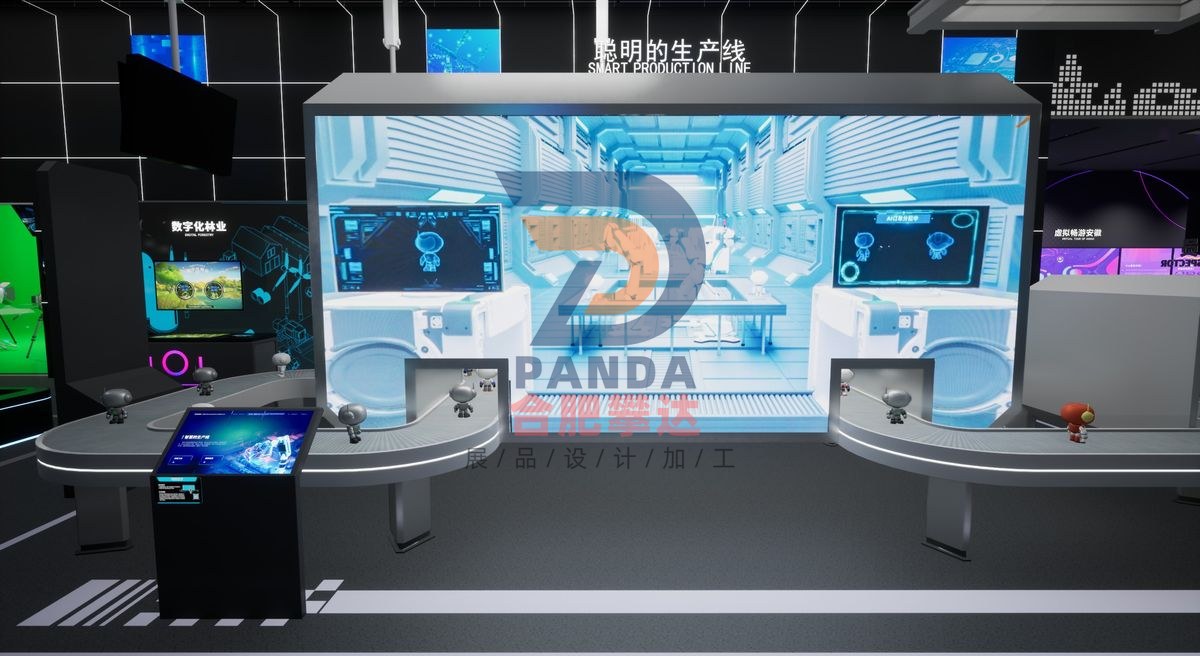
Smart Production Line
Smart Technology · Interactive
- DimensionsSubject to on-site plan
- PresentationInteractive
- PricingQuoted by manufacture spec
Purpose & Scientific Principle
The digital production exhibit group is the core exhibit group of this area, including 4 exhibits: "customized ordering", "smart production line", "AI quality inspector" and "smart manipulator".
This exhibit simulates the AI smart production process of a smart factory. Highlight the flexible customization technology concept of intelligent manufacturing production lines.
How to Operate
(1) Intelligent manufacturing - flexible production
(2) Data prediction of factory production links
(3) Achieving flexible production is inseparable from digital drive
The exhibits lead the audience to observe the production process of IP images on flexible production lines and learn about intelligent production knowledge through a multimedia interactive program that controls a small screen and a large screen.
Flexible production means that the production line can arbitrarily switch between large-volume production and small-volume production while maintaining consistent quality, delivery time, and cost. Faced with the demand for small batches and large-scale customization, manufacturing companies have begun to transform into a production model that can both reduce costs and meet personalized needs. This is flexible production.
Data prediction in the factory production process: Using technologies such as cloud computing and the Internet of Things, the factory is equipped with a "smart brain"; the production lines and equipment in the factory have their own "identity IDs", and the equipment is interconnected. Each link has corresponding data for full-link tracking. Relying on these data, the factory has flexible manufacturing capabilities such as flexible production changes, one-click order insertion, intelligent production scheduling, and rapid production, and has achieved "quick turnaround for small orders" with a minimum order of 100 pieces and delivery within 7 days.
Smart factory production tasks are managed through the production management platform in the cloud platform, and scheduling and control tasks with real-time requirements are handed over to edge layer management and control. Some data directly interact with the model in the control dimension of the digital twin to obtain predicted data, and complete the optimized control of the processing process in the control cycle to achieve virtual control of reality; on the other hand, the edge layer screens and filters these data and transmits them to the platform layer to drive the virtual factory in the cloud platform
It runs synchronously (virtual and real interaction) and is stored in a large database to provide a data source for knowledge mining and perform non-real-time prediction and optimization of the processing process.
In the product development process, the factory uses big data analysis to predict changes in consumer demand and achieves "production based on demand" through digital intelligent evaluation. In the product production process, the production end has also entered digitalization: IoT sensors are spread across various production equipment of the company, collecting real-time data from the entire production chain, and then through integration
Data information from suppliers and customers enables real-time control of all processes in the upstream and downstream links of the supply chain. The 5G network allows for the rapid transmission of massive data. This data is transmitted to the industrial Internet platform and processed through big data analysis. Artificial intelligence relies on the data to make intelligent decisions and ultimately formulate better production solutions.
scheme.
Related Exhibits
Need a quote for this piece or a full exhibit configuration? Tell us your venue area, theme direction, and budget range.