
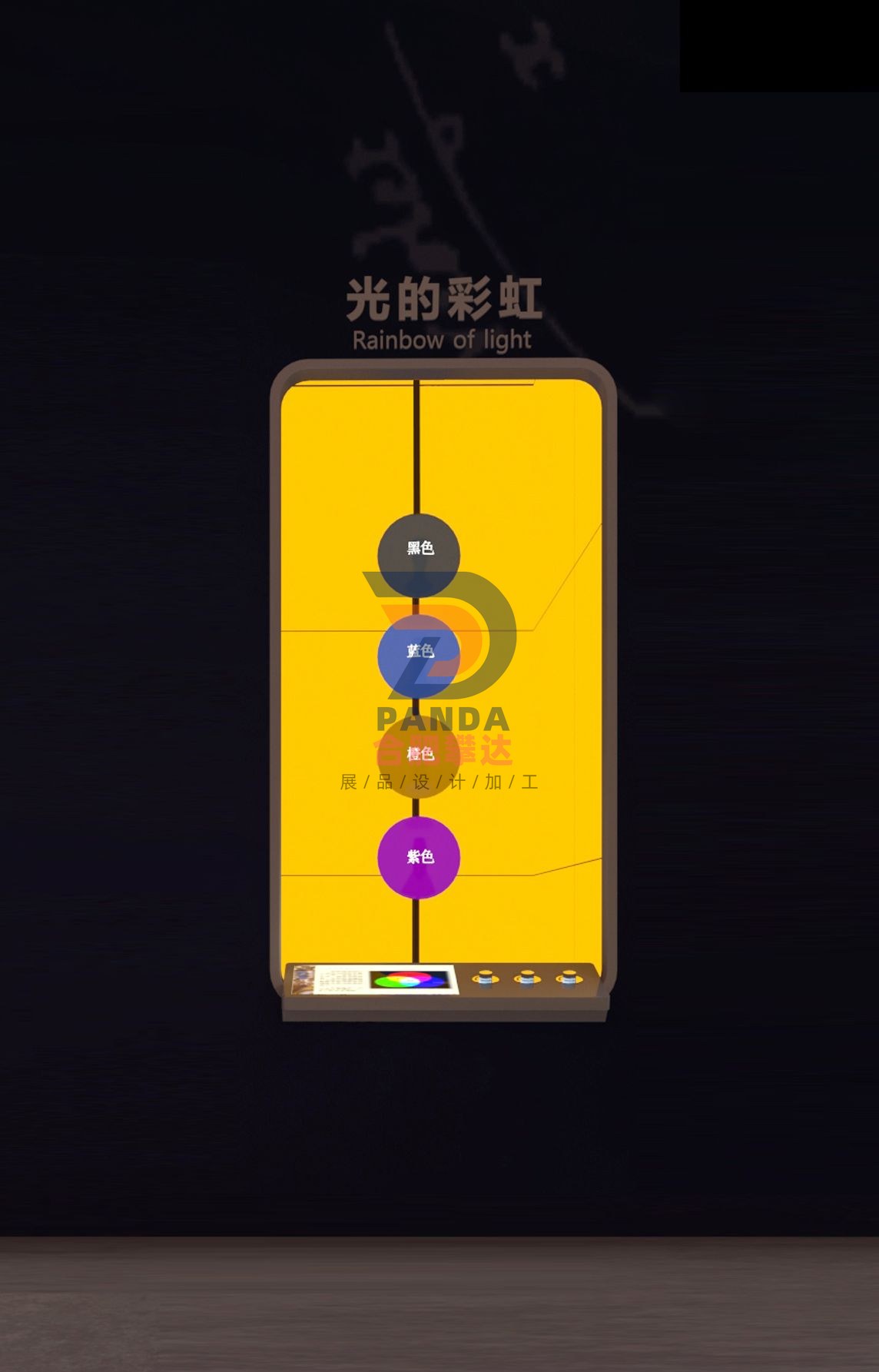
Rainbow of Light
Optics · Interactive
- DimensionsSubject to on-site plan
- PresentationInteractive
- PricingQuoted by manufacture spec
Purpose & Scientific Principle
The exhibition item is designed to allow the audience to manually adjust the RGB values of light in a closed space and watch the different colors of the hanging balls change based on the changes in the color of the ambient light.
How to Operate
In 1666, Newton used a prism to decompose sunlight into a spectrum of seven colors, and conducted a color-light mixing experiment, scientifically proving the relationship between light and color. Newton discovered that mixing colors can produce an intermediate color or another new color. He used a simple model to generalize all the results of color mixing. Newton arranged the seven colors in the spectrum from red to purple in order on a circle and each occupied a certain area.
This model can be used to qualitatively predict the result of mixing individual colors. For example, when equal amounts of red (R) and blue (B) are mixed, you only need to connect points R and B, draw a straight line from the center of the circle O through the midpoint of RB and intersect at a point on the circle. The purple at the intersection is the mixed color. Another example is grass green after mixing yellow and green. If the line connecting two points representing two colors passes through the center point O, then the two equal colors are combined into white. Two colors that can be synthesized into white are called complementary colors. For example, red and green represented by points R and G are complementary colors.
The more different colors of light are mixed, the brighter they will be. That is, the mixed color light produced after mixing is brighter than the average brightness of each color light before mixing. This color mixing is called additive color mixing.
The RGB color model (English: RGB color model), also known as the RGB color model, is an additive color model that adds the RGB three primary colors in different proportions to produce a variety of colors. The exhibition item uses this principle to change the color RGB values in the environment and demonstrates the concept of the three primary colors through the principle of color superposition.
Related Exhibits

Need a quote for this piece or a full exhibit configuration? Tell us your venue area, theme direction, and budget range.