
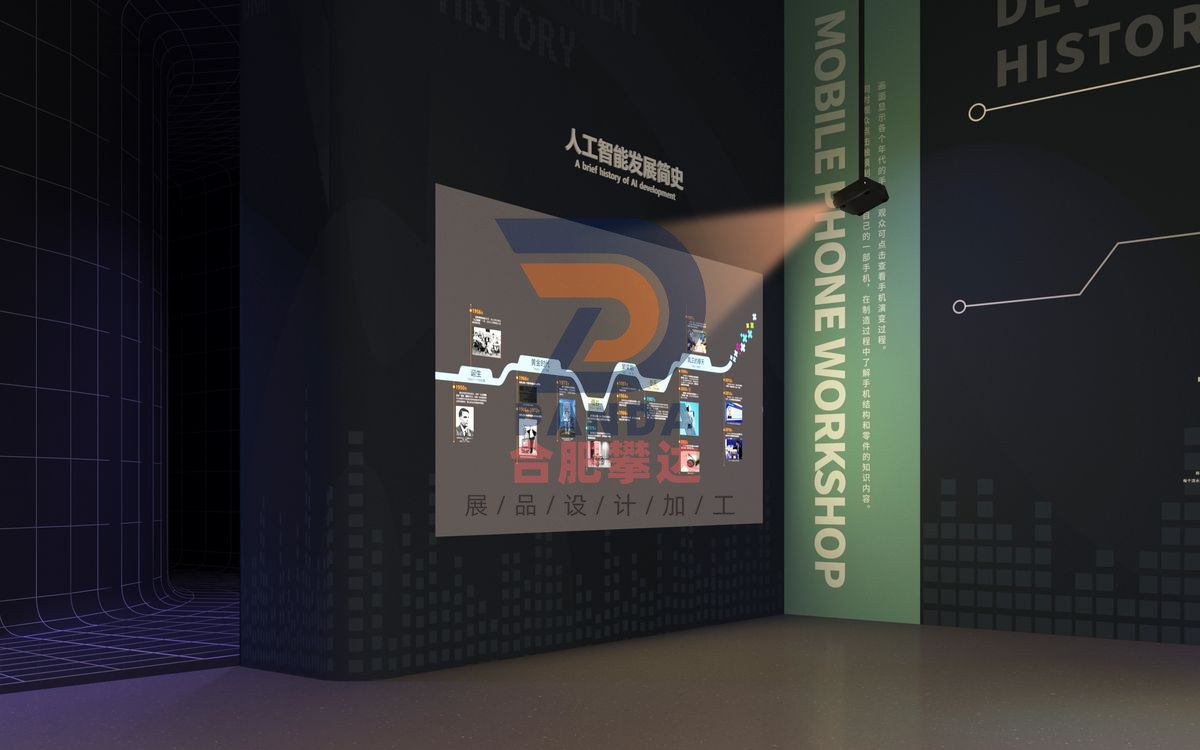
A brief history of the development of artificial intelligence
Smart Technology · Interactive
- DimensionsSubject to on-site plan
- PresentationInteractive
- PricingQuoted by manufacture spec
Purpose & Scientific Principle
Artificial intelligence has entered our lives. As early as the era of electronic tubes, Turing had an idea about artificial intelligence. The exhibition aims to let the audience understand the brief history of the development of artificial intelligence and imagine the future development of artificial intelligence.
How to Operate
A brief history of artificial intelligence:
1. The birth of artificial intelligence (1940s-1950s)
The 1950 Turing test.
In 1954, American George DeVore designed the world's first programmable robot.
In 1956, Dartmouth College in the United States held the first artificial intelligence seminar in history, which is considered to be a symbol of the birth of artificial intelligence. At the meeting, McCarthy proposed the concept of "artificial intelligence" for the first time, and Newell and Simon demonstrated the logic theory machine they had written.
2. The golden age of artificial intelligence (1950s to 1970s)
1966-1972: Shakey, the first artificial intelligence robot, is born
From 1966 to 1972, the Stanford Research Institute for International Research in the United States developed the robot Shakey, which was the first mobile robot using artificial intelligence.
1966: The world’s first chatbot ELIZA is developed
Weizenbaum of the Massachusetts Institute of Technology (MIT) released the world's first chat robot ELIZA. The intelligence of ELIZA lies in her ability to understand simple natural language through scripts and generate human-like interactions.
1968: The computer mouse is invented
On December 9, 1968, Doug Englebart of the Stanford Research Institute in California invented the computer mouse and conceived the concept of hypertext links, which decades later became the foundation of the modern Internet.
3. The low point of artificial intelligence (1970s-1980s)
In the early 1970s, artificial intelligence encountered a bottleneck. The limited memory and processing speed of computers at the time were insufficient to solve any practical artificial intelligence problems. Requiring a program to have a child-level understanding of the world, researchers soon discovered that this requirement was too high: no one could create such a huge database in 1970, and no one knew how a program could learn such a wealth of information. Agencies that fund AI, such as the British government, the U.S. Defense Advanced Research Projects Agency, and the U.S. National Science Board, have gradually stopped funding undirected AI research due to a lack of progress. The National Science Council (NRC) stopped funding after appropriating $20 million.
4. The boom period of artificial intelligence (1980-1987)
1981: Japan develops artificial intelligence computer
1984: The Cyc (Encyclopedia) project is launched, with the goal of enabling artificial intelligence applications to work in a manner similar to human reasoning.
1986: The 3D printer is introduced
American inventor Charles Hull created the first 3D printer in human history.
5. The winter of artificial intelligence (1987-1993)
The term "AI (artificial intelligence) winter" was coined by researchers who experienced funding cuts in 1974. They noted the enthusiasm for expert systems and predicted that it would soon turn to disillusionment. Unfortunately, as they say, the usefulness of expert systems is limited to certain situations. By the late 1980s, the new leadership of the U.S. Defense Advanced Research Projects Agency (DARPA) believed that artificial intelligence was not “the next wave,” and that funding would be directed toward projects that seemed more likely to produce results.
6. The real spring of artificial intelligence (1993 to present)
1997: The computer Deep Blue defeats the world chess champion.
2011: Developed an artificial intelligence program that uses natural language to answer questions.
2012: A team of Canadian neuroscientists created a virtual brain with simple cognitive abilities and 2.5 million simulated "neurons", named "Spaun", and passed the most basic IQ test.
2013: Deep learning algorithms are widely used in product development.
2015: The year of breakthroughs in artificial intelligence. Google has developed TensorFlow, a second-generation machine learning platform that can directly train computers to complete tasks using large amounts of data; the University of Cambridge has established an artificial intelligence research institute, etc.
2016: AlphaGo defeated Go world champion Lee Sedol.
Artificial intelligence has entered our lives. As early as the era of electronic tubes, Turing had ideas about artificial intelligence.
Related Exhibits


Need a quote for this piece or a full exhibit configuration? Tell us your venue area, theme direction, and budget range.