
Exploring the interior of the atom
Smart Technology · Interactive
- DimensionsSubject to on-site plan
- PresentationInteractive
- PricingQuoted by manufacture spec
Purpose & Scientific Principle
Shows a series of scientific discoveries caused by scientists studying the phenomenon of high-voltage discharge in rarefied gases. These discoveries have subverted people's understanding of the most basic unit of matter, the atom. People have since believed that the atom is not the smallest unit that constitutes matter, thus opening up a new discipline - particle physics.
How to Operate
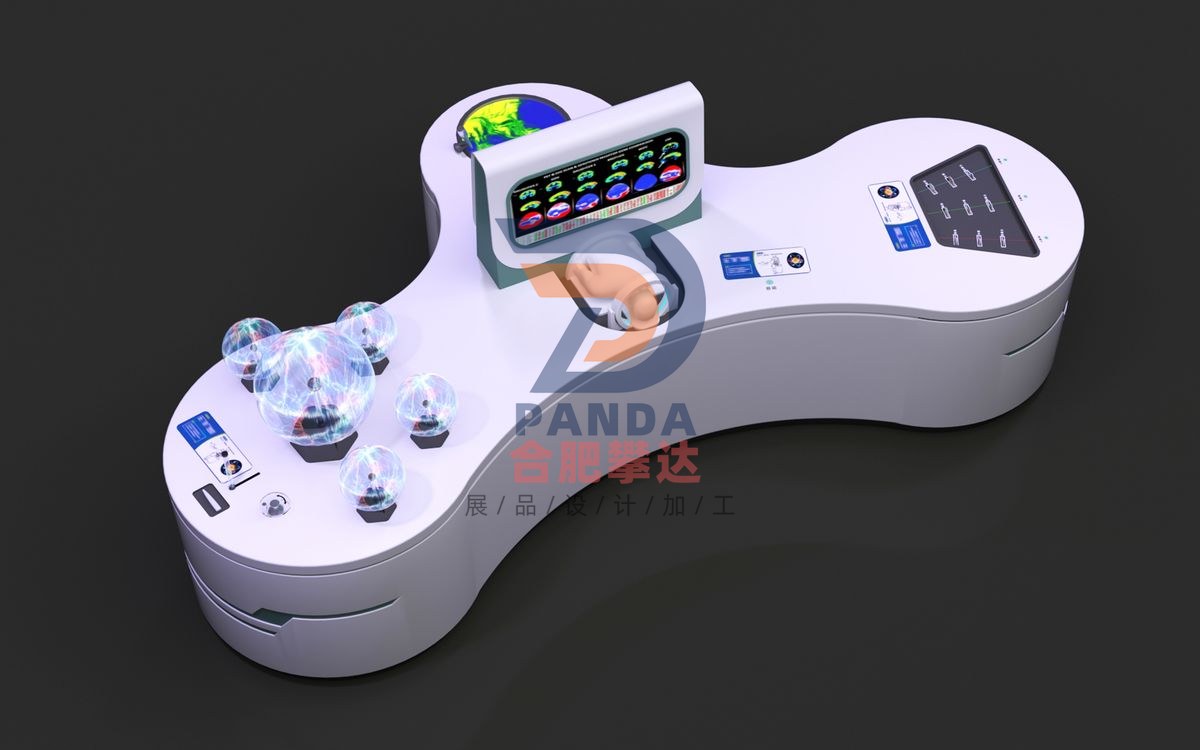
The exhibition group includes cathode rays, X-rays, natural radioactivity and radium extraction devices, each demonstrating the experiments and principles of several microscopic particles.
Cathode ray demonstration device: In 1838, Michael Faraday was transmitting electric current in a glass tube filled with thin air. He discovered a strange arc of light between the cathode and anode. There is no arc of light directly in front of the cathode, and this place is called "Faraday dark space". In 1859, German physicist Julius Plucker observed that when the gas inside the tube was thin enough, green phosphorescence would appear on the tube wall near the cathode. Applying a magnetic field could change the position of the phosphorescence. Therefore, he distinguished that this discharge was different from ordinary discharge. He concluded that the green phosphorescence was caused by the impact of electric current on the glass. In 1876, German physicist Eugen Goldstein discovered that the glow was emitted not in all directions, but in a direction perpendicular to the surface of the cathode, which was very different from the way a candle was emitted, which was emitted in all directions. Goldstein called this glow cathode rays.
X-rays: In 1895, while Röntgen was researching cathode rays, he accidentally discovered a type of visible light and named it "X-rays". This discovery not only had a major impact on medical diagnosis, but also directly influenced many major scientific discoveries in the 20th century. Roentgen also became the first scientist to win the Nobel Prize in Physics. The exhibition item builds a circular X-ray scanning device. The audience can personally operate the device to find lesions on the human body model, so as to understand the important significance of the discovery of X-rays in the history of human medicine.
Natural radioactive device: In 1896, the French physicist Becquerel discovered the phenomenon of natural radiation. This research made people realize that the atomic nucleus has a complex structure, which gave rise to a new branch of physics - atomic physics. The exhibition allows the audience to understand the radioactive intensity of the three natural rays α, β, and γ through comparative and interactive methods, and to realize the significance of the discovery of the three rays to human research on microscopic atoms.
Radium extraction device: Although radium is not the first radioactive element discovered by humans, it is a very radioactive element. The discovery of radium drew worldwide attention to the phenomenon of radioactivity, and a real revolution broke out in the scientific community. By restoring the process of radium extracted by Madame Curie, the exhibition allows the audience to interactively experience the arduous process of extracting 0.1 grams of radium from 1 ton of slag, feel Marie Curie's selfless dedication to science, and understand the huge impact the discovery of radium has had on the fields of physics and medicine.
Scientists studied the phenomenon of high-voltage discharges in thin gases, resulting in a series of scientific discoveries. These discoveries overturned people's understanding of the most basic unit of matter, the atom. Since then, people have believed that the atom is not the smallest unit that constitutes matter, thus opening up a new discipline - particle physics.
Related Exhibits





Need a quote for this piece or a full exhibit configuration? Tell us your venue area, theme direction, and budget range.