
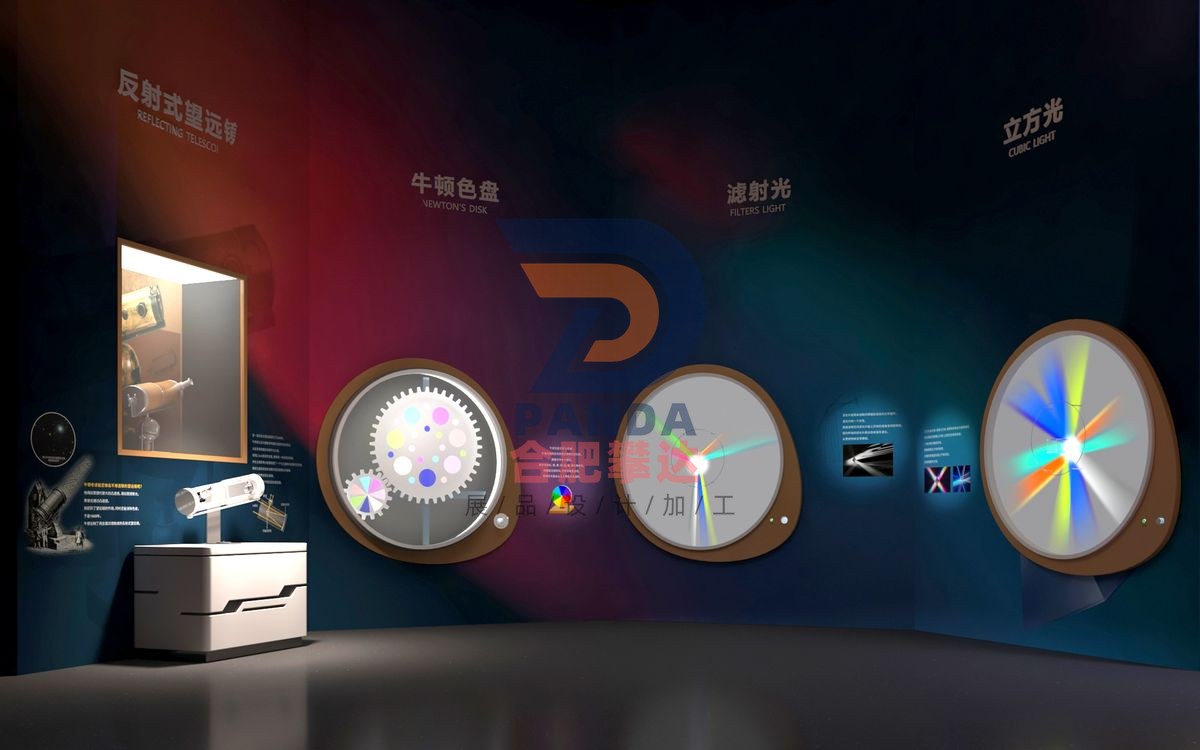
Optical Laboratory
Optics · Interactive
- DimensionsSubject to on-site plan
- PresentationInteractive
- PricingQuoted by manufacture spec
Purpose & Scientific Principle
Introducing Newton's exploration experiments and tool inventions on light, including the dispersion of light, reflective telescopes, as well as the refraction and reflection of extended light, and color filtering phenomena.
How to Operate
1. Dispersion and mixing of light
The phenomenon of decomposing complex colored light into monochromatic light to form a spectrum is called dispersion of light. After the polychromatic light enters the prism, since it has different refractive index for the light of various frequencies, the propagation direction of the various colored lights has different degrees of deflection. Therefore, when it leaves the prism, it disperses separately, and the colors are arranged in a certain order to form a spectrum. In 1666, Newton used a prism to decompose sunlight into a spectrum of seven colors, and conducted a color-light mixing experiment, scientifically proving the relationship between light and color.
Newton discovered that mixing colors can produce an intermediate color or another new color. He used a simple model to generalize all the results of color mixing. Newton arranged the seven colors in the spectrum from red to purple in order on a circle and each occupied a certain area. Paint each area with a corresponding color to make a disk, and quickly rotate it around its axis. Using the persistence of vision effect of the human eye, a mixture of seven colors will be produced on the retina, resulting in white. Newton's model was not very accurate. It was people's first attempt to find the law of color synthesis.
The more different colors of light are mixed, the brighter they will be. That is, the mixed color light produced after mixing is brighter than the average brightness of each color light before mixing. This color mixing is called additive color mixing.
2.Newton and reflecting telescopes
In his experiments on the dispersion of light, Newton noticed that light of different colors was refracted at different angles. He immediately realized that the refracting telescopes commonly used by people at that time must be imperfect, because every part of the lens is some form of prism. After light passes through the prism, different color components cannot converge at the same point due to different refractive indexes. This is a good explanation for why the image of an object seen in a telescope always has some colored images on the edge.
In 1668, Newton finally invented a reflecting telescope that worked on a different principle than ordinary telescopes, completely eliminating chromatic aberration.
Newton ground a 2.5 cm diameter metal into a concave reflector, and placed a reflector at a 45-degree angle to the primary mirror in front of the focus of the primary mirror, so that the concentrated light reflected by the primary mirror would be reflected out of the lens barrel at a 90-degree angle by the reflector and then reach the eyepiece.
Reflecting telescopes produce images through reflection, so there is no chromatic aberration problem. Moreover, its lens only needs to be made into a spherical or parabolic surface, which is easier to make and lower in cost than a refracting telescope. The invention of the reflecting telescope laid the foundation for modern large-scale optical astronomical telescopes.
3. Filter
The filter is made of plastic or glass with special dye added. The red filter can only let red light pass through, and so on. The transmittance of the glass sheet was originally about the same as that of air, and all colored light could pass through it, so it was transparent. However, after being dyed with dye, the molecular structure changes and the refractive index changes, so the passage of certain colored light changes.
Subtractive color mixing means that the average brightness of the mixed color produced after mixing the color materials is lower than the color before mixing, and as the number of mixing increases, the brightness continues to decrease, and the purity of the color will also decrease. In subtractive color mixing, the colors absorb each other's reflected light, darkening the color.
4. Cube light
Reflection of light refers to the phenomenon that when a wave front enters from one medium into another medium, its propagation direction changes at the interface of the two media and returns to its original medium. In the reflection phenomenon of light, both diffuse reflection and specular reflection follow the law of light reflection, that is, in the reflection phenomenon, the reflected light ray, the incident light ray, and the normal line are in the same plane, the reflection angle is equal to the incident angle, and the reflected light ray and the incident light ray are separated on both sides of the normal line. The image produced by a plane mirror is caused by the reflection of light.
Refraction of light means that when light is incident obliquely from one transparent medium into another transparent medium, the propagation direction generally changes. The refraction of light, like the reflection of light, occurs at the junction of two media. It is just that the reflected light returns to the original medium, while the refracted light enters another medium. Since light propagates at different speeds in two different materials, the direction of propagation changes at the junction of the two media.
Optics is an important branch of physics. It is also a subject related to optical engineering technology. In a narrow sense, optics is the science of light and vision. In the early days, the word optics was only used for things related to eyes and events. Optics often referred to today is in a broad sense. It is the science that studies the generation, propagation, reception and display of electromagnetic radiation in a wide range of wavelengths from microwaves, infrared, visible light, ultraviolet to X-rays and gamma rays, as well as the interaction with matter. The focus of research is from the infrared to ultraviolet band. It is an important part of physics. The exhibits restore the scene of Newton's optical laboratory and select some classic experiments to show the development process of optics.
Related Exhibits
Need a quote for this piece or a full exhibit configuration? Tell us your venue area, theme direction, and budget range.