
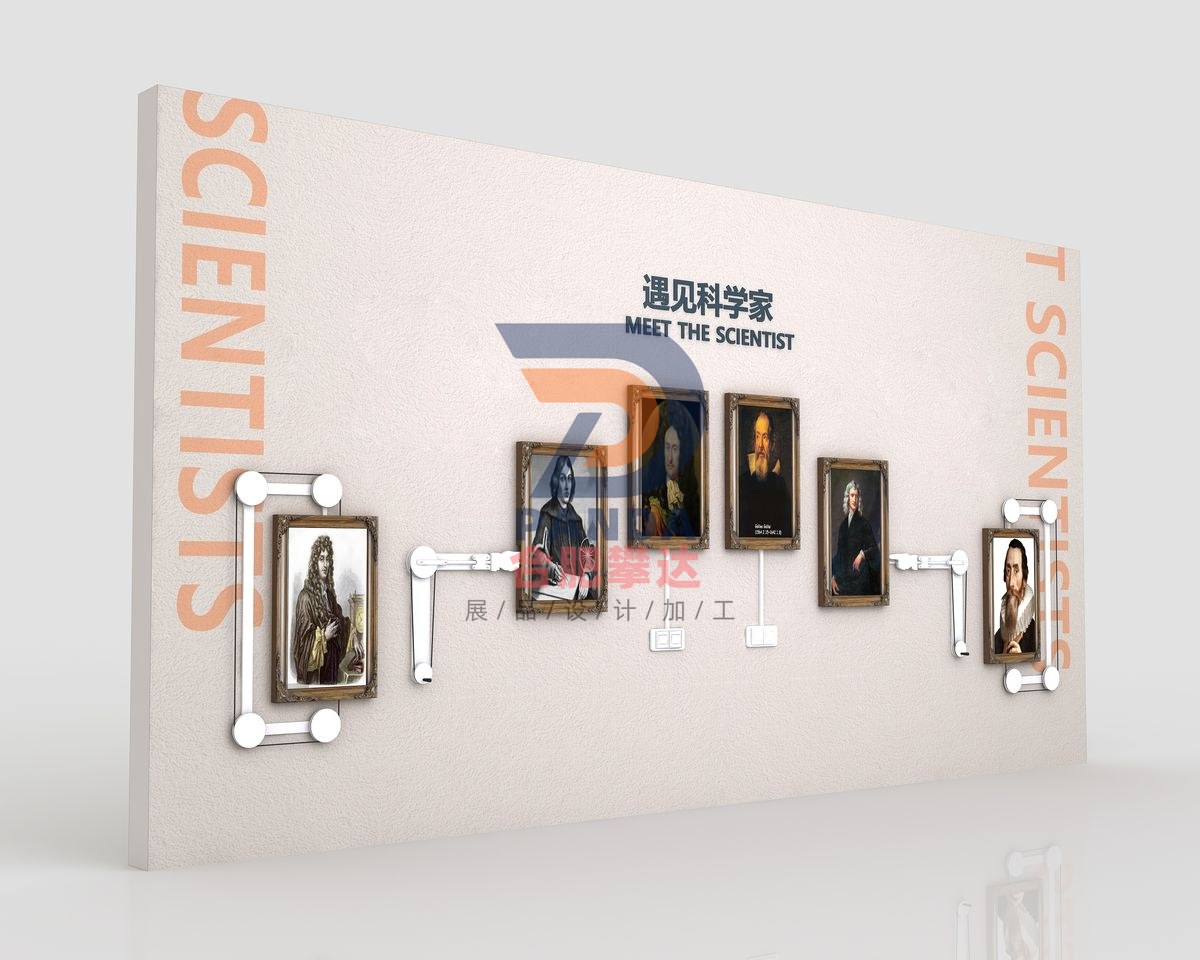
Meet the Scientists
Smart Technology · Interactive
- DimensionsSubject to on-site plan
- PresentationInteractive
- PricingQuoted by manufacture spec
Purpose & Scientific Principle
Introduces the inheritance and improvement, disagreements and debates among different scientists, and tells the stories of scientists and the spirit of science.
How to Operate
Copernicus: Polish astronomer and mathematician during the Renaissance. Copernicus proposed the heliocentric theory, and after years of observation and calculation, he completed his great work "On the Revolution of the Celestial Bodies", which denied the authority of the church, corrected people's view of the universe, and changed mankind's view of nature and itself.
Tycho: The last and greatest astronomer who observed the heavens with the naked eye. In 1600, Tycho invited Kepler to be his assistant. Tycho died the following year and Kepler took over his work. Tycho's large amount of extremely precise astronomical observations created the conditions for Kepler's work, and his compilation was completed by Kepler.
Kepler: German astronomer. Kepler was Tycho Brahe's assistant. He inherited Tycho's career. Using Tycho's accumulated observation data for many years, he carefully analyzed and studied it and discovered that the planets move in elliptical orbits. He also proposed the three laws of planetary motion, which laid the foundation for Newton's discovery of the law of universal gravitation.
Galileo: The great Italian physicist and astronomer, the founder of modern science and modern physics. Galileo brought effective quantification into physics, used celestial observations to deny the geocentric theory, made a thermometer, discovered the law of inertia, the period formula of a simple pendulum, the formula of falling bodies, and the understanding of motion that was postulated as Galileo's theory of relativity.
Newton: A famous British physicist and an encyclopedic "all-rounder". Newton described universal gravitation and the three laws of motion in his "Mathematical Principles of Natural Philosophy", which established the scientific view of the physical world in the next three centuries and became the basis of modern engineering. In optics, Newton invented the reflecting telescope and developed a theory of color based on observations of prisms diverging white light into the visible spectrum. He also formulated the laws of cooling and studied the speed of sound.
Cavendish: British chemist and physicist. After Newton discovered the law of universal gravitation, he was the scientist who measured the gravitational constant.
Bruno: Italian natural scientist and philosopher during the Renaissance. As a symbol of freedom of thought, he inspired the freedom movement in Europe in the 16th century and became one of the important figures in the history of Western thought. He bravely defended and developed Copernicus' heliocentric theory and spread it throughout Europe. He was hailed by the world as a fearless fighter against the church and scholasticism, and a martyr defending the truth.
Huygens: Dutch physicist, astronomer, and mathematician. He established the law of centripetal force, proposed the principle of conservation of momentum, and improved the timer. He was an important pioneer in modern natural science.
Leibniz: German philosopher and mathematician. In mathematics, he and Isaac Newton independently discovered calculus, and the symbols he invented are generally considered to be more comprehensive and applicable to a wider range of applications. He also discovered and perfected binary.
Hooke: British naturalist and inventor. In terms of physical research, he proposed the basic law describing the elasticity of materials - Hooke's law; in terms of mechanical manufacturing, he designed and manufactured vacuum pumps, microscopes and telescopes, and wrote his observations with the microscope in the book "Microscopy". The word "cell" was named after him. In terms of new technology inventions, many of the devices he invented are still in use.
Boyle: British physicist and chemist, the founder of chemical science and the founder of modern chemistry. The publication of his book "The Skeptical Chemist" in 1661 is regarded as the first year of modern chemistry.
Scientists have a great role in promoting social development. First of all, science and technology are the primary productive forces. The progress of society from ancient times to the present is the result of the development of productive forces: the first industrial revolution replaced manual production with mechanized large-scale production; the second industrial revolution, the use of electricity brought people into a bright era; the modern information technology revolution brought us into the information age, and scientists played a pivotal role in different historical periods.
Related Exhibits






Need a quote for this piece or a full exhibit configuration? Tell us your venue area, theme direction, and budget range.