
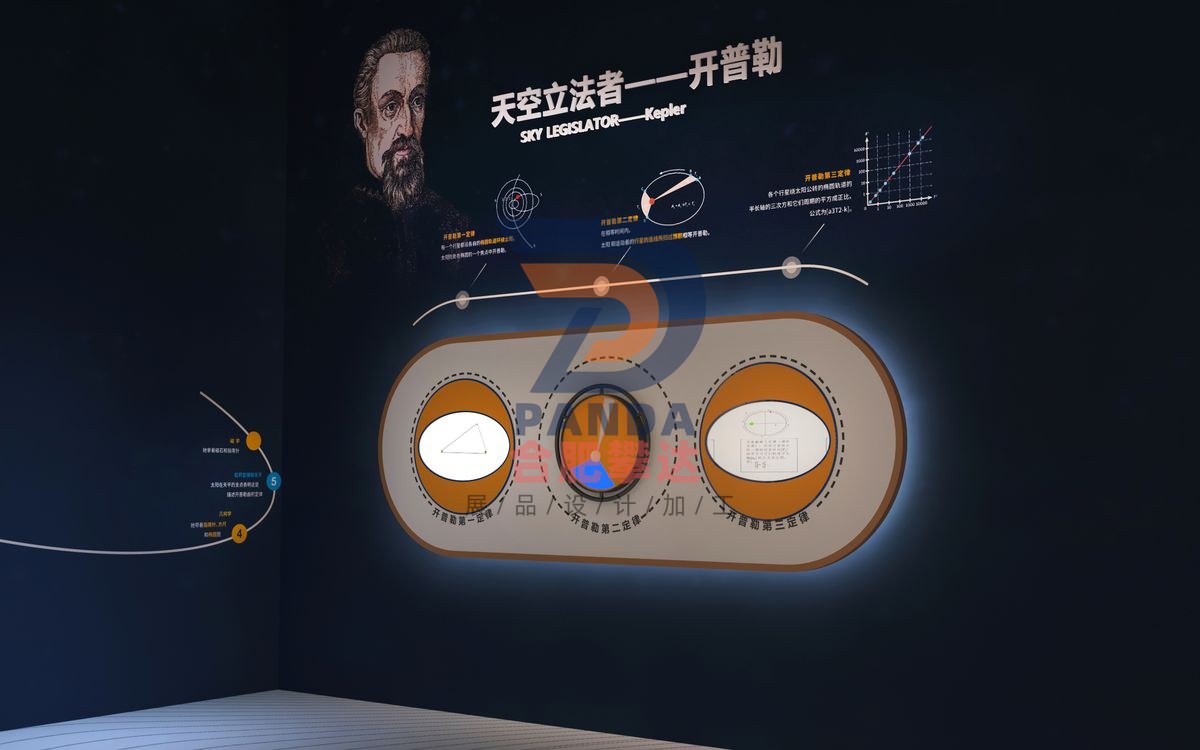
Sky Legislator
Aerospace · Interactive
- DimensionsSubject to on-site plan
- PresentationInteractive
- PricingQuoted by manufacture spec
Purpose & Scientific Principle
Kepler used Tycho's observation data to summarize Kepler's three laws of planetary motion. The exhibition allows the audience to understand the scientific principles of Kepler's three laws through interactive operations.
How to Operate
Kepler's first law (ellipse law): The orbits of all planets around the sun are ellipses, and the sun is at one focus of the ellipse.
Kepler's second law (area law): The lines connecting the sun and the moving planets in the solar system sweep out equal areas in equal times.
Kepler's third law (harmonic law): When all planets revolve around the sun, the ratio of the cube of the orbital semi-major axis (a) to the square of the orbital period (T) is a constant value, that is, a³/T² = k, where k is only related to the mass of the central celestial body (such as the sun).
Kepler used Tycho's observation data to cleverly calculate the orbits of the six planets, including the Earth, and further summarized the mathematical laws followed by planetary motion. Later, he discovered that there was an error of 8 arc minutes between the calculation plan of the eccentric uniform point and Tycho's observation data, and these 8 arc minutes already showed the path to a complete reform of astronomy. After that, Kepler explored new methods to study the motion laws of Mars and extended them to all planets in the solar system, namely Kepler's three laws of planetary motion, which completely eliminated a lot of epicycles and deferents used by Ptolemy and Copernicus. The planets traveled through space in an orderly manner according to Kepler's laws, and Kepler became the "legislator of the sky."
Related Exhibits


Need a quote for this piece or a full exhibit configuration? Tell us your venue area, theme direction, and budget range.