
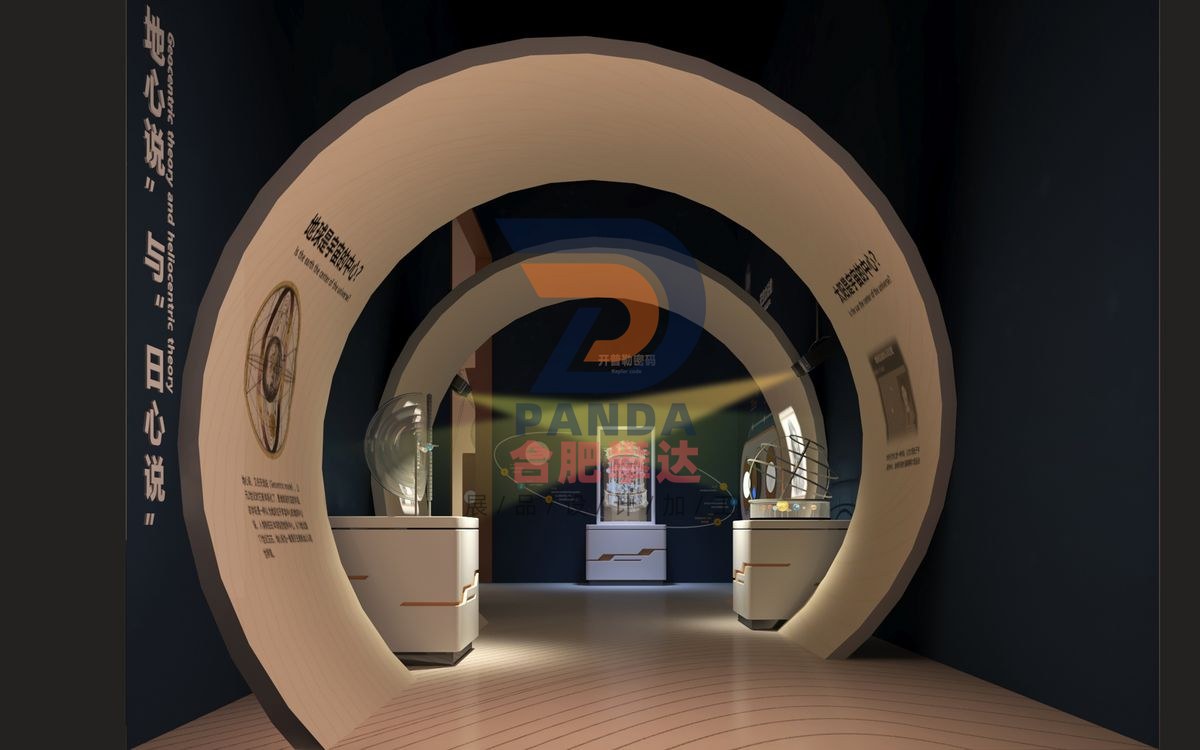
"Geocentric Theory" and "Heliocentric Theory"
Aerospace · Interactive
- DimensionsSubject to on-site plan
- PresentationInteractive
- PricingQuoted by manufacture spec
Purpose & Scientific Principle
Modern natural science started with the revolution in the field of astronomy. The exhibition items use "Dialogue on the Two World Systems of Ptolemy and Copernicus" written by Galileo as the design element, allowing Ptolemy and Copernicus to have a "dialogue", aiming to let the audience understand the difference between the "geocentric" universe system and the heliocentric universe system, understand the operating rules of the two major universe model systems and the background of the era when the heliocentric theory was proposed.
How to Operate
1. Geocentric theory
Ptolemy systematically summarized the results of Greek astronomy, inherited the geocentric universe model of Eudoxus and Aristotle, added explanations of epicycles and deferents, and wrote the Almagest. This 13-volume work was praised by the Arabs as "the greatest" and dominated the Western astronomical community for more than 1,000 years, and Ptolemy was also considered the master of Greek astronomy.
Ptolemy's geocentric theory believed that the earth is spherical and is at the center of the universe; the celestial bodies are embedded in their respective celestial spheres, arranged in ascending order of distance from the earth. The celestial spheres are the moon, Mercury, Venus, sun, Mars, Jupiter, Saturn and stars; each celestial sphere moves around a smaller circle, and the center of each circle moves on a circle with the earth as the center. He called the circle around the earth "deferent wheel" and each small circle "epicycle".
The superposition of epicycles and deferents in the Ptolemaic system can explain the retrograde motion and brightness changes of the planet; the introduction of the eccentric uniform point further explains the uneven motion speed of the planet. But as observation materials continue to increase, so do the wheels needed to rescue these phenomena. By the time of Copernicus, the number of wheels had increased to more than 80, making the Ptolemaic system extremely complex.
2. Heliocentric theory
Copernicus' "heliocentric theory" replaced the earth at the center of the universe with the sun, allowing the earth that was previously considered stationary to move, and proposed the concepts of the earth's rotation and revolution. The "heliocentric theory" broke the "geocentric theory" that had long dominated religion, realized a fundamental change in astronomy, and was the beginning of modern astronomy.
The concept of Earth's rotation and revolution. The diurnal rotation of the entire starry sky is actually caused by the rotation of the earth. It is the rotation of the earth on its axis from west to east that causes the changes in day and night. The annual apparent motion of the sun is actually caused by the earth's revolution around the sun once a year.
The sun is at the center of the universe, and all planets, including the earth, rotate around the sun. This change unified the movements of the major planets.
Copernicus' picture of the universe. The outermost layer is the star, which is stationary and forms the reference background for planetary motion; the farthest planet is Saturn, whose orbit period is 30 years. Next is Jupiter, with a period of 12 years; Mars, with a period of 2 years; Earth, with a period of 1 year; Venus, with a period of 9 months; and finally Mercury, with a period of 88 days around the sun. The moon is a satellite of the earth. It not only rotates with the earth around the sun, but also rotates around the earth once every month.
Related Exhibits

Need a quote for this piece or a full exhibit configuration? Tell us your venue area, theme direction, and budget range.