
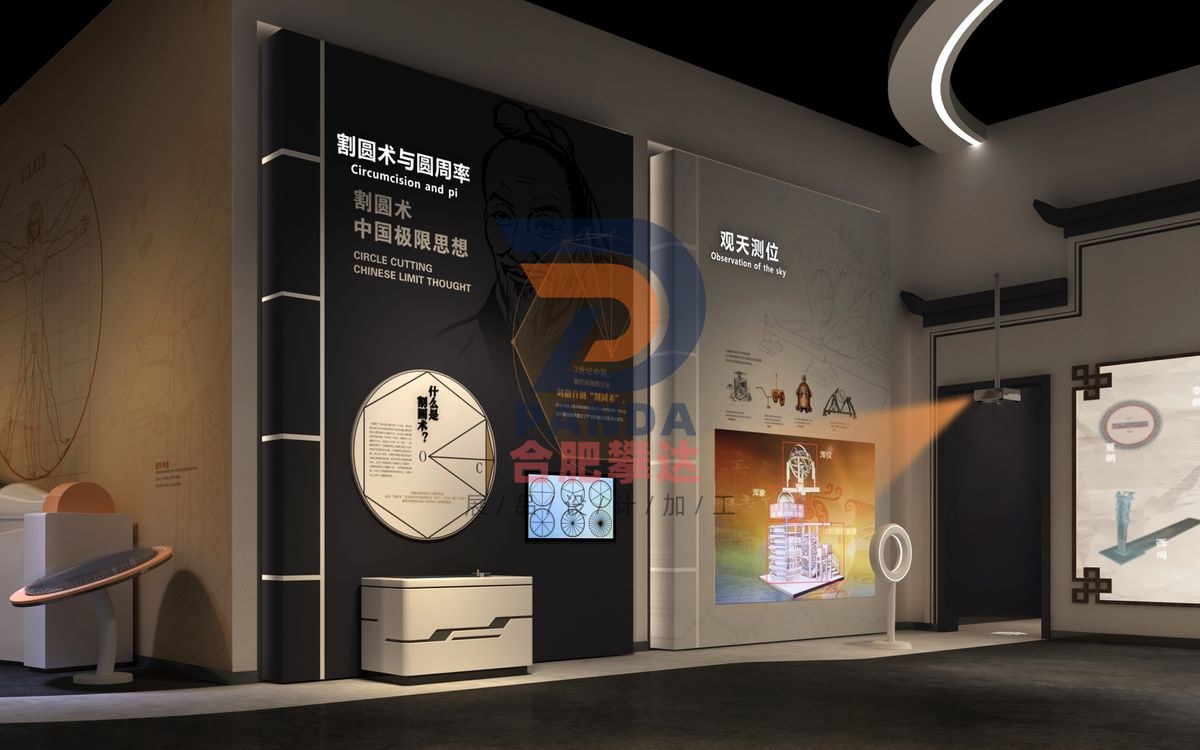
Sky Observation and Position Measurement
Aerospace · Interactive
- DimensionsSubject to on-site plan
- PresentationInteractive
- PricingQuoted by manufacture spec
Purpose & Scientific Principle
The exhibition allows the audience to appreciate the wisdom and ingenuity of Chinese civilization in the field of mechanical creation and invention through the decomposition and display of the most representative precision instruments for astronomical observation and geographical surveying in ancient China.
How to Operate
China is an ancient civilization with a long history. It has made many outstanding inventions in the progress of human civilization, among which the achievements of ancient machinery are particularly outstanding and colorful.
Compass car: Compass car, also known as Sinan car, is a type of special vehicle in ancient China. With the help of an ingenious transmission mechanism, no matter how the vehicle turns, the wooden figure on the vehicle always points its arms due south. According to Volume 6 of "Xijing Miscellaneous Notes", there was a compass in the Western Han Dynasty. The compass has a mechanism that can automatically adjust the steering, which reflects the ingenuity of the ancients in designing mechanical devices and occupies a certain position in the history of technology. Most scholars believe that the transmission mechanism of the compass should include a gear train.
Seismograph: During the Eastern Han Dynasty, Zhang Heng invented and manufactured the world's first instrument for measuring the direction of earthquakes, the Houfeng seismometer, which began the history of human beings using instruments to observe earthquakes. The seismograph has eight directions, namely east, south, west, north, southeast, southwest, northeast and northwest. Each direction has a dragon head with a dragon ball in its mouth. Under each dragon head there is a toad corresponding to it. If an earthquake occurs in any direction, the dragon ball contained in the dragon mouth in that direction will fall into the toad's mouth, so the direction of the earthquake can be measured.
Waterborne Instrument Tower: The Waterborne Instrument Tower is a water-powered astronomical clock designed by Northern Song Dynasty astronomers Su Song and Han Gonglian. It was built in the Yuanyou period of the Northern Song Dynasty (1088 AD). It is a large astronomical clock that integrates the three functions of timekeeping, astronomical observation and star display. It can be called a large mechanical device with a high level of technical comprehensiveness at that time. Its mechanical transmission device is similar to the escapement of modern clocks, and was considered by Joseph Needham of the United Kingdom to be "probably the direct ancestor of European medieval astronomical clocks."
Jian Yi: Jian Yi is an instrument created in 1276 by Guo Shoujing, an astronomer of the Yuan Dynasty, to measure the position of celestial bodies. Because it was a simplified version of the previously complex armillary sphere of the Tang and Song dynasties, it was called the Jianyi. The instrument includes independent equatorial devices and horizon devices, which can measure the equatorial coordinates and horizon coordinates of celestial bodies respectively. The creation of the simple instrument was a great leap forward in the history of manufacturing astronomical instruments in my country and was an advanced technology in the world at that time. It was not until more than three hundred years later in Europe, in 1598, that a similar device was invented by the Danish astronomer Tycho.
The exhibition allows the audience to appreciate the wisdom and ingenuity of Chinese civilization in the field of mechanical creation and invention through the decomposition and display of the most representative precision instruments for astronomical observation and geographical surveying in ancient China, such as compasses, seismometers, etc.
Related Exhibits
Need a quote for this piece or a full exhibit configuration? Tell us your venue area, theme direction, and budget range.