
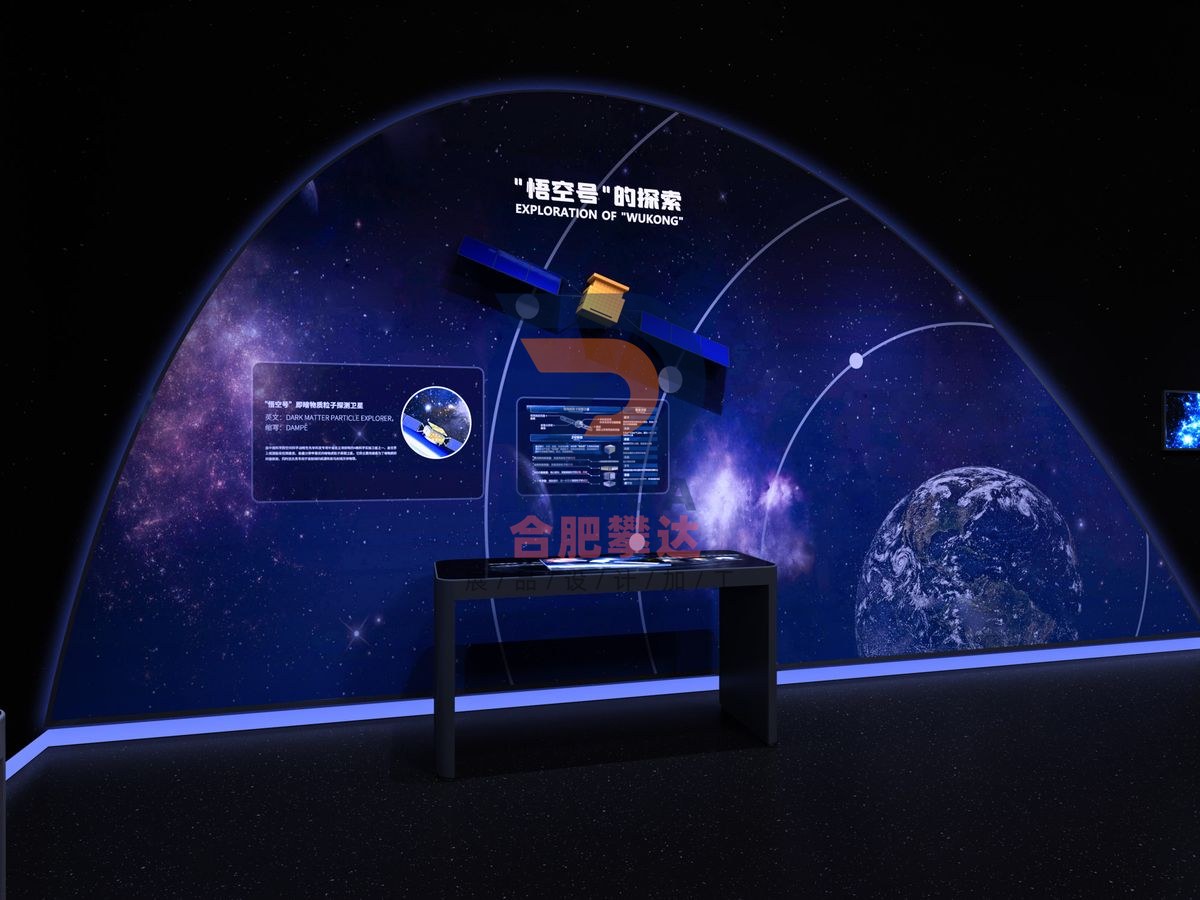
Exploration of "Wukong"
Aerospace · Interactive
- DimensionsSubject to on-site plan
- PresentationInteractive
- PricingQuoted by manufacture spec
Purpose & Scientific Principle
The exhibits show the exploration of dark matter from the perspective of the "Wukong" dark matter particle detection satellite, allowing the audience to understand the universe and understand China's cutting-edge scientific efforts in exploring the universe.
How to Operate
"Wukong" dark matter particle detection satellite: It is one of the first four scientific experimental satellites developed under the Chinese Academy of Sciences' strategic leading science and technology project for space science. It is the dark matter particle detection satellite with the widest observation energy range and the best energy resolution in the world. The dark matter particle detector carried on the "Wukong" is mainly composed of four parts: a plastic scintillation array detector, a silicon array detector, a BGO calorimeter and a neutron detector. It contains more than 70,000 sub-detectors and is at the forefront of the world in terms of detection accuracy.
Launch time: On December 17, 2015, my country successfully launched the dark matter particle detection satellite "Wukong" from the Jiuquan Satellite Launch Center using the Long March 2D carrier rocket and operated in an orbit 500 kilometers above the earth.
The main purpose: to search for evidence of the existence of dark matter in space, to search for dark matter particles, to explore the origin of cosmic rays and to observe high-energy gamma rays, which is expected to bring new major breakthroughs at the frontiers of physics and astronomy.
Main abilities: Detect electrons, photons and cosmic rays (protons and heavy ions).
Exploration results: Since October 2016, the "Wukong" satellite has repeatedly captured gamma-ray radiation from the super-large black hole CTA 102. In 2019, "Wukong" used space experiments for the first time to achieve precise measurement of the cosmic ray proton energy spectrum. In 2021, the team released the first batch of gamma photon scientific data and drew the most accurate spectrum of helium core cosmic rays so far. It can be said that "Wukong" has achieved important results in the measurement of electrons, protons, and helium nuclear cosmic rays. These results provide an important basis for the study of cosmic physics. They are likely to open up a new world beyond the existing physical models and help mankind search for dark matter more accurately.
The exhibits focus on displaying the basic knowledge of Wukong, such as its research process, launch process, scientific achievements during its service, etc.
Related Exhibits
Need a quote for this piece or a full exhibit configuration? Tell us your venue area, theme direction, and budget range.