
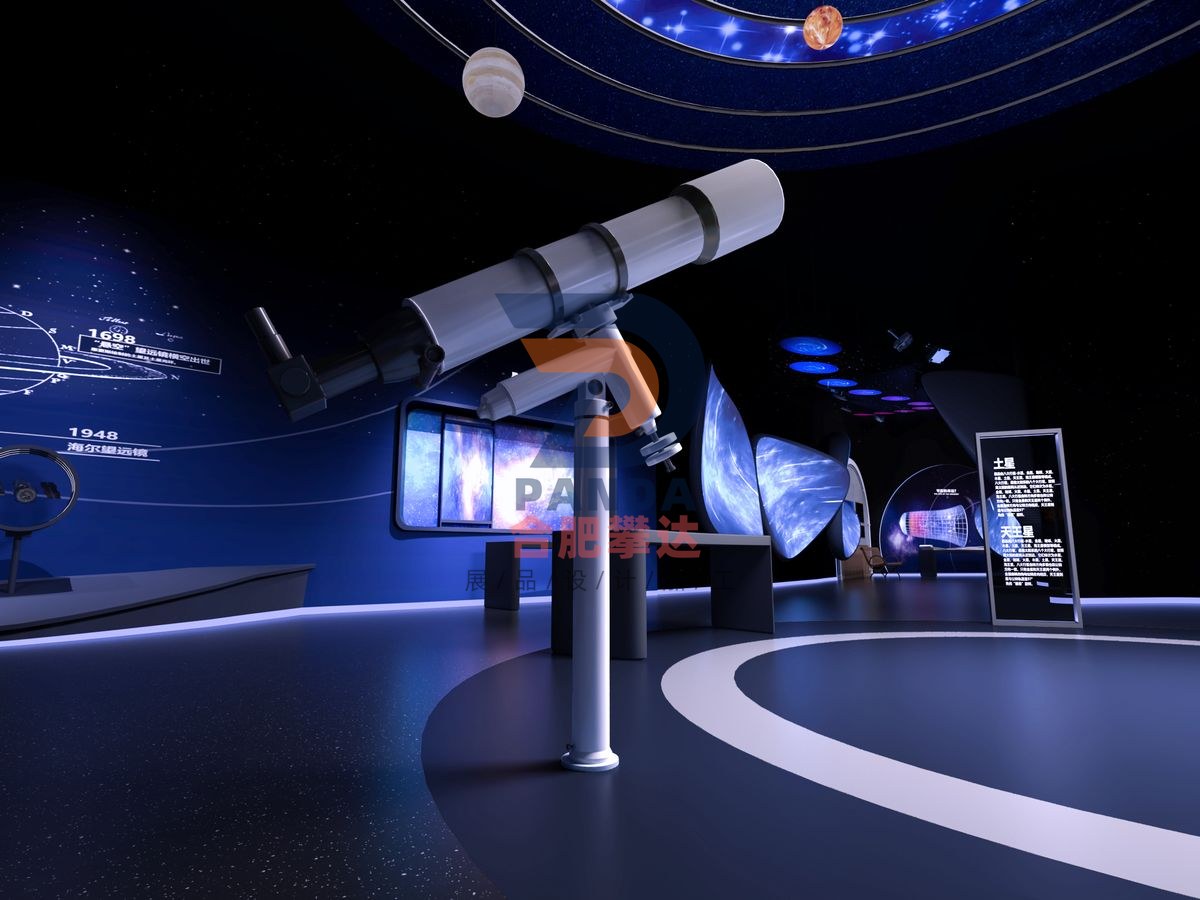
Searching for Planets with Life (VR Telescope)
Aerospace · Interactive
- DimensionsSubject to on-site plan
- PresentationInteractive
- PricingQuoted by manufacture spec
Purpose & Scientific Principle
The exhibits switch screens by rotating the knob of the telescope body, showing the appearance of various celestial bodies in the solar system (including the sun, planets, dwarf planets, asteroids, satellites, comets, etc.).
How to Operate
Definition of dwarf planet: or "dwarf planet", which is between a planet and an asteroid in size, orbits a star, has enough mass to overcome the gravity of solids to achieve a hydrostatic equilibrium (nearly spherical) shape, does not clear other celestial bodies in its orbit, and is not a planet.
Among celestial bodies orbiting directly around the sun, Pluto ranks 9th in volume and 10th in mass. In 1930, Clyde Tombaugh discovered Pluto and regarded it as the ninth planet. After 1992, some objects with a mass similar to Pluto were discovered in the Kuiper Belt, which began to challenge its planetary status. Eris, which was discovered in 2005, is even 27% more massive than Pluto. Therefore, the International Astronomical Union (IAU) officially defined the concept of a planet in 2006, excluding Pluto from the ranks of planets and reclassifying it as a dwarf planet.
Representative dwarf planets: Pluto, Charon, Eris, Ceres, Makemake, Haumea, and Gonggong.
The exhibits have the same content as "02-11 Understanding Planets", but the heights of the two telescopes are different, meeting the needs of different groups of people.
Related Exhibits

Need a quote for this piece or a full exhibit configuration? Tell us your venue area, theme direction, and budget range.