
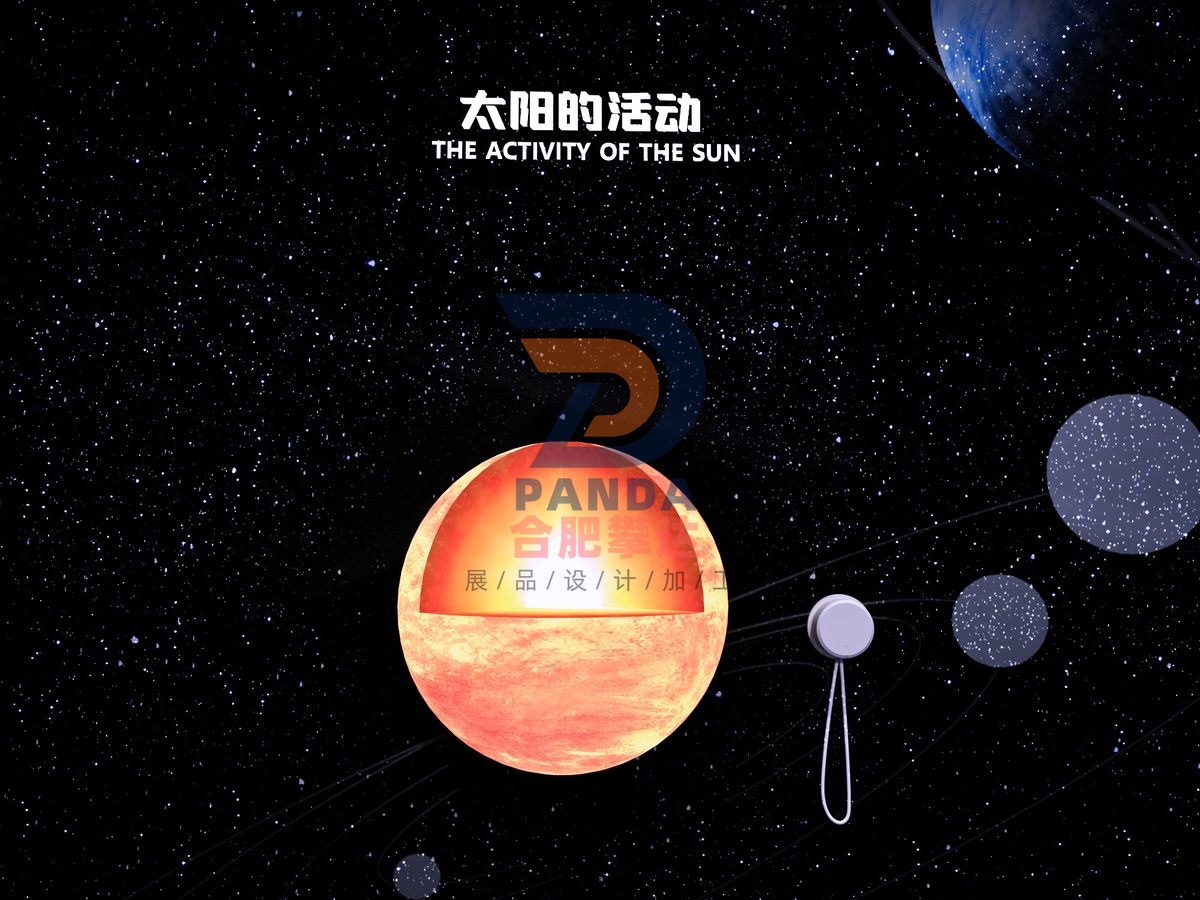
Activities of the Sun
Aerospace · Interactive
- DimensionsSubject to on-site plan
- PresentationInteractive
- PricingQuoted by manufacture spec
Purpose & Scientific Principle
The exhibits play the sounds of solar activities and model the internal structure of the sun, allowing the audience to hear and understand solar activities and their impact on the earth.
How to Operate
Solar activity is the general term for all active phenomena in the solar atmosphere. Mainly include sunspots, spots, spectral spots, flares, prominences and coronal transient events. When the sun is in a period of intense activity, it radiates large amounts of ultraviolet,
Solar activity:
(1) Sunspots: Some dark spots sometimes appear on the surface of the sun’s photosphere, which are places where magnetic fields gather. These are sunspots;
(2) Solar flare: A rapidly developing bright spot suddenly appears on the sun. Its lifespan is only between a few minutes and tens of minutes. The brightness rises rapidly and decreases slowly;
(3) Light spots: Some are bright and some are dark on the surface of the photosphere. This kind of light and dark spots are formed due to the different temperatures here. The darker spots are called "sunspots" and the brighter spots are called "light spots".
(4) Corona: During a total solar eclipse, the dark periphery of the sun is surrounded by silvery white light, which is buckled on the sun like a hat and is called the corona.
(5) Solar prominence: During a total solar eclipse, the sun is surrounded by a red ring with bright red tongues of fire dancing on it. This tongue-shaped object is called a solar prominence.
Comparison of sounds in the solar system: Although space is almost a vacuum and sound cannot propagate in space, this does not mean that there is no sound in space. Sound in space exists in the form of electromagnetic vibrations. Scientists capture the electromagnetic signals emitted by the planet through an "astronomical interferometer", and then convert these electromagnetic signals into sound frequencies that can be heard by human ears, so that the sounds of the planet can be heard.
The exhibits mainly introduce the types, characteristics and impacts of solar activities. According to the structural form of the sun, the structure is perfectly displayed through the solar model, and the internal structure of the sun is displayed through sectioning.
Related Exhibits
Need a quote for this piece or a full exhibit configuration? Tell us your venue area, theme direction, and budget range.