
Questioning the Universe
Aerospace · Interactive
- DimensionsSubject to on-site plan
- PresentationInteractive
- PricingQuoted by manufacture spec
Purpose & Scientific Principle
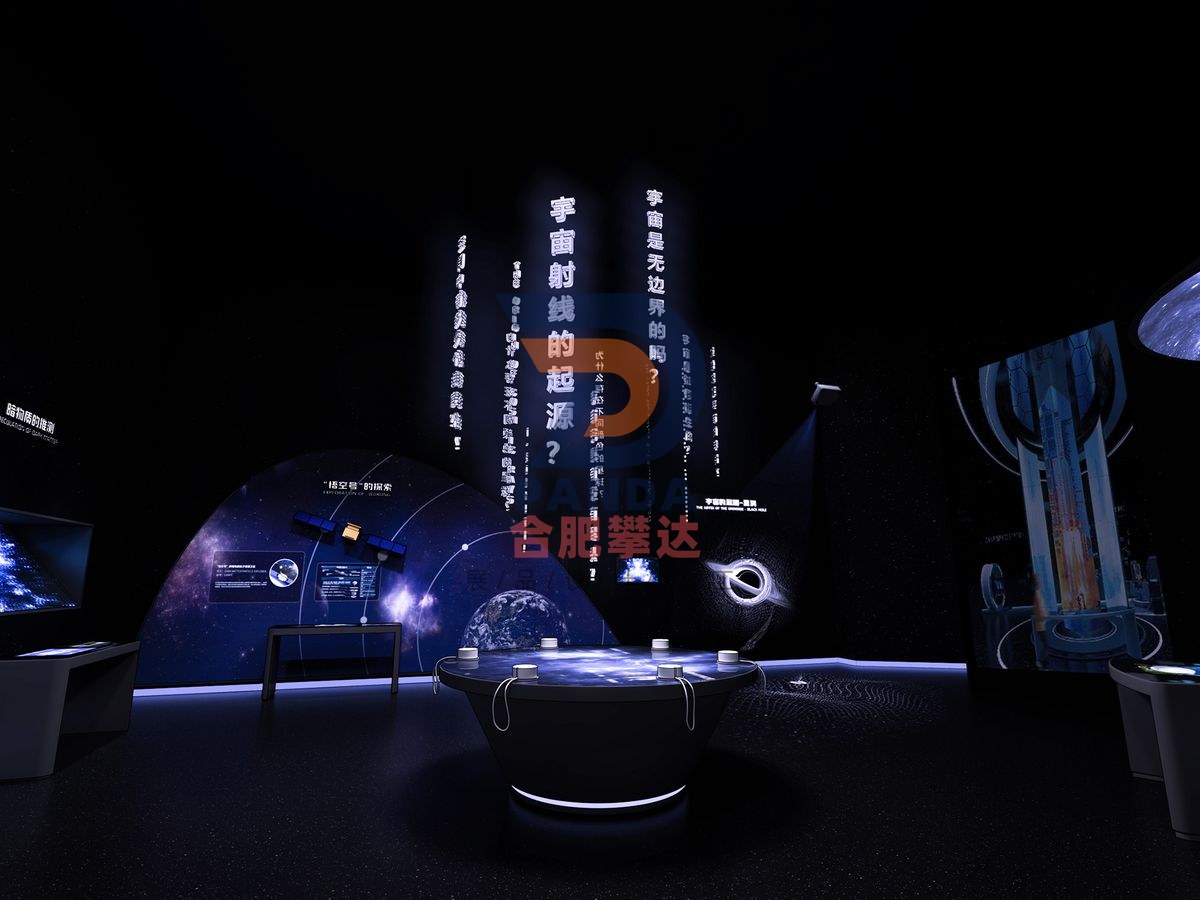
The exhibits arouse the audience’s thinking by showing scientists’ questions about the unsolved mysteries of the universe, and listening to scientists’ related concepts and subsequent research results on dark matter, dark energy, and black holes.
How to Operate
(1) Chinese and foreign scientists:
Stephen William Hawking: A famous physicist at the University of Cambridge in the United Kingdom, one of the greatest physicists in modern times and one of the internationally renowned great men of the 20th century. The main research areas are cosmology and black holes. He proved the singularity theorem and black hole area theorem of general relativity, proposed the black hole evaporation theory and the boundaryless Hawking universe model, and took an important step in unifying the two basic theories of physics in the 20th century - the theory of relativity founded by Einstein and the quantum mechanics founded by Planck.
Vera Rubin: American female astronomer, pioneer in studying the rotation speed of galaxies, and provided strong evidence for the existence of dark matter. The Large Synoptic Survey Telescope (LSST) under construction in the United States is named Vera C. Rubin Observatory in memory of the late female astronomer.
Ding Zhaozhong: Professor at MIT, physicist, Nobel Prize winner in physics. Led the Alpha Magnetic Spectrometer experiment, which is used to detect exotic matter including dark matter and antimatter.
Chen Xuelei: Chief Scientist of the National Astronomical Observatory’s Cosmic Dark Matter and Dark Energy Research Group. Mainly engaged in theoretical and data analysis research in cosmology and particle astrophysics. Research topics also include galaxy formation, especially the formation, reionization and 21 cm observations of the first generation of luminous objects in the universe.
Frank Wilczek: American theoretical physicist and winner of the 2004 Nobel Prize in Physics. Part of his achievements lie in conducting theoretical research on particle physics.
(2) Questioning about the universe:
What is the origin of cosmic rays?
Is there an end to time?
Where did galaxies come from?
Why do pulsars pulse?
Where does the matter swallowed by the black hole go?
Does space smell?
Do white holes really exist?
Can space be curved?
Is our universe conscious?
Why is the universe expanding?
Why was the universe born with the Big Bang?
Is the universe finite or infinite?
Are there other universes?
According to the characteristics of the exhibits, a set of eye-catching luminous characters that are always bright are hung above the booth. The characters are staggered at different heights. The characters attract the audience in the dim environment. At the same time, the spiral-shaped artistic arrangement is used to display the many questions humans have about the universe, showing that there are endless unsolved mysteries in the universe, leaving room for the audience to think, and inspiring the audience to further explore and understand in the future.
Related Exhibits

Need a quote for this piece or a full exhibit configuration? Tell us your venue area, theme direction, and budget range.