
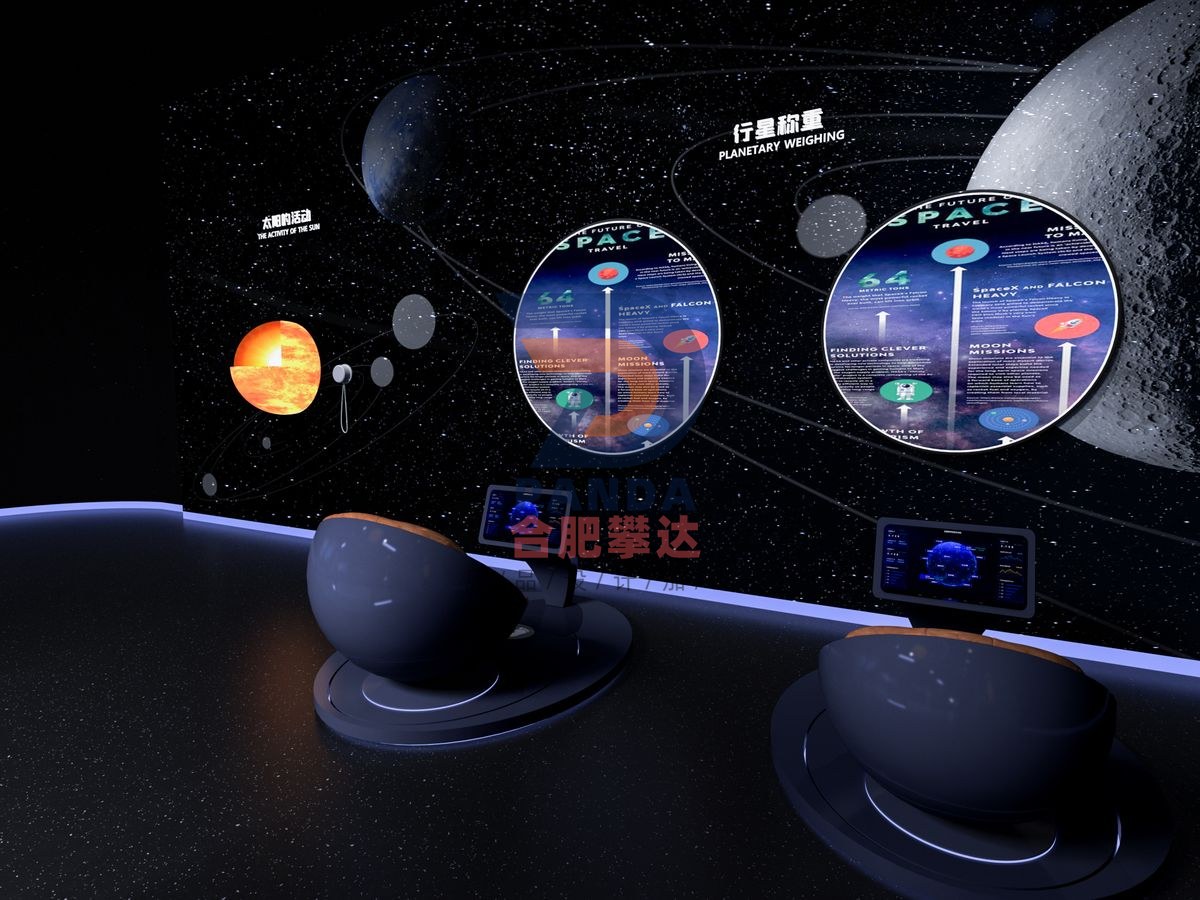
Planet Weighing
Aerospace · Interactive
- DimensionsSubject to on-site plan
- PresentationInteractive
- PricingQuoted by manufacture spec
Purpose & Scientific Principle
By simulating weighing on different planets, the exhibits allow the audience to understand the different gravity experienced by the same object on different planets, understand the reasons why the gravity of the eight planets are different, and understand the relationship between planetary gravity and gravity.
How to Operate
Each celestial body in the solar system has different masses and densities, so the eight planets in the solar system also have different gravitational pulls. The surface gravity of a planet is directly proportional to the acceleration due to gravity.
The gravitational acceleration of Venus is 8.87 meters/second square; the gravitational acceleration of the Earth is 9798 meters/second square; the gravitational acceleration of Mars is 3.71 meters/second square; the gravitational acceleration of Uranus is 8.87 meters/second square; Earth The gravitational acceleration of the star is 10.44 meters/second square; the gravitational acceleration of Neptune is 11.15 meters/second square; the gravitational acceleration of Mercury is 3.70 meters/second square; and the gravitational acceleration of Jupiter is 24.79 meters/second square.
The eight planets in descending order of mass are: Jupiter, Saturn, Neptune, Uranus, Earth, Venus, Mars, and Mercury. For the same object, assuming that the Earth's gravity is 1, the gravity of the eight planets can be expressed as follows: Earth 1, Mercury 0.37, Venus 0.88, Mars 0.38, Jupiter 2.64, Saturn 1.15, Uranus 1.17, and Neptune 1.18. If an object weighs 100 Newtons on Earth, it would weigh 264 Newtons on Jupiter, 118 Newtons on Neptune, 117 Newtons on Uranus, 115 Newtons on Saturn, 88 Newtons on Venus, 38 Newtons on Mars, and 37 Newtons on Mercury.
Different planets have different gravitational accelerations, resulting in different gravitational forces on the surfaces of different planets. If people stand on different planets and weigh themselves, they will have different results.
Related Exhibits
Need a quote for this piece or a full exhibit configuration? Tell us your venue area, theme direction, and budget range.