
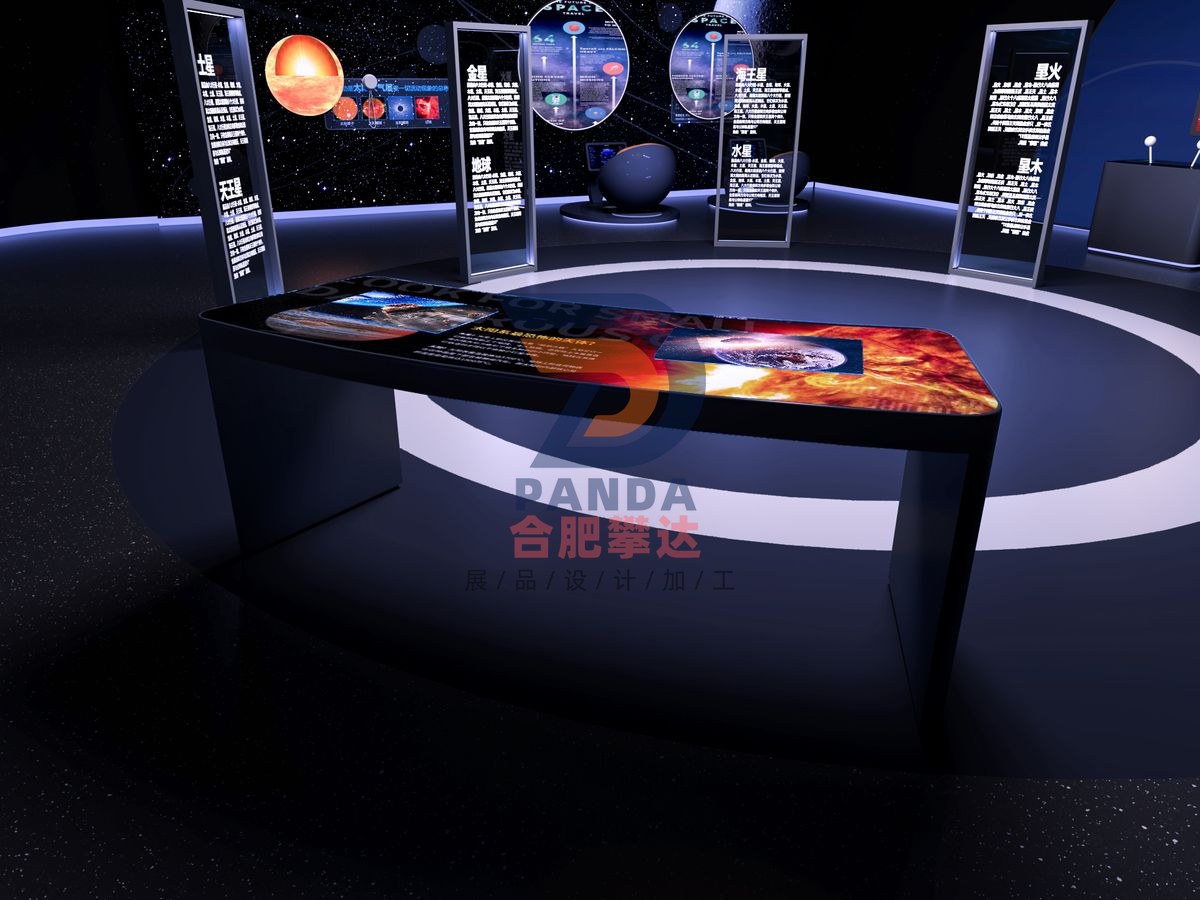
Searching for Dangerous Small Celestial Objects (VR Telescope)
Aerospace · Interactive
- DimensionsSubject to on-site plan
- PresentationInteractive
- PricingQuoted by manufacture spec
Purpose & Scientific Principle
The exhibits allow the audience to learn about planets, dwarf planets, comets and other celestial bodies in the solar system through touch inquiry, as well as knowledge about planets that may have life in the solar system, celestial bodies that may threaten the earth and their response strategies.
How to Operate
A satellite refers to a natural celestial body that orbits a planet and moves periodically in a closed orbit. Artificial satellites are generally also called satellites. Artificial satellites are devices built by humans, launched into space by space shuttles, etc., and orbit the earth or other planets like natural satellites. Gas planets often have many satellites. The eight planets have a total of 205 satellites. Except for Mercury and Venus, all other planets have satellites orbiting them. In order of the number of satellites, there are 82 Saturn, 79 Jupiter, 27 Uranus, 14 Neptune, 2 Mars and 1 Earth. The size and mass of different satellites vary greatly. There are 7 satellites with a radius greater than 1,000 kilometers, and the moon is one of them.
Comet refers to a celestial body that enters the solar system and moves around the sun. Its brightness and shape change with the change of solar distance. It has a unique cloud-like appearance. It is also the broom star (official name of the star) in Chinese mythology. Comet is divided into three parts: nucleus, coma and tail. The comet's core is made of icy material. When the comet approaches the star, the comet's material sublimates, forming a hazy coma and a tail composed of a thin flow of material around the icy core. The mass and density of comets are very small. When they are far away from the sun, they are just frozen ice cubes made of water, ammonia, methane, etc. and a "dirty snowball" mixed with many solid dust particles. When it approaches the sun, the comet is broken down into a comet head and a tail by solar radiation, which looks like a broom. Comets can cause dramatic celestial phenomena when they enter the inner solar system. Their small coma cores are surrounded by bright clouds of gas and dust, called coma, about 100,000 kilometers in diameter. Large comets close to the sun also produce long, bright comet tails that extend tens of millions of kilometers in space and are bright enough to be seen from Earth.
The exhibits are in line with the content of "02-05 The Formation of the Sun and the Solar System" and the Eight Planets, and mainly include the introduction of knowledge about planets, dwarf planets, comets and other celestial bodies in the solar system.
Related Exhibits
Need a quote for this piece or a full exhibit configuration? Tell us your venue area, theme direction, and budget range.