
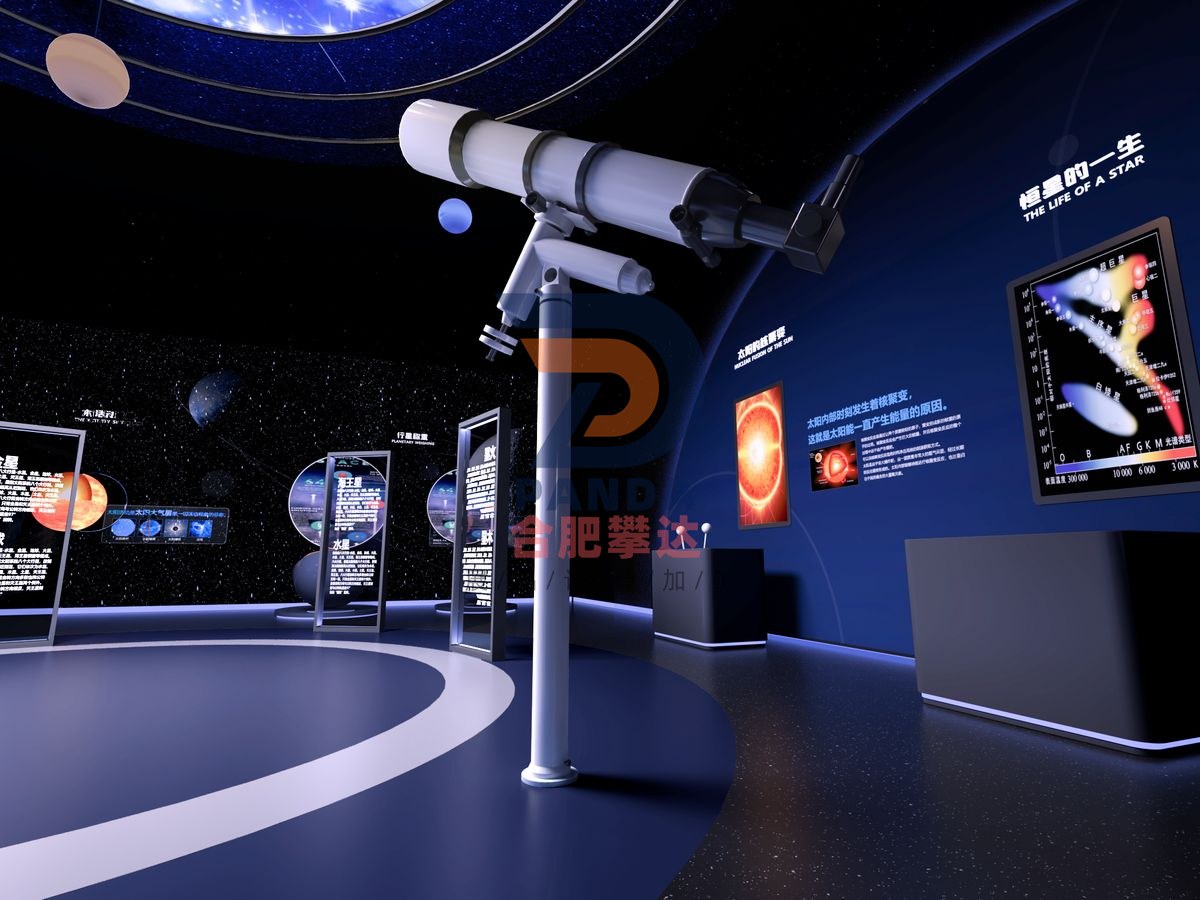
Understanding the Planets (VR Telescope)
Aerospace · Interactive
- DimensionsSubject to on-site plan
- PresentationInteractive
- PricingQuoted by manufacture spec
Purpose & Scientific Principle
The exhibits switch screens by rotating the knob of the telescope body, showing the appearance of various celestial bodies in the solar system (including the sun, planets, dwarf planets, asteroids, satellites, comets, etc.).
How to Operate
(1) Mercury: Mercury is the closest planet to the sun and is the planet with the smallest volume and mass in the solar system. It often appears and sets at the same time as the sun. In ancient China, it was called "Chenxing". So far, only the Mariner 10 probe has visited Mercury three times, in 1973 and 1974. It only surveyed 45% of Mercury's surface.
(2) Venus: The sixth largest planet in the solar system and the hottest planet in the solar system. It was called Taibai or Taibai Venus in ancient China. Sometimes it is a morning star, appearing in the eastern sky at dawn, and is called "Qiming"; sometimes it is an evening star, appearing in the western sky after dusk, and is called "Chang Geng". The first spacecraft to visit Venus was Mariner 2 in 1962. Subsequently, it was successively visited by other spacecraft: Venus Pioneer, Soviet Dignity 7 and Dignity 9.
(3) Earth: The Earth is the third planet from the sun and the fifth largest planet in the solar system. The earth is the densest planet in the solar system. The Earth, of course, can be observed without an aircraft, yet it was not until the twentieth century that we had maps of the entire planet. In addition, the earth's natural satellite is the moon, which is also the earth's only natural satellite. The Moon is the most obvious example of a natural satellite. In the solar system, except for Mercury and Venus, all other planets have natural satellites.
(4) Mars: It is the fourth farthest planet from the sun and the seventh largest planet in the solar system. It was also called Yinghuo in ancient China because Mars is red, glowing like fire, and its brightness often changes; and it moves in the sky, sometimes from west to east, sometimes from east to west. The situation is complicated and confusing, so ancient Chinese called it "Yinghuo", which means "Yingying fire, separation and chaos." The first exploration of Mars was carried out by the Mariner 4 spacecraft in 1965. Several more attempts were made, including two Viking aircraft in 1976. After that, after a gap of 20 years, on July 4, 1997, the Mars Pathfinder finally successfully landed on Mars.
(5) Jupiter: Jupiter is the fifth planet from the sun. It was called the Year Star in ancient China because it takes exactly 12 years to orbit, which is one of the Earthly Branches. Jupiter is the most massive planet in the solar system. Its mass is 2.5 times the sum of all other seven planets, or 318 times that of the Earth. Its volume is 1316 times that of the Earth. Because of its huge size, people can see it without a telescope. Jupiter is called the "King of Planets in the Solar System." It has the fastest rotation speed in the entire solar system. Jupiter was first visited by Pioneer 10 in 1973, and was subsequently visited by Pioneer 11, Voyager 1, Voyager 2, Ulysses and Galileo. The Juno probe entered Jupiter's orbit in July 2016.
(6) Saturn: Saturn is the sixth planet from the sun and the second largest planet among the eight planets. It was called the "Zhenxing" in ancient China. It is the planet with the smallest density in the solar system and can float on water. Pioneer 11 first visited Saturn in 1979, and was visited by Voyager 1 and 2 in the same year. The Cassini spacecraft also reached Saturn in 2004.
(7) Uranus: Uranus is the seventh planet from the sun in the solar system and the coldest planet in the solar system. In terms of diameter, it is the third largest planet in the solar system. Uranus is larger than Neptune, but its mass is smaller. Only one interstellar probe has ever visited Uranus, which was completed by Voyager 2 on January 24, 1986.
(8) Neptune: Neptune is the eighth planet orbiting the sun and the fourth largest celestial body (in diameter) in the solar system. Neptune is smaller in diameter than Uranus, but more massive. Only one spacecraft, Voyager 2, visited Neptune on August 25, 1989. Almost everything we know about Neptune comes from this brief encounter.
The exhibits mainly show the appearance of the eight major planets, dwarf planets, comets, satellites and other solar system objects.
Related Exhibits
Need a quote for this piece or a full exhibit configuration? Tell us your venue area, theme direction, and budget range.