
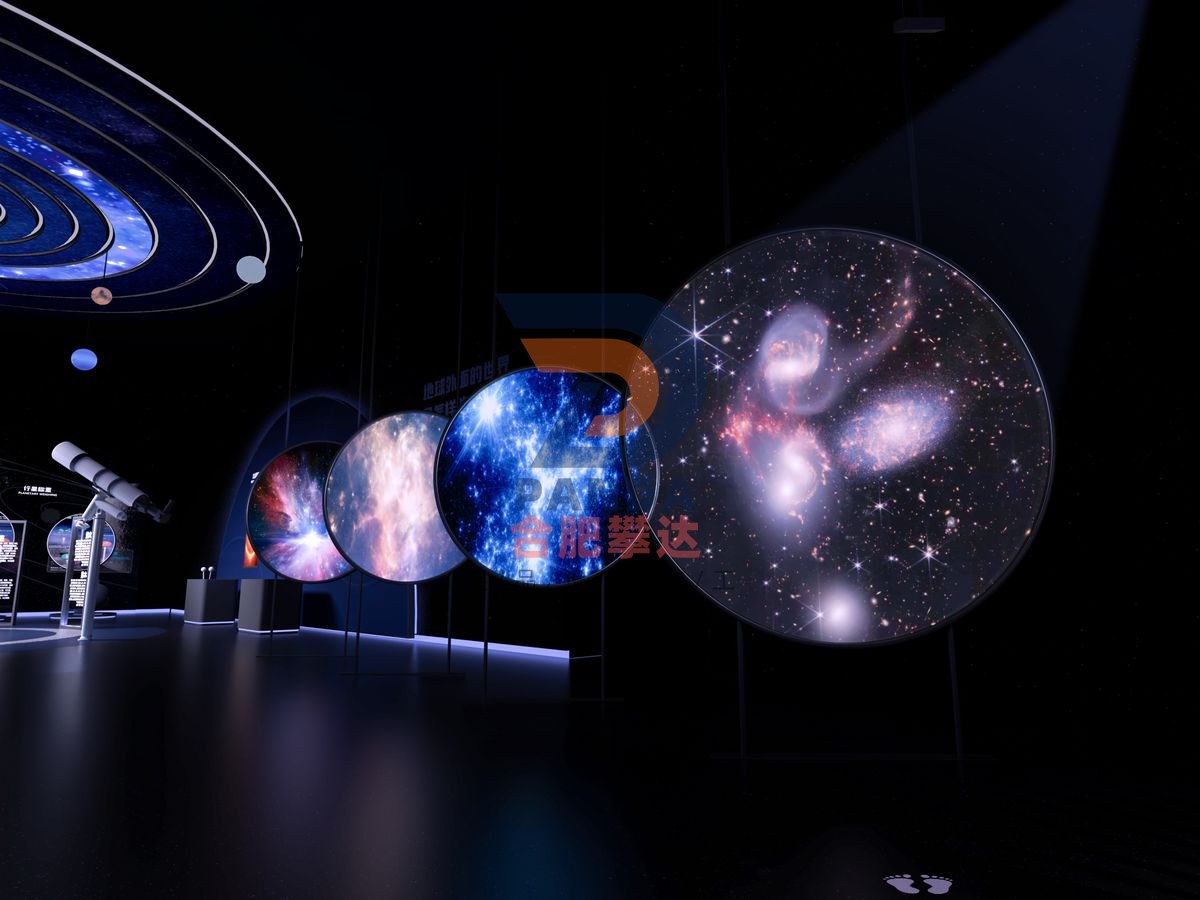
Looking into the depths of the universe
Aerospace · Interactive
- DimensionsSubject to on-site plan
- PresentationInteractive
- PricingQuoted by manufacture spec
Purpose & Scientific Principle
The exhibits use "telescope lenses" as design elements. From the simulated "lenses", viewers can peep into the starry sky that humans can observe at different times, display the photos of the universe taken by telescopes such as Hubble, and feel the process of human vision constantly expanding into the depths of the universe.
How to Operate
(1) Crab Nebula: The Crab Nebula is a supernova remnant and pulsating wind nebula located northeast of the Zeta Taurus star (Tianguan). It is part of the Perseus Arm of the Milky Way, about 6,500 light-years away from the Earth, has a diameter of 11 light-years, and is expanding at a speed of about 1,500 kilometers per second. Corresponds to a supernova explosion recorded by astronomers from China's Song Dynasty, Arabia and Japan in 1054 AD (numbered SN 1054, called Tianguan Guest Star in China). At its center is a pulsar, about 28–30 kilometers in diameter, spinning 30.2 times per second and emitting electromagnetic waves in a wide frequency range from gamma rays to radio waves. It is also the first object to be confirmed as the remnant of a historical supernova explosion.
(2) Andromeda Galaxy: The Andromeda Galaxy (also known as Messier 31) is a barred spiral galaxy, about 2.5 million light-years away from the Earth. It is the farthest deep sky object visible to the naked eye (magnitude 3.4 stars). The Andromeda Galaxy is believed to be the largest galaxy in the Local Group, with a diameter of about 200,000 light-years and nearly one trillion stars. The total star mass is about twice that of the Milky Way.
(3) Cosmic Microwave Background: The Cosmic Microwave Background (CMB) is the thermal radiation left over from the thermal Big Bang. Its characteristics are the same as the black body radiation of 2.725K. Cosmologists propose that neutral atoms form during a "recombination" period, immediately following "photon decoupling," in which photons begin to travel freely throughout space rather than tightly colliding in a plasma of electrons and protons. The photon starts to propagate after decoupling, but due to the expansion of space, the wavelength increases over time, and the light becomes weaker and lower energy. The glow is nearly uniform in all directions, but slight residual variations exhibit anisotropy, as expected. The Planck satellite has given the latest temperature distribution and anisotropy of the cosmic microwave background radiation.
The starry sky in the universe is colorful, and "Looking into the Deep Universe" mainly displays the fantastic beauty of the universe that humans can observe.
Related Exhibits
Need a quote for this piece or a full exhibit configuration? Tell us your venue area, theme direction, and budget range.