
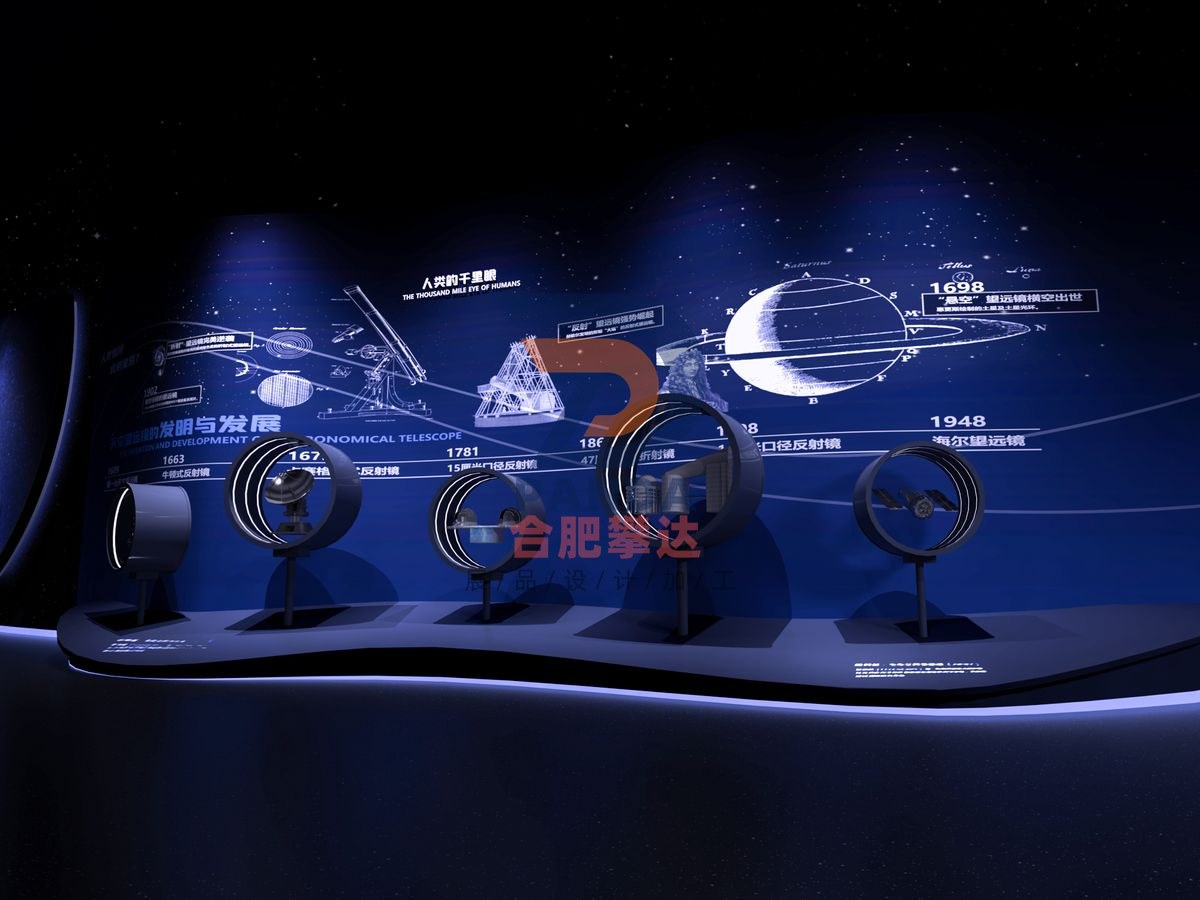
Human Clairvoyance
Aerospace · Interactive
- DimensionsSubject to on-site plan
- PresentationInteractive
- PricingQuoted by manufacture spec
Purpose & Scientific Principle
The exhibits display five telescope models: Hubble Space Telescope, James Webb Space Telescope (JWST), Keck Telescope, Atacama Large Millimeter/submillimeter Array (ALMA) and Guo Shoujing Telescope (LAMOST), allowing the audience to take a close look at the cutting-edge astronomical telescope models that are existing, under construction or planned in the world, and understand their appearance, function and achievements.
How to Operate
(1) Hubble Space Telescope HST:
The optical telescope located above the Earth's atmosphere was successfully launched on April 24, 1990.
Cost: US$2.5 billion; total cost (as of 2010) approximately US$10 billion.
In May 2019, Hubble Space Telescope scientists released the latest cosmic photos - the "Hubble Legacy Field". This is the most complete cosmic map to date. It is stitched together from 7,500 starry sky photos taken by Hubble over 16 years. It contains about 265,000 galaxies, some of which are at least 13.3 billion years old. Studying them will help scientists gain a deeper understanding of the earlier history of the universe.
(2) James Webb Space Telescope JWST:
The James Webb Space Telescope JWST is currently the most outstanding infrared space telescope. The main mirror has a diameter of 6.5 meters and is made up of 18 lenses. The orbit is the sun-earth L2 point. On December 25, 2021, Western United States time, at the European Space Agency’s Kourou base in French Guiana, the Ariane 5 rocket responsible for transportation successfully lifted off. The total cost is as high as 10 billion US dollars. On July 12, 2022, the first batch of full-color images were released to the public. The main scientific goals include studying the first generation stars and galaxies in the universe, habitable exoplanet atmospheres, etc.
(3) Keck telescope:
The Keck Telescope is located on the top of Mauna Kea in Hawaii, USA, at an altitude of 4,145 meters. It includes two telescopes with a diameter of 10 meters. The main mirror is composed of 36 hexagonal lenses with a diameter of 1.8 meters. Each Keck telescope is equipped with an adaptive optics system that compensates for the effects of atmospheric jitter. In addition, Keck I and Keck II can also be used as Keck interferometers; they are separated by a distance of 85 meters, so that when they work together, their resolving power in a specific direction is equivalent to a single telescope with an aperture of 85 meters.
(4) Atacama Large Millimeter Wave/Submillimeter Wave Array ALMA:
The Atacama Large Millimeter/submillimeter Array (ALMA) is located in the Atacama Desert in northern Chile. It consists of 54 antennas with a diameter of 12 meters and 12 antennas with a diameter of 7 meters, for a total of 66 antennas. Antenna baseline range is from 150 meters to 16 kilometers. The observation band is from 0.3mm to 9mm, and the resolution can reach 4 milliarcseconds. Scientific trial observations began in the second half of 2011 and entered full operation in March 2013.
(5) Guo Shoujing telescope LAMOST:
The full name of the Guo Shoujing Telescope is the Large Sky Area Multi-Object Optical Fiber Spectroscopic Astronomical Telescope ("LAMOST" for short). It is my country's independent innovation and was developed by the National Astronomical Observatory of the Chinese Academy of Sciences. It is the world's largest telescope with a large field of view and a large aperture and the highest spectral acquisition rate. It is a major national scientific and technological infrastructure of the National Astronomical Observatory of the Chinese Academy of Sciences. It is a mid-star ceremony reflection Schmidt telescope with a field of view of 5 degrees lying in the north-south direction. LAMOST was established as a project in 1997, started construction in 2001, passed national acceptance in June 2009, and was named the "Guo Shoujing Telescope" in April 2010. The official sky survey was launched in September 2012.
The exhibits focus on displaying information such as the appearance, structure and achievements of the world's cutting-edge astronomical telescopes. The model display method can be used to display it more intuitively. On this basis, it is supplemented with graphic and text annotations to supplement the relevant knowledge of astronomical telescopes.
Related Exhibits
Need a quote for this piece or a full exhibit configuration? Tell us your venue area, theme direction, and budget range.