
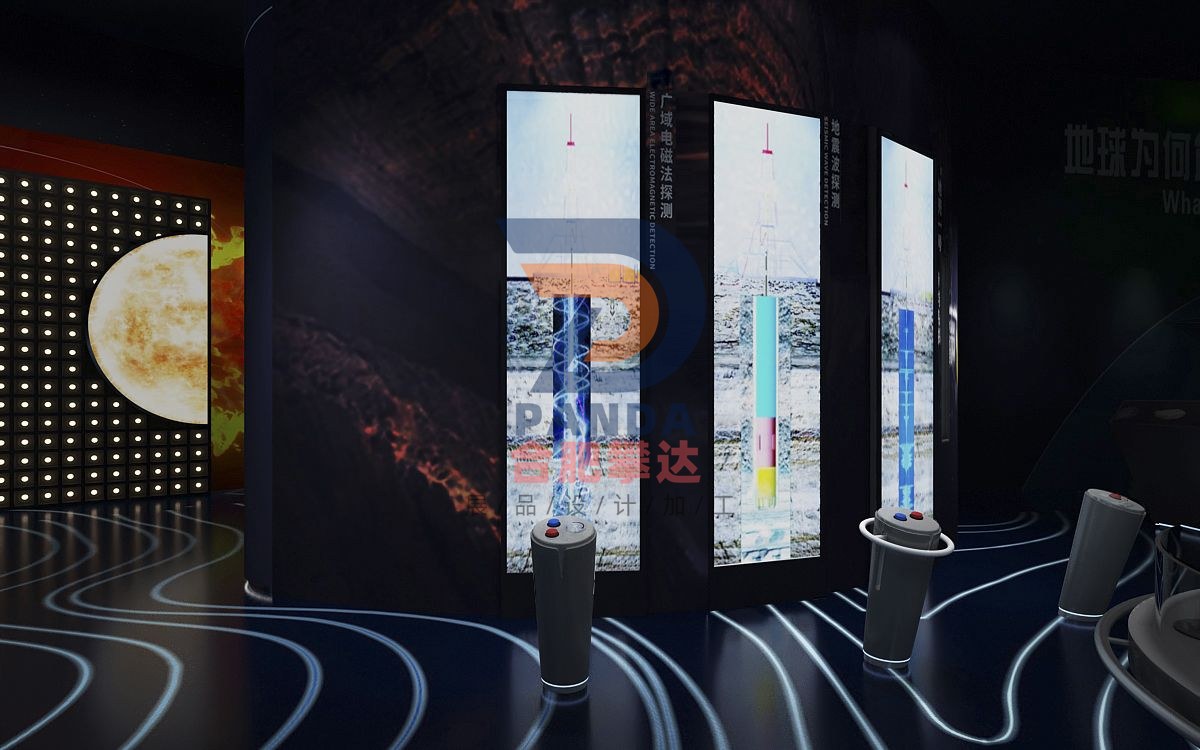
Wide-field electromagnetic method detection
Aerospace · Interactive
- DimensionsSubject to on-site plan
- PresentationInteractive
- PricingQuoted by manufacture spec
Purpose & Scientific Principle
This exhibit allows the audience to gain an in-depth understanding of the technical principles and characteristics of the wide-field electromagnetic method during the actual operation through multimedia splicing screens and interactive devices, and fully understand the process of "using electromagnetic waves to perform CT scans on the earth". At the same time, they can learn about the mineral resource information detected by the wide-field electromagnetic method through video interpretation.
How to Operate
Chinese geophysicist He Jishan proposed the wide-field electromagnetic method in 2006, and officially launched a self-developed wide-field electromagnetic detection complete set of equipment in 2010. The wide-field electromagnetic method establishes a harmonic electromagnetic field through an artificial grounded field source, sends alternating currents of different frequencies underground, observes one or more electromagnetic field components, and uses wide-area apparent resistivity to detect geological targets at different burial depths. Based on the traditional controlled source audio electromagnetic magnetotellurics (CSAMT) method and the MELOS method; the wide-field electromagnetic method uses high-power, strong-signal artificial fields to suppress interference fields to improve the signal-to-noise ratio, thereby obtaining effective observation data.
The advantages of the wide-field electromagnetic method include large exploration depth (up to 8,000 meters underground), anti-electromagnetic interference capability, high deep resolution, green and environmentally friendly (no blasting is required and nature is not destroyed). Compared with the traditional seismic wave method, the speed and depth of data collection are greatly improved.
The Zhuxi Tungsten Copper Mine in Jiangxi Province, my country, has the largest tungsten ore reserves in the world. Due to the complex geological structure, especially in the face of the precise exploration requirements at a depth of 3,000 meters, the CSAMT method commonly used in geophysical prospecting has failed one after another. After the intervention of wide-field electromagnetic exploration technology and equipment, the fine distribution of resistivity within the 3,000-meter depth range of the mining area was obtained, clearly revealing the deep rock-controlling ore-controlling structures for the first time, providing a scientific basis for subsequent exploration.
The exhibits focus on the scientific principles and detection process of wide-field electromagnetic method. They use an electromechanical button interactive device combined with a multimedia splicing screen to mobilize the audience's participation and more intuitively display the scientific pictures of deep ground exploration through the display screen.
Related Exhibits
Need a quote for this piece or a full exhibit configuration? Tell us your venue area, theme direction, and budget range.