
Compare
Kids' Zone · Interactive
- DimensionsSubject to on-site plan
- PresentationInteractive
- PricingQuoted by manufacture spec
Purpose & Scientific Principle
The exhibition items use comparison to intuitively show the differences in attributes between objects, allowing children to improve their observation skills and understanding of object characteristics through comparison.
How to Operate
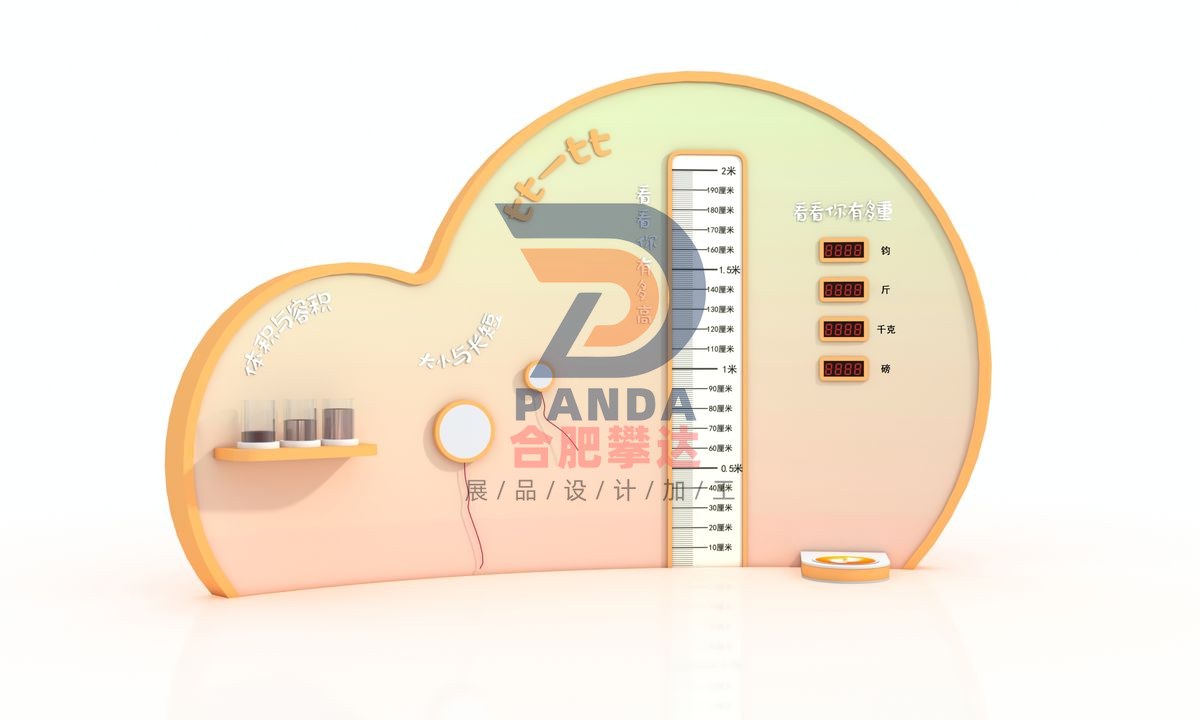
The exhibits consist of a height interactive mechanism, a circle contrast interactive mechanism, a weight comparison interactive mechanism, and a volume comparison model. During the interaction, you can intuitively feel the comparison of sizes.
Height interactive mechanism: A height scale is set up on the wall, with different colors to distinguish the units of meters, decimeters and centimeters. Children can test their own height. The pictures and texts give the standard height range for children aged 3-8 years old.
Circle contrast interactive mechanism: Two rings of different sizes are set up on the wall, and a rope is set around the circles to visually display the circumferences of circles of different sizes.
Weight comparison interactive mechanism: Four sets of digital tubes are set up on the wall, corresponding to the ancient Chinese weight unit Jun, the international weight unit kilogram, the British and American weight unit pound and the Chinese weight unit kilogram. A weight scale is set up on the ground, and the weight scale is linked to the digital tubes. The child stands on the scale and weighs, and the digital tube displays the weight values corresponding to different units. (1 jun = 30 kilograms = 15 kilograms = 33.0693393 pounds)
Volume comparison model: Using liters, quarts, and gallons as volume units, the container model is designed so that the audience can intuitively understand the relationship between different volume units. (Imperial system: 1 gal = 4 quarts = 4.546 liters)
The characteristics of an object include mass, volume, density, shape, length, width, height, radius, etc. Objects refer to all tangible substances that exist objectively in nature, generally divided into gaseous, liquid and solid states. Individuals made of matter and occupying a certain space are called objects. The objective reality of its existence is felt through human sense organs. An object is a substance that has a macroscopic shape, macroscopic volume, or macroscopic mass.
Related Exhibits
Need a quote for this piece or a full exhibit configuration? Tell us your venue area, theme direction, and budget range.