
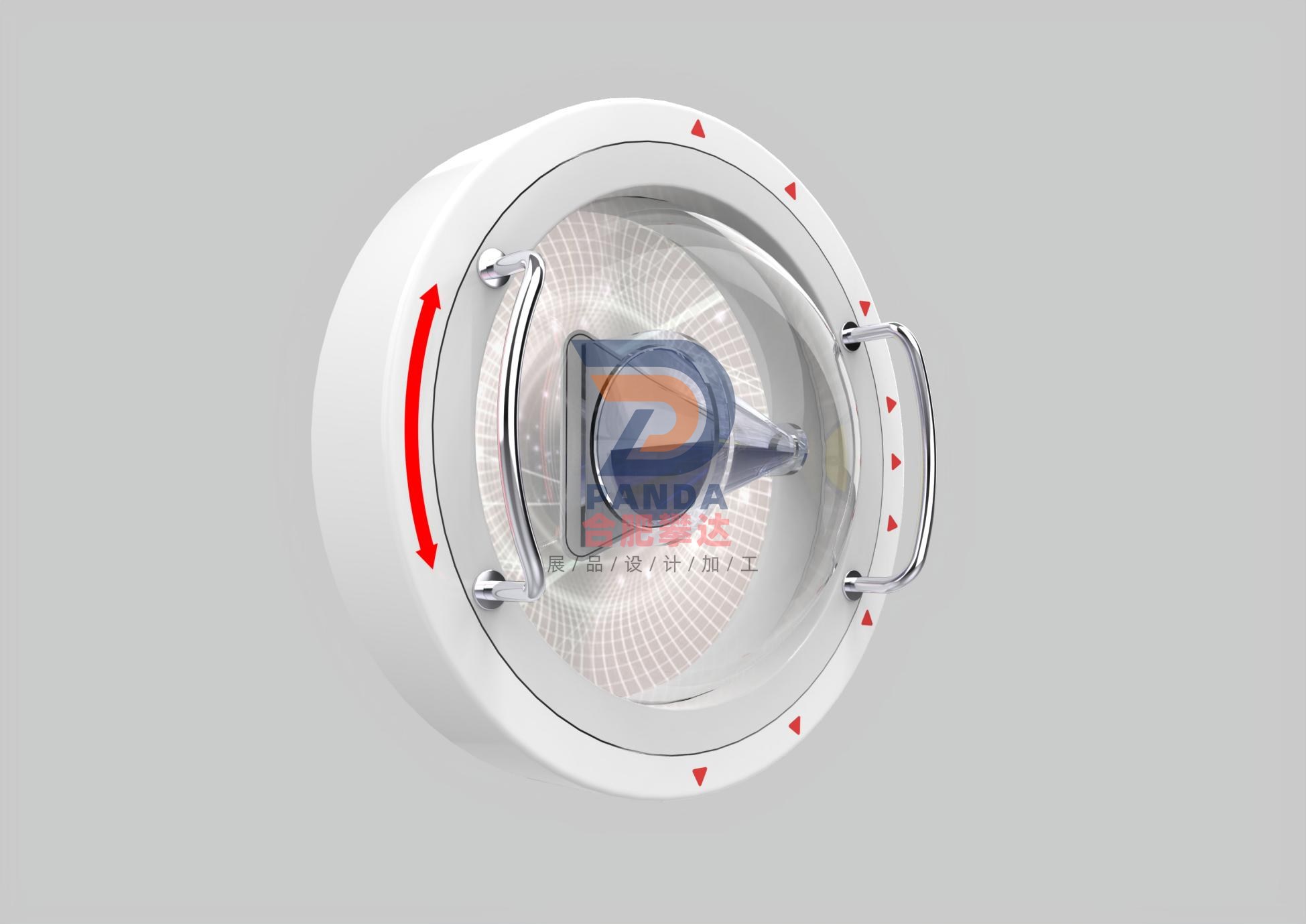
Conic Sections
Mathematics · Mechanical Interaction
- DimensionsDiameter 900*370mm
- PresentationMechanical Interaction
- PricingQuoted by manufacture spec
Purpose & Scientific Principle
The ancient Greek mathematician Apollonius used the method of cutting a cone with a plane to study these types of curves. If you truncate the cone with a plane perpendicular to the axis of the cone, you will get a circle; if you gradually tilt the plane, you will get an ellipse; when the plane is tilted to be parallel to a generatrix of the cone, you will get a parabola; when the plane is tilted further, you will get a hyperbola. Apollonius once called the ellipse the "loss curve", the hyperbola the "hypercurve", and the parabola the "uniform curve"
How to Operate
The exhibition consists of a conical container filled with liquid and a curved scale plate. The conical container is fixed on a disk and has a transparent hemispherical cover. When the audience turns the circular handle on the disk, the curve formed by the liquid surface also changes. When the conical container containing liquid is rotated so that the tip of the cone is aligned with the scale on the scale plate, the arrow will indicate which type of cone it is, and the cross-sectional shape of the liquid surface in the cone will be observed.
1. Turn the circular handle on the disk so that the tip of the conical container is aligned with the scale on the scale plate;
2. Observe the cross-sectional shape of the liquid surface in the cone.
Related Exhibits



Need a quote for this piece or a full exhibit configuration? Tell us your venue area, theme direction, and budget range.