
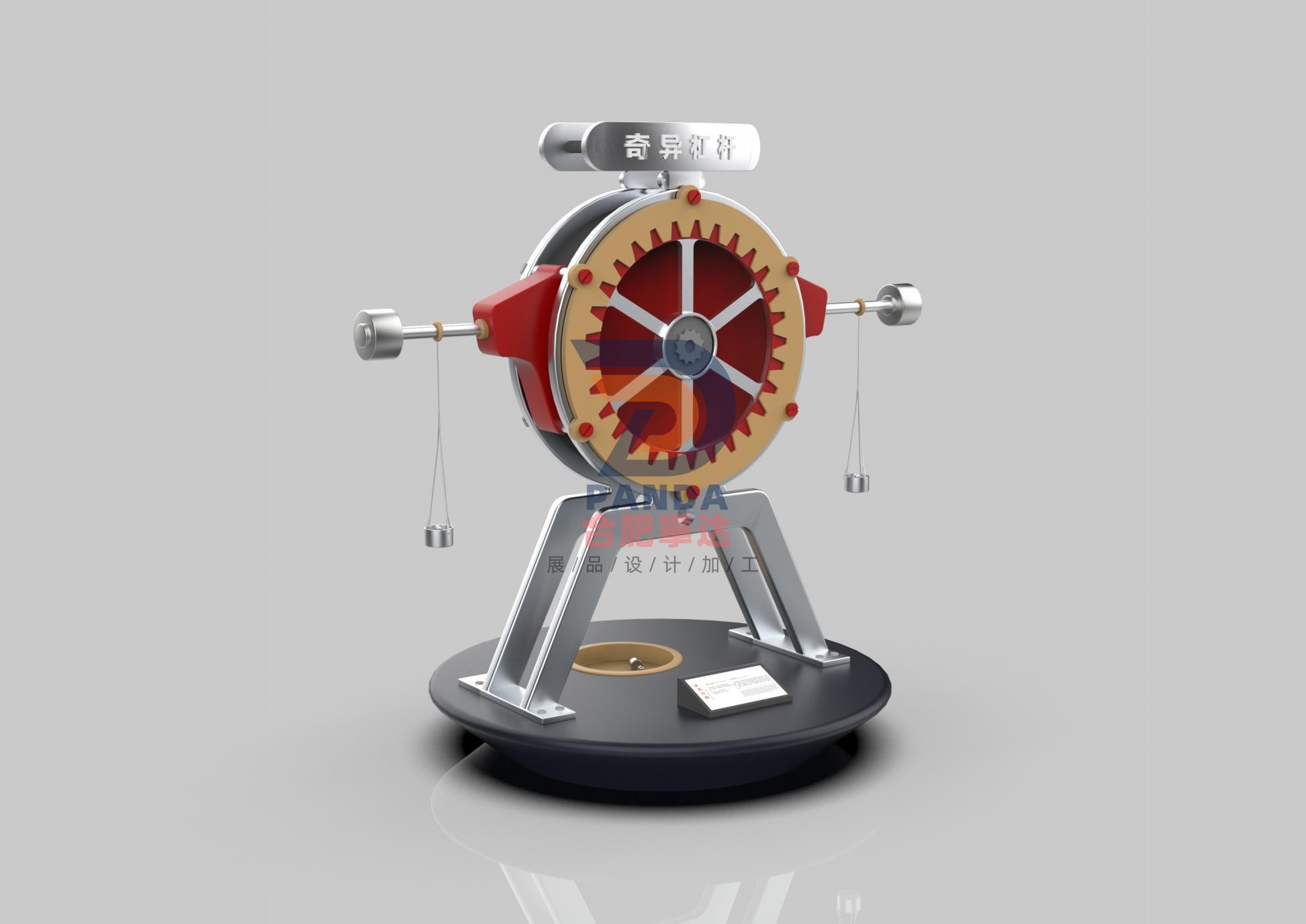
Singular Lever
Mechanics in Motion · Mechanical Interaction
- Dimensions2000*1400*1860mm
- PresentationMechanical Interaction
- PricingQuoted by manufacture spec
Purpose & Scientific Principle
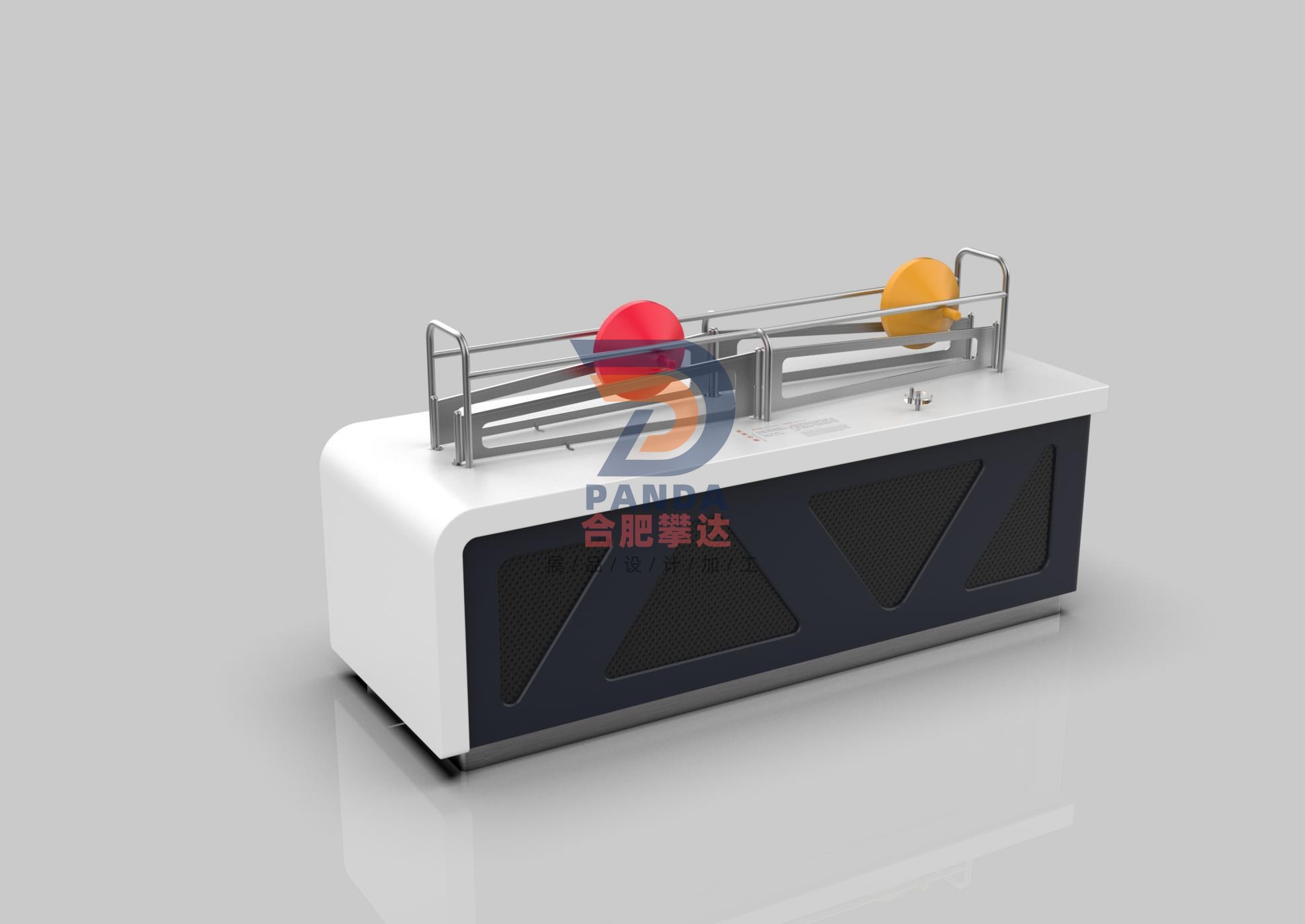
A lever is a rigid object that can rotate around a fixed point. The place where force is applied on the lever is called the force application point. The rotation fixed point is the fulcrum. The distance from the fulcrum to the force application point is called the moment arm. The multiplication of the force and the moment arm is the moment. The "strange lever" consists of a bracket (leg), a body lever, a T-shaped frame (arm), and a heavy object (weight). The body lever is composed of two upper and lower straight bars. The midpoints of the upper and lower straight bars are hinged to the bracket respectively. The two ends of the cross bars of the two T-shaped frames are fixedly connected to the upper and lower straight bars of the body lever respectively. That is, the body and arms form a parallelogram. When weights of the same weight are hung on the left and right arms (no matter where the weights are hung), the T-shaped frame causes equal forces in the left and right vertical directions and produces equal moments, so it is always in a balanced state. When weights of different weights are hung on the horizontal bars (arms) of the left and right T-frames (no matter where the weights are hung), the forces received in the vertical direction are not equal and the moments generated are not equal, so it is always in an unbalanced state. If the same weight is hung on both sides, the lever will be balanced no matter where the weight is hung; but if the number of hooks hung on both sides is not equal, the lever will always be unbalanced no matter how it is placed.
How to Operate
The exhibition item is a lever mechanism composed of cartoon character models. The left and right arms of the cartoon character have a T-shaped bar structure. From the transparent cover on the back of the cartoon character, you can see the "strange lever" in the shape of a parallelogram. The left and right arms are equipped with weight placement platforms.
1. If a cartoon character hangs weights of the same weight on his left and right arms, no matter where the weight is hung, the lever experience will be balanced; 2. If a cartoon character hangs weights of different weights on his left and right arms, no matter where the weight is hung, the lever experience will be balanced.
Related Exhibits
Need a quote for this piece or a full exhibit configuration? Tell us your venue area, theme direction, and budget range.