
Victorinox generator
Electromagnetism · Interactive
- DimensionsSubject to on-site plan
- PresentationInteractive
- PricingQuoted by manufacture spec
Purpose & Scientific Principle
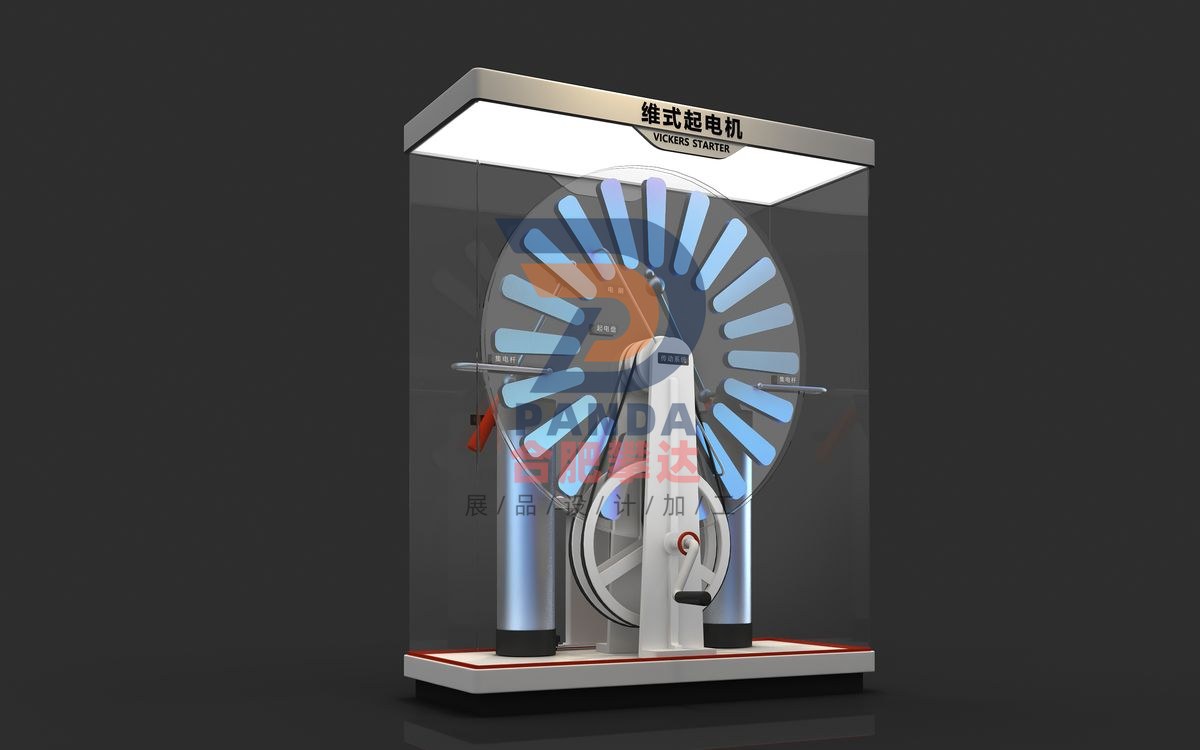
The audience worked together, turned the handwheel, observed the structure of the Vickers generator, thought about the reasons why the Vickers generator produced electricity, and understood the development process of the generator in history.
How to Operate
1. The invention process of generator
The earliest electrostatic generator appeared in the 17th century. Glick used a crank to quickly rotate a sulfur ball and rubbed it with hands to generate electricity. In 1775, Volta created a galvanizing disk, which consisted of a flat plate made of insulating material and a conductive flat plate with an insulating handle. In 1865, Kepler and Holtz made induction generators respectively. Later, Wimhus improved the existing electrostatic generator, and the Vickers generator was born.
2.Vickers generator
The Vickers generator, also known as the Wimhoff generator, is a commonly used experimental instrument in electrostatics. It is an experimental device that can continuously obtain and accumulate more positive and negative charges. The Leyden jar is a capacitor used to store electricity. There is a Leyden bottle on the left and right sides of the Vickers generator. The two Leyden bottles collect different types of charges and serve as the positive and negative poles of the power supply. When the handle on the wheel is shaken clockwise, since aluminum ranks before copper in the electrostatic sequence, when the disc rotates, the aluminum sheet rubs against the copper wire on the brush and becomes positively charged, while the copper wire becomes negatively charged.
Vickers generator can not only be used as a power generating device, but also can demonstrate the phenomenon of spark discharge, and the effect is very good.
The Vickers generator, also known as the Wimhoff generator, is a commonly used experimental instrument in electrostatics. It is an experimental device that can continuously obtain and accumulate more positive and negative charges. The Leyden jar is a capacitor used to store electricity. There is a Leyden bottle on the left and right sides of the Vickers generator. The two Leyden bottles collect different types of charges and serve as the positive and negative poles of the power supply. When the handle on the wheel is shaken clockwise, since aluminum ranks before copper in the electrostatic sequence, when the disc rotates, the aluminum sheet rubs against the copper wire on the brush and becomes positively charged, while the copper wire becomes negatively charged.
Related Exhibits

Need a quote for this piece or a full exhibit configuration? Tell us your venue area, theme direction, and budget range.