

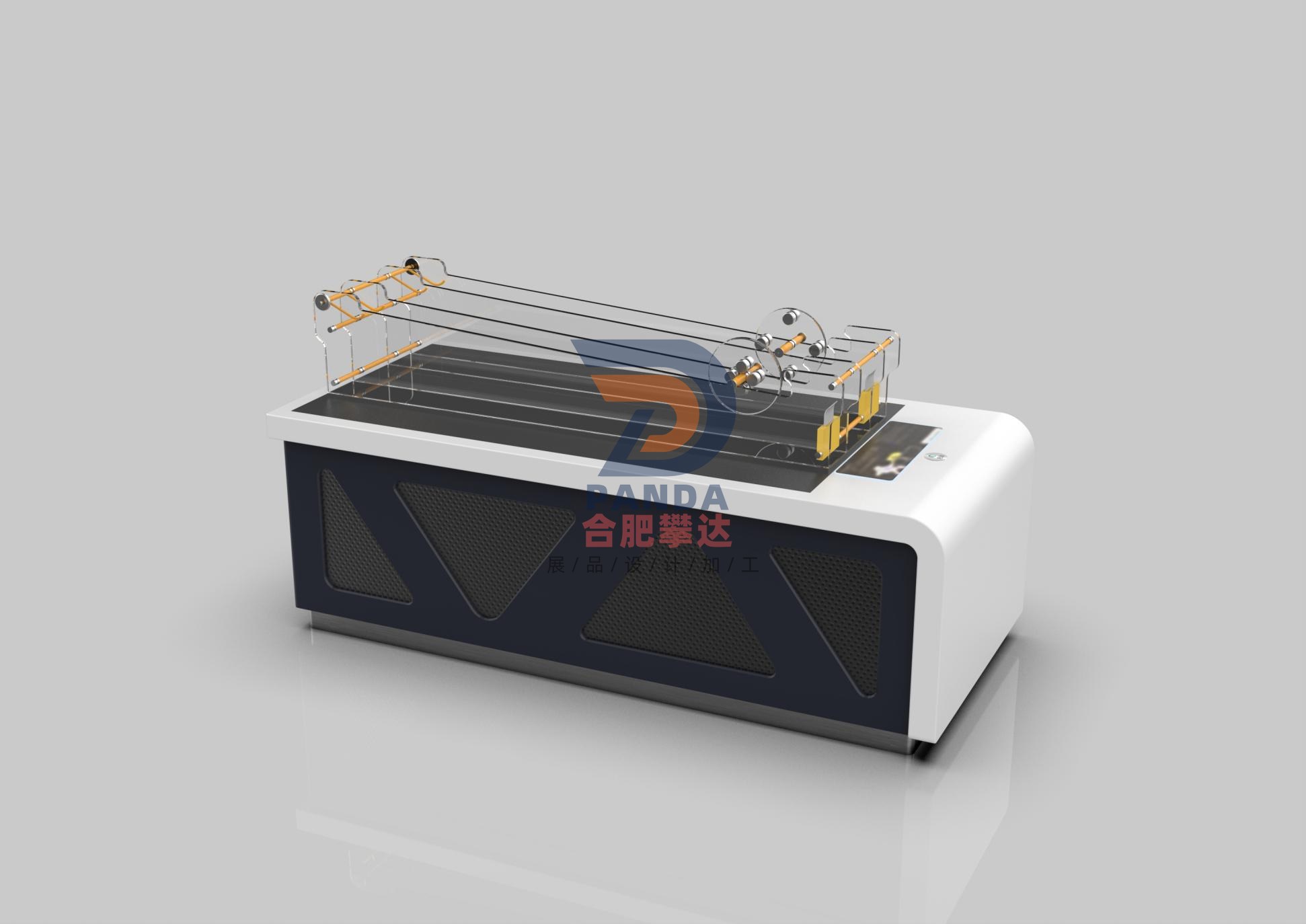
Galileo's Inclined Plane Experiment
Mechanics in Motion · Interactive
- DimensionsSubject to on-site plan
- PresentationInteractive
- PricingQuoted by manufacture spec
Purpose & Scientific Principle
By simulating Galileo's Inclined Plane Experiment, the exhibition allows the audience to think about and explore the derivation of the law of free fall and the law of inertia.
How to Operate
Through observation and reasoning, Galileo refuted Aristotle's statement that the falling speed of an object is proportional to its weight, and proposed a conjecture: the motion of a falling body is a uniformly accelerated linear motion, and the falling speed of an object is proportional to time. Moreover, through derivation, he came to the conclusion that distance is proportional to the square of time.
In order to "dilute gravity" and slow down the falling motion, Galileo conducted the famous inclined plane experiment in 1632. He carved a straight groove on a piece of wood, covered it with smooth parchment, let a smooth copper ball fall along the inclined straight groove, and measured the falling time with a water clock. Galileo conducted hundreds of experiments with the inclined plane at different inclination angles and the copper ball rolling different distances, and found that: "The ratio of the distances traveled by an object falling from rest at equal time intervals is equal to the ratio of a series of odd numbers starting from 1." He also explained through reasoning: "The various distances traveled by a falling object are always proportional to the square of the time taken."
Later, Galileo conducted a double-inclined experiment. He placed two smooth inclined planes opposite each other on the table, with the same angle to the table. He let the ball roll down from rest along one inclined plane. The ball would roll up the other inclined plane, reach almost the same height as the original, and then roll down again. The further you reduce the inclination of the second slope, the farther the ball will roll when it reaches the same height. Then, he did a "thought experiment": imagine that when the angle between the inclined plane and the tabletop is 90 degrees, it will return to the free fall situation; imagine that when the angle between the inclined plane and the tabletop approaches zero degrees, the rolling ball will move forward endlessly, so he discovered inertia.
Galileo combined experimental observation with abstract thinking and deduced that force is not the reason for maintaining the motion of an object (that is, maintaining the speed of the object), but the reason for changing the state of motion of the object (that is, changing the speed of the object).
Through observation and reasoning, Galileo refuted Aristotle's statement that the falling speed of an object is proportional to its weight, and proposed a conjecture: the motion of a falling body is a uniformly accelerated linear motion, and the falling speed of an object is proportional to time. Moreover, through derivation, he came to the conclusion that distance is proportional to the square of time.
In order to "dilute gravity" and slow down the falling motion, Galileo conducted the famous inclined plane experiment in 1632. He carved a straight groove on a piece of wood, covered it with smooth parchment, let a smooth copper ball fall along the inclined straight groove, and measured the falling time with a water clock. Galileo conducted hundreds of experiments with the inclined plane at different inclination angles and the copper ball rolling different distances, and found that: "The ratio of the distances traveled by an object falling from rest at equal time intervals is equal to the ratio of a series of odd numbers starting from 1." He also explained through reasoning: "The various distances traveled by a falling object are always proportional to the square of the time taken."
Related Exhibits

Need a quote for this piece or a full exhibit configuration? Tell us your venue area, theme direction, and budget range.