
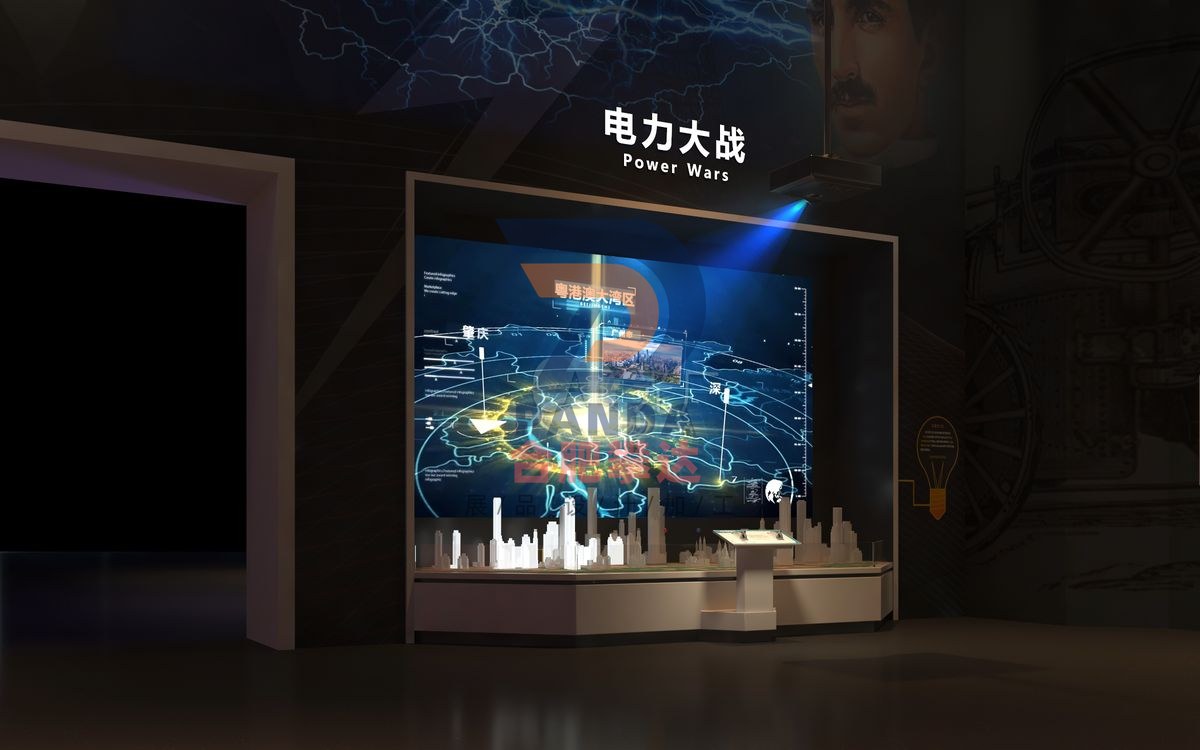
Electricity War
Electromagnetism · Interactive
- DimensionsSubject to on-site plan
- PresentationInteractive
- PricingQuoted by manufacture spec
Purpose & Scientific Principle
The exhibition uses the form of electromechanical interaction to show the audience which alternating current or direct current is more suitable for daily life applications. Set up a set of DC circuit and AC circuit systems respectively, which can light up the Ferris wheel, high-rise buildings, etc. in the sand table. The audience tried to activate the DC circuit or the AC circuit and watched the changes in the brightness of the electrical equipment in the sandbox, showing the scene from the power war between Edison and Tesla.
How to Operate
1. Edison brought the development of the power grid:
In 1880, Edison invented the parallel grid, trunk and branch grid, and wire insulation material technology. It can be said that he invented the entire power system.
Electric energy generated from power stations is generally sent everywhere through transmission lines. Different high voltages will be selected according to the distance of transmitting electric energy. High-voltage power transmission is to use a transformer in a power plant to boost the voltage output by a generator and then transmit it. In an attempt to reduce the power in the transmission process through high-voltage power transmission, thereby reducing the heat loss caused by current and the material costs caused by long-distance power transmission.
2. The difference between direct current and alternating current:
Direct current - refers to an electric current whose direction does not change with time. Direct current can be stored, such as various batteries, and is highly mobile. At the same time, DC has constant properties and is suitable for precision electronic equipment that requires stable operation.
Alternating current - refers to an electric current that changes periodically in magnitude and direction. Alternating current cannot be stored and can only be generated at any time according to power usage. Therefore, alternating current is suitable for low-power conversion and transmission of current and is mostly used in power transmission systems.
3. Battle between AC and DC:
After the invention of the electric light, Edison concentrated on solving the problem of power transmission. At that time, the voltage was very low, and it was not practical to use DC transmission over long distances. At this time, the AC power transmission proposed by Tesla can increase the voltage when the electricity leaves the factory, which means that the electricity can be transmitted to longer distances. A battle over the superiority of power transmission technology revolved around two outstanding inventors, Tesla and Edison.
Edison originally held the status of an industry leader and firmly believed that DC was the future choice. He ignored his lofty reputation in the business battle and created public opinion to exaggerate AC and electric shock accidents, ultimately losing his company. Tesla once regarded Edison as an idol, but was deceived by the idol and was heartbroken. Both parties relied on their huge backgrounds. The electric power empires faced off against each other. The bright lights at the World Expo allowed the world to appreciate the greatness and obvious superiority of alternating current. Not long after the exhibition, Tesla received the help of the noble Westinghouse and signed an order for the Niagara Falls Power Station. In one fell swoop, Tesla established the standard for the modern power system and won the victory over its former idol.
Electric energy generated from power stations is generally sent everywhere through transmission lines. Different high voltages will be selected according to the distance of transmitting electric energy. High-voltage power transmission is to use a transformer in a power plant to boost the voltage output by a generator and then transmit it. In an attempt to reduce the power in the transmission process through high-voltage power transmission, thereby reducing the heat loss caused by current and the material costs caused by long-distance power transmission.
Related Exhibits
Need a quote for this piece or a full exhibit configuration? Tell us your venue area, theme direction, and budget range.