
Wave Wall
Mechanics in Motion · Interactive
- DimensionsSubject to on-site plan
- PresentationInteractive
- PricingQuoted by manufacture spec
Purpose & Scientific Principle
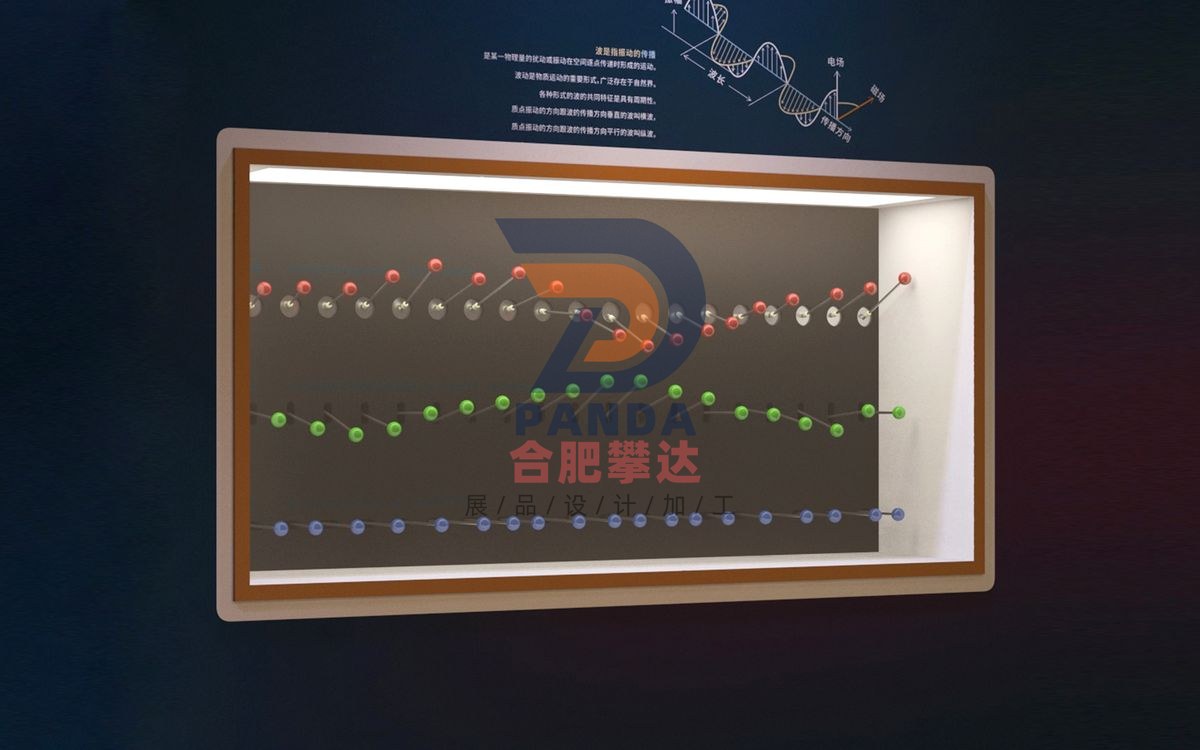
The mechanical structure displays three waveforms: superposed wave, transverse wave, and longitudinal wave, showing the characteristics of each waveform.
How to Operate
The common characteristic of waves is that they are periodic. There is time periodicity when the disturbed physical quantity changes, that is, the physical quantity at the same point completely returns to its original value after a cycle; it also has space periodicity when it is transmitted in space, that is, the same vibration state (such as the displacement and velocity of the particle) will appear after a certain spatial distance along the propagation direction of the wave.
1. Transverse waves and longitudinal waves
A wave is the propagation of vibrations, traveling through a medium. When vibration propagates in a medium, there are two forms. One is a longitudinal wave. The characteristic of this wave is that when propagating in the medium, the propagation direction of the wave is consistent with the direction of particle vibration; the other is a transverse wave. The characteristic of this wave is that when propagating in the medium, the propagation direction of the wave is perpendicular to the direction of particle vibration. Electromagnetic waves and light waves are both transverse waves. Sound waves are longitudinal waves.
2. Superposition waves
When several waves meet in the same area, as long as the vibration is not very strong, each wave can maintain its own frequency, amplitude, vibration direction and other characteristics, and continue to move forward according to its original propagation direction without being affected by each other. This is the independence of waves. In the encounter region, the total vibration is a linear superposition of the partial vibrations.
If two or more columns of waves have the same frequency, the waves are uninterrupted within the observation time, and the vibration direction is almost along the same straight line when they meet, then the combined vibration after superposition may be strengthened in some places and weakened in some places. This phenomenon is called interference. The distribution of vibration intensity is called an interference pattern, or interference pattern.
Interference is a behavior unique to waves, indicating that the motion of physical objects is completely different from waves. Two moving physical objects—such as two trains—cannot pass through each other without interference.
The independence and superposition of waves are not always true. When the intensity of the wave is very large, the independence and superposition may fail.
Waves are a common form of material motion. For example, waves on ropes, sound waves in the air, waves on the water surface, etc. These waves are the propagation of mechanical vibrations in elastic media and are called mechanical waves. The cause of the formation of mechanical waves is that the particles in the medium are disturbed by adjacent particles and move accordingly, and the vibration form is spread from far to near. There is an elastic force of interaction between the particles. Mechanical waves are recurring motion phenomena exhibited by groups of particles united together.
Related Exhibits
Need a quote for this piece or a full exhibit configuration? Tell us your venue area, theme direction, and budget range.