
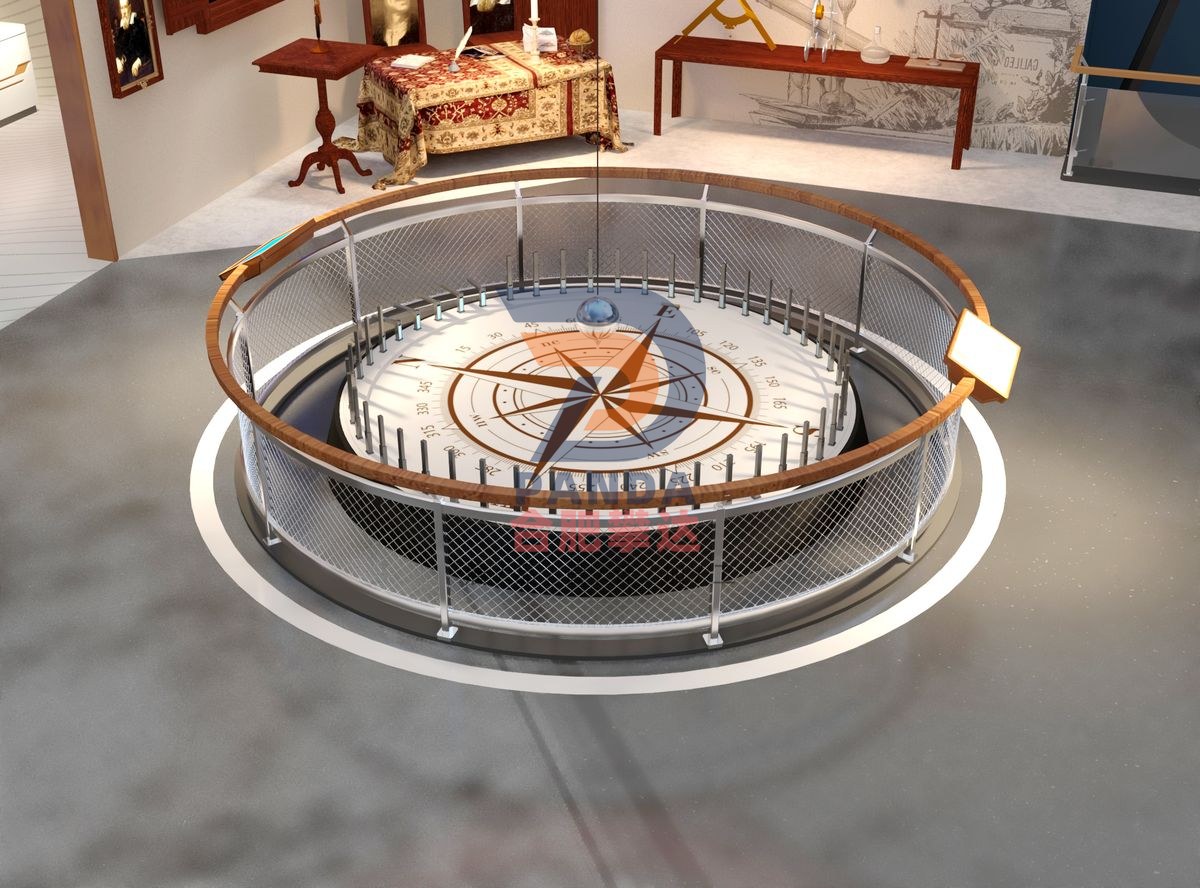
Foucault's Pendulum
Mechanics in Motion · Interactive
- DimensionsSubject to on-site plan
- PresentationInteractive
- PricingQuoted by manufacture spec
Purpose & Scientific Principle
Simulates the experimental process of Foucault's Pendulum, allowing the audience to experience the magical process of experimental verification of science.
How to Operate
If the earth does not rotate, the vibration surface of the pendulum will remain unchanged, and there will be only one trajectory on the sand table; if the earth is constantly rotating, the vibration surface of the pendulum will rotate in the eyes of people on the earth, and there will be different trajectories on the sand table.
The experiment began, and people were surprised to find that every time the pendulum set by Foucault went through a cycle of oscillation, the trajectory drawn on the sand table would deviate from the original trajectory. To be precise, at the edge of this 6-meter-diameter sand table, the difference between the two trajectories is about 3 millimeters.
This experiment was later carried out in different locations, and it was found that the rotation period of the pendulum's vibrating surface varies from location to location. Its period is proportional to the sine of the latitude of the location where the pendulum is located. The rotation period at the two poles is 24 hours. The direction of rotation of the vibration surface is clockwise in the northern hemisphere and counterclockwise in the southern hemisphere. The change in the swing direction of Foucault's pendulum is the result of the counterclockwise rotation of the earth where the observer is located. What the observer on the earth sees is the phenomenon of relative motion.
Foucault's pendulum experiment is rated as one of the "most beautiful experiments in physics". It is the best proof of the rotation of the earth. On January 3, 1851, the physicist Foucault hung a 67-meter-long rope on the dome of the Pantheon in Paris, France. Below the rope was a 28-kilogram pendulum, and below the pendulum was a huge sand table. When the pendulum passes over the sand table, the pointer on the pendulum will leave a trajectory on the sand table. Due to the rotation of the earth, the swing of the pendulum is deflected, and eventually the trajectory of the pendulum will cover the entire sand table surface.
Related Exhibits





Need a quote for this piece or a full exhibit configuration? Tell us your venue area, theme direction, and budget range.