
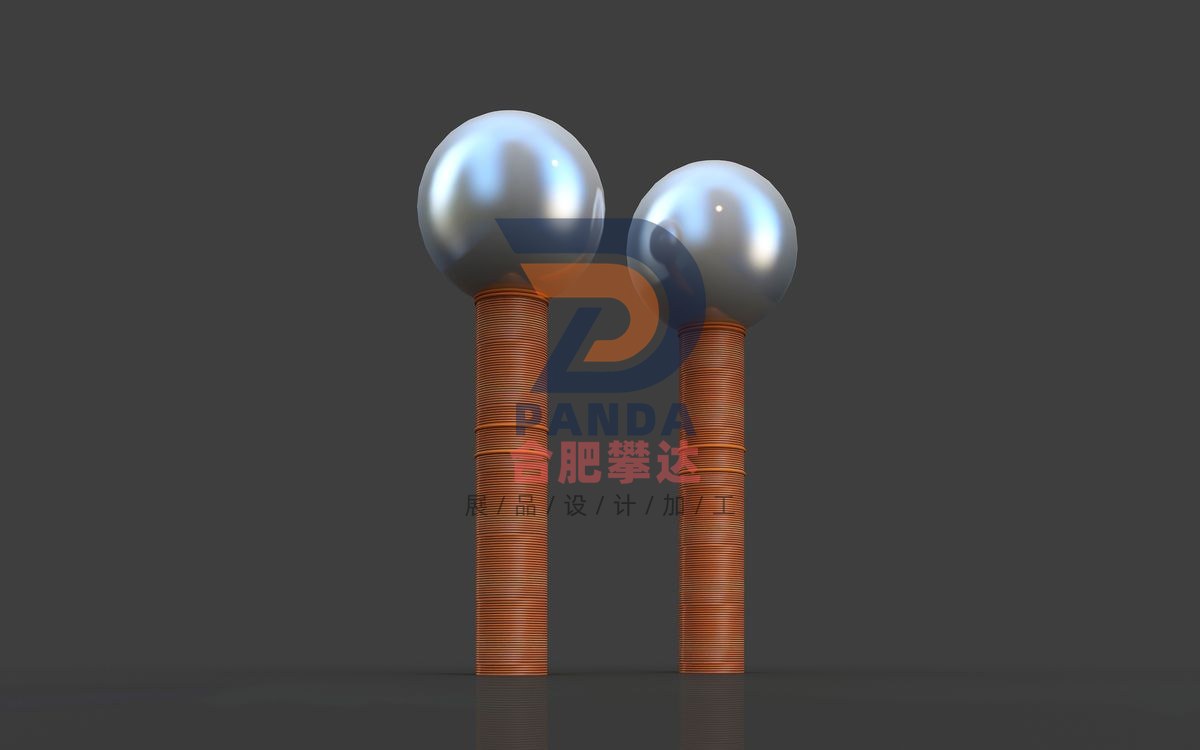
The big stage of electromagnetism - Van de Graaff generator
Electromagnetism · Interactive
- DimensionsSubject to on-site plan
- PresentationInteractive
- PricingQuoted by manufacture spec
Purpose & Scientific Principle
It aims to allow the audience to independently become curious about electromagnetism through various interesting and surprising discharge phenomena; and combines the historical classic experiments of famous scientists such as Faraday and Tesla with the device to vividly reproduce the near-miss electromagnetic phenomena, allowing the audience to understand the electrical experiments such as capturing electricity and storing electricity done by scientists in history; and while watching the exhibition and teaching performances, they will be deeply impressed by electricity and feel the scientific spirit of having the courage to challenge authority.
How to Operate
American physicist Robert Jemison Van de Graaff invented the Van de Graaff generator in 1931, which is a device used to generate electrostatic high voltage. Van de Graaff generators are very easy to obtain very high voltages, and modern Van de Graaff generators have potentials up to 5 million volts. Van de Graaf invented the generator to provide the high energy needed for early particle accelerators. These accelerators are called atom smashers because they are capable of accelerating subatomic particles to very high velocities and then "bumping" them into target atoms. Collisions can produce other subatomic particles and high-energy radiation (such as X-rays). Being able to produce these high-energy collisions is fundamental to particle and nuclear physics.
lWhy did Van de Graaff develop a generator?
The late 19th and early 20th centuries were an era of great development in physics. Roentgen discovered X-rays in 1895, Becquerel discovered the radioactivity of uranium in 1896, and John Thomson discovered the electron in 1897. These experimental results strongly imply that atoms also have internal structures. In 1911, Rutherford bombarded gold foil with alpha rays produced by natural radioactive substances, and proposed a nuclear structure model of atoms based on the scattering angle distribution of alpha particles. In 1919, Rutherford bombarded nitrogen nuclei with alpha particles and found that a particle was knocked out, its mass number was one atomic mass unit, and its charge was also one charge unit, that is, a proton. This is the first time that artificial nuclear reactions have been achieved using particles ejected from naturally occurring radioactive materials. Physicists are not satisfied with using alpha rays or beta rays produced by natural radioactive substances to bombard atoms to cause nuclear reactions. They hope to use faster particles with greater energy to bombard atoms.
Van de Graaf developed the motor precisely to use a high-voltage DC power supply to accelerate charged particles. The Van de Graaff generator is much smaller than the Max high voltage generator, has a simple structure, and can generate continuous high voltage rather than pulsed high voltage. Although the current generated by the Van de Graaff generator is not large, only on the order of microamps, it is sufficient for the purpose of accelerating charged particles.
The Van de Graaf generator on display: consists of metal balls, insulating columns, LED lights, high voltage, etc. It will discharge and change color during the experimental interaction process, creating a realistic environment.
Van de Graaf invented the generator to provide the high energy needed for early particle accelerators. These accelerators are called atom smashers because they are capable of accelerating subatomic particles to very high velocities and then "bumping" them into target atoms. Collisions can produce other subatomic particles and high-energy radiation (such as X-rays). Being able to produce these high-energy collisions is fundamental to particle and nuclear physics.
Related Exhibits
Need a quote for this piece or a full exhibit configuration? Tell us your venue area, theme direction, and budget range.