
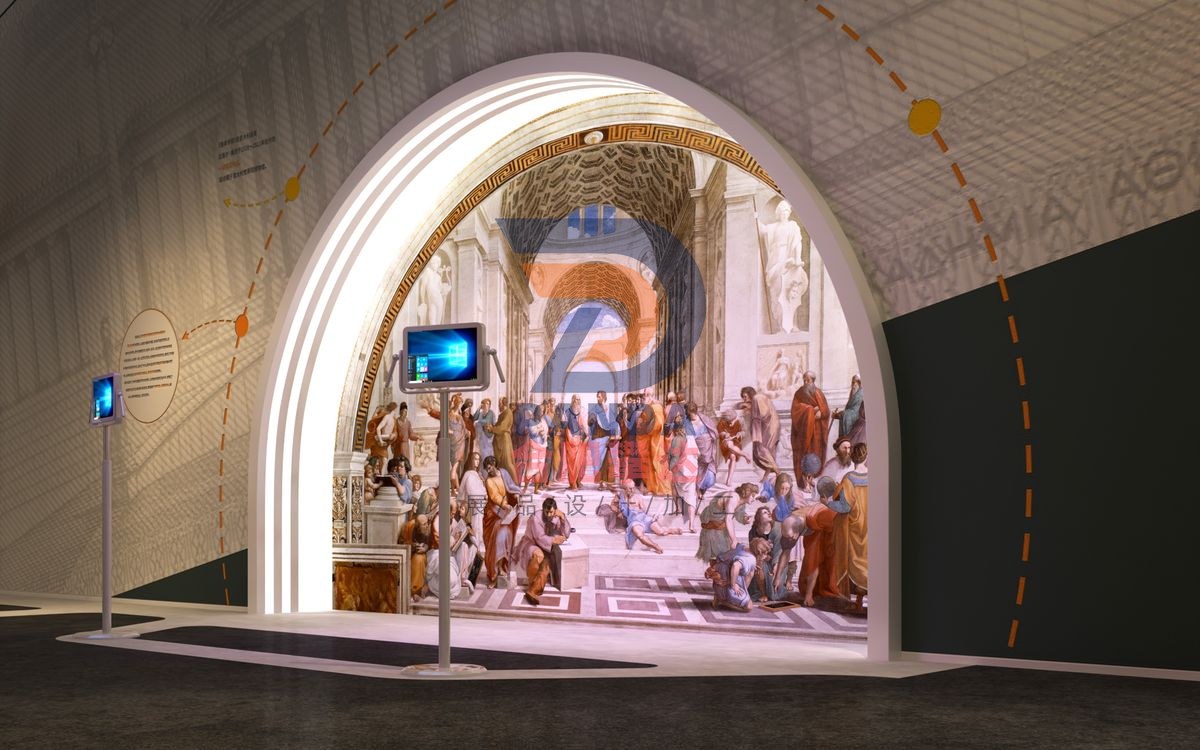
Academy of Athens
Smart Technology · Interactive
- DimensionsSubject to on-site plan
- PresentationInteractive
- PricingQuoted by manufacture spec
Purpose & Scientific Principle
For the first time in human history, the Greeks formed a unique rational view of nature. The exhibition uses Raphael's famous painting "The School of Athens" as the design entry point, aiming to interpret the humanistic spirit and philosophical speculation of the most representative scientific sages in ancient Greece and Rome that transcended the shackles of the times, and lead the audience to trace the source of the modern scientific spirit.
How to Operate
"School of Athens" and the characters in the painting: Raphael's fresco "School of Athens", now in the Vatican Museum.
Figures in the painting include (1) Zeno of Didion: the old man to the left of Epicurus. (2) Epicurus: Those who wear leaf crowns advocate that "human happiness is the pursuit of eternal happiness in the soul." (3) Democritus. (4) Averroes: Behind Pythagoras, the old man with a white turban on his head stretches his head and looks to the left. (5) Mathematician Pythagoras: The old man who wrote on the thick book was also the inventor of the "Pythagoras Theorem". (6) Alexander the Great: King of Macedonia in Greece. (7) Antisthenes: founder of the Cynic school. (8) Hypatia: A well-known ancient Greek female mathematician. (9) Xenophon: Military and literary historian Xenophon. (10) Parmenides (11) Philosopher Socrates (12) Heraclitus: A representative figure who holds the theory of flux. His face was painted by Raphael with the face of another great painter-Michelangelo. (13) Philosopher Plato: Holding "Timaeus" in hand, pointing to the sky with his finger. Raphael painted this figure based on Leonardo da Vinci. (14) Philosopher Aristotle: holding "Nicomachean Ethics" in hand. (15) Diogenes: Ancient Greek Cynic scholar. (16) Zeno: A famous Stoic philosopher. (17) Archimedes: The lower right figure is hunched over, holding a compass in his hand to measure a geometric figure. (18) Zoroaster: The one holding an astronomical instrument. (19) Astronomer Ptolemy (20) Duke of Urbino: The boy in white next to Raphael in the lower right corner is the Duke of Urbino, the nephew of the pope at that time and a famous art lover. (R) Raphael; the man in black and hat in the lower right corner is the author of the mural, symbolizing that art has entered the palace of the wise.
The unique rational view of nature in ancient Greece: The Greeks first viewed nature as a whole as something independent of humans; secondly, they viewed nature as an object with inherent laws that could be grasped by humans; thirdly, they developed complex and sophisticated mathematical tools to grasp the laws of nature. In these three aspects, the Greeks pioneered the scientific spirit. The ancient Greek philosophers in the painting "School of Athens" had some essential thoughts on the origin of all things. For example, Thales, the father of ancient Greek philosophy, proposed that the origin of all things is water, Heraclitus proposed that the origin of all things is fire, Pythagoras believed that the origin of the world is number, and Democritus proposed that the world is composed of atoms. The thoughts of these sages made people at that time gradually doubt "creationism" and think about the composition and operation of the world in a more rational way.
Ancient Greek and Roman science and technology refers to the science and technology of the ancient Greek and Roman periods. Its achievements reached the peak of the development of science and technology in slave society and were the basis for the emergence of modern Western science and technology. Its scientific ideas and scientific methods also had a certain impact on the development of modern Western science and technology.
Related Exhibits






Need a quote for this piece or a full exhibit configuration? Tell us your venue area, theme direction, and budget range.