
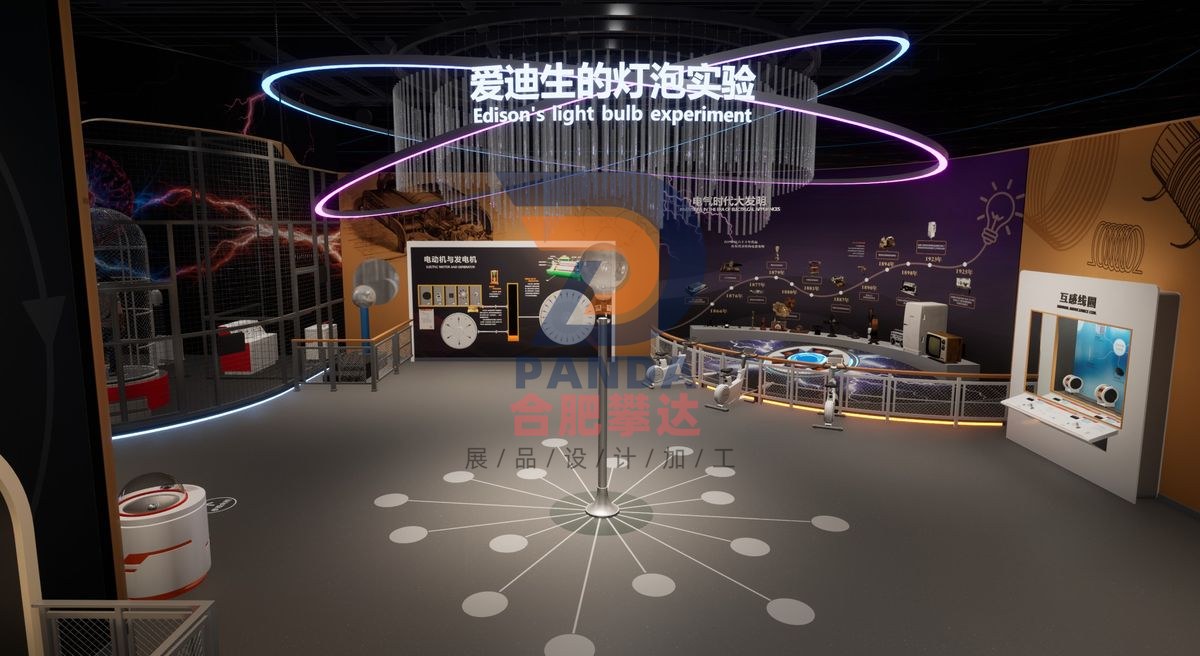
Edison's light bulb experiment
Electromagnetism · Interactive
- DimensionsSubject to on-site plan
- PresentationInteractive
- PricingQuoted by manufacture spec
Purpose & Scientific Principle
The exhibition item uses the story of Edison's improved electric light as the starting point, simulating the setting up of multiple groups of light bulbs made of filaments of different materials, and adjusting different voltages and times for lighting tests in groups, simulating which light bulb has the longest lifespan, and allowing the audience to intuitively feel the significance of the light bulb experiment through model display.
How to Operate
The invention of the electric light:
In 1854, the American scientist Goebbels placed a carbonized bamboo filament in a vacuum glass bottle and energized it to emit light. At that time, the experimental light bulb could last for 400 hours. This was the first real light bulb in history, but Goebbels did not apply for a patent.
In 1874, two Canadian electricians filled a glass bubble with nitrogen and used an electrified carbon rod to emit light, which was equivalent to further improving Goebbels' technology. In 1878, the Englishman Wilson also completed the "light bulb powered by carbon filaments under vacuum" and immediately applied for a patent.
This was the initial discovery and invention of the electric light. After the invention of the electric light, many scientists tried to mass-produce light bulbs, but they were unable to do so due to short lighting time, instability, pungent odor, noise, and high price.
When Edison improved the electric light, he first had to solve the problem of the filament burning time being too short. He thought of a way to extract the air from the bulb. Without oxygen, the filament did not burn out. However, this method failed to extend the life of the bulb too much. Within a few minutes, the filament still broke. Since the filament is easy to break, of course you must choose a material with good heat resistance. Edison initially focused on platinum, but this expensive metal still disappointed him. Although the lighting time of the electric lamp was extended to two hours, the light was very unstable.
Edison then tried all kinds of rare metals. He tried a total of 1,600 materials, but their effects were not as good as platinum. If platinum is used as the filament, the price of the light bulb will definitely not be cheap, and ordinary people will definitely not be able to afford it. This was far from Edison's goal of inventing a cheap and durable light bulb, but because of the lack of suitable materials, Edison's invention entered a bottleneck period.
Edison experienced no less than 7,000 failures. On October 21, 1879, while he was meditating by the fire, he touched the scarf around his neck. An idea flashed in his mind, why not try cotton yarn? Edison pulled a fiber from the scarf, roasted it in the fire, and put the charred cotton yarn into the light bulb. Edison was overjoyed by the test results. The humble cotton yarn actually made the light bulb light up for 13 hours. Not long after, Edison made a slight improvement and used carbonized cotton filament to make a filament, which allowed the light bulb to light up for 45 hours. This was the first practical electric light in the world. But he was still not satisfied and set his goal to create a light bulb that could last for 1,000 hours.
In 1880, Edison discovered that carbonized bamboo fiber could keep a light bulb on for 1,200 hours. He then sent assistants and experts to search for suitable bamboos around the world, and found the most durable Japanese bamboo among six thousand species of bamboo. This kind of lamp was called a "carbonized bamboo filament lamp." Eventually, this kind of light bulb was put into mass production and lit up thousands of households.
Edison invented the bamboo filament light bulb that lit up the earth for many years. It was not until 1906, when American Coolidge discovered that using tungsten filament as a filament could extend the life of the light bulb again, that tungsten filament light bulbs replaced bamboo filament light bulbs and are still in use today.
Multiple groups of light bulbs made of filaments of different materials are tested by adjusting different voltages and times to determine which bulb has the longest life.
Related Exhibits
Need a quote for this piece or a full exhibit configuration? Tell us your venue area, theme direction, and budget range.