
From technological revolution to rational enlightenment
Smart Technology · Interactive
- DimensionsSubject to on-site plan
- PresentationInteractive
- PricingQuoted by manufacture spec
Purpose & Scientific Principle
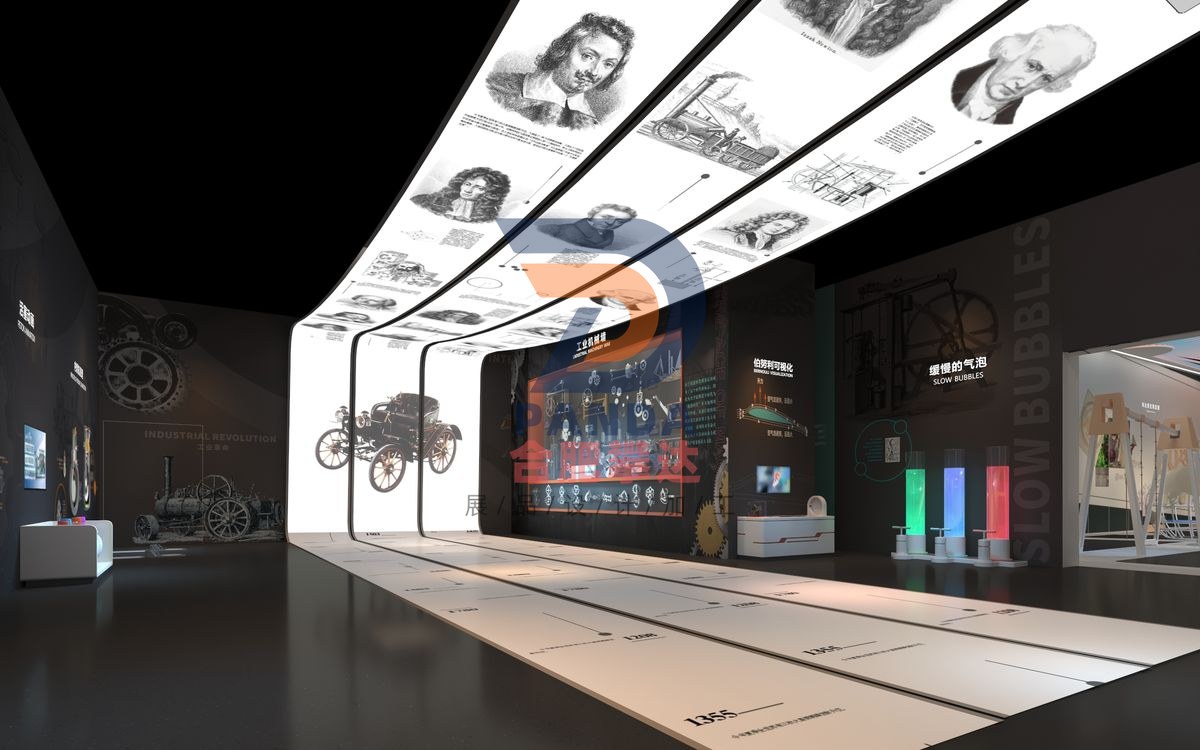
The exhibits are mainly composed of projection screens and projectors, hanging in the middle of the exhibition hall. Through multimedia, they display the works of scientists in the steam age and the scientific stories, scientific spirit and scientific quality behind them. The audience is guided to stop and think about the innovative spirit of climbing to new heights in science and daring to be the first, and the pragmatic spirit of pursuing truth and rigorous scholarship.
How to Operate
Main scientists:
Torricelli: Torricelli was an Italian physicist and mathematician. As Galileo's student and assistant in his later years, he succeeded Galileo as professor of mathematics at the Academy of Florence in 1642. His first achievement was the invention of the mercury barometer, which confirmed the weight of air and the existence of vacuum; he proposed the Toryset ratio through experiments, laying the foundation for fluid mechanics.
Pascal: Pascal was a French mathematician and physicist. He discovered the famous Pascal's hexagonal theorem when he was 16 years old. In 1653, he proposed Pascal's theorem to prove that fluid can transmit pressure, and used this principle to make a hydraulic press. In order to commemorate Pascal, later generations named the unit of pressure after him.
Watt: Watt has a delicate mind and rich imagination. The phenomena that can be seen at any time in daily life will arouse Watt's curiosity and desire to explore, allowing Watt to draw new discoveries and ideas from the subtle things in life, and have the spirit of perseverance to explore the unknown.
Lavoisier: Lavoisier is revered as the "Father of Modern Chemistry". He dared to break through the inherent cognition of the scientific community in the social context of the time. In the troubled times of France, he bravely insisted on scientific truth, even if he ultimately paid for it with his life. In the French social environment at that time, it was believed that "scholars are the public enemies of the people, and societies are anti-people groups." In this case, Lavoisier behaved bravely. He still abides by his duties as an academician of science and a fellow of the Society of Weights and Measures. Not only did he devote himself to his personal research work, but also traveled around to raise funds for the two societies. He also sometimes donated his personal property to fund the research of his colleagues. His determination and courage made him the pillar and protector of French science.
Other scientists: Glick, Boyle, Hargreaves, Thomas Newcomen, Stephenson.
The exhibits are mainly composed of projection screens and projectors, hanging in the middle of the exhibition hall. Through multimedia, they display the works of scientists in the steam age and the scientific stories, scientific spirit and scientific quality behind them. The audience is guided to stop and think about the innovative spirit of climbing to new heights in science and daring to be the first, and the pragmatic spirit of pursuing truth and rigorous scholarship.
Related Exhibits





Need a quote for this piece or a full exhibit configuration? Tell us your venue area, theme direction, and budget range.