

Newton's first law of motion
Mechanics in Motion · Interactive
- DimensionsSubject to on-site plan
- PresentationInteractive
- PricingQuoted by manufacture spec
Purpose & Scientific Principle
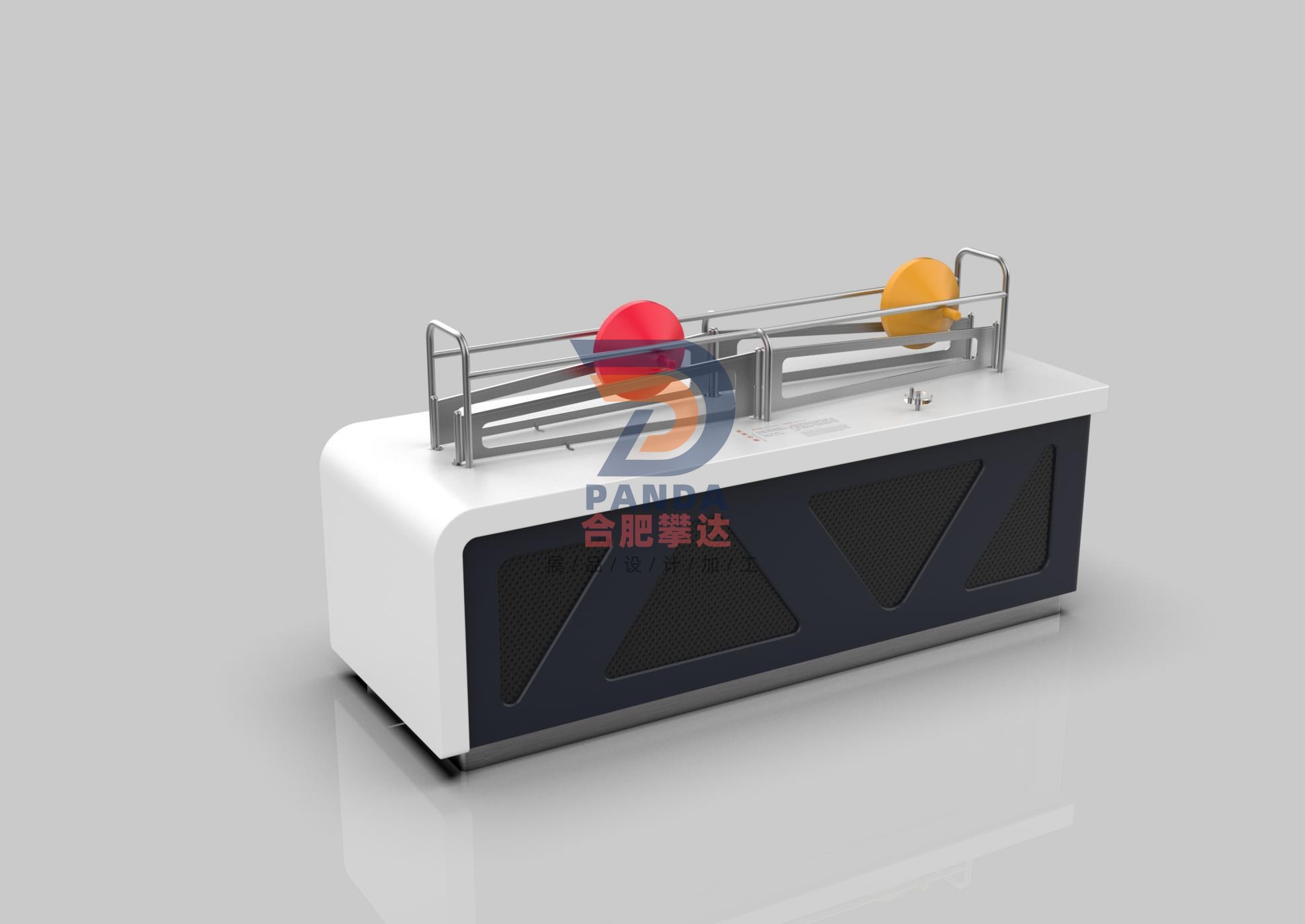
Visually demonstrates Newton's first law of motion through the ball ejection mechanism.
How to Operate
On the basis of Galileo's discovery of inertia (force is the reason for changing the state of motion of an object) in Galileo's inclined plane experiment, after careful study and summary, he felt that if an object is not subject to force, it will remain at rest. This includes all objects in the world (either moving or not), and thus came to Newton's first law (i.e., the law of inertia): All objects will always remain at rest or in a state of uniform linear motion when not acted upon by a force, that is, an isolated particle remains at rest or moves in a uniform linear motion. Its mathematical expression:
Newton's first law and Newton's second and third laws constitute the complete system of Newtonian mechanics. Newton's first law gives the concept of an inertial system. The second and third laws and the particle mechanics system established by Newton's laws of motion only hold true for inertial systems. Therefore, Newton's first law is indispensable and is a completely independent and important law of mechanics. Newton discovered inertia (force is the reason for changing the state of motion of an object) in Galileo's inclined plane experiment. After careful study and summary, he felt that if an object is not subject to force, it will remain at rest. This includes all objects in the world (either moving or not), and thus came to Newton's first law (i.e., the law of inertia): All objects always remain at rest or in a state of uniform linear motion when not acted upon by a force, that is: an isolated particle remains at rest or moves in a uniform linear motion. Its mathematical expression:
Newton's first law and Newton's second and third laws constitute the complete system of Newtonian mechanics. Newton's first law gives the concept of an inertial system. The second and third laws and the particle mechanics system established by Newton's laws of motion only hold true for inertial systems. Therefore, Newton's first law is indispensable and is a completely independent and important law of mechanics.
Newton's first law gives the concept of an inertial system. The second and third laws and the particle mechanics system established by Newton's laws of motion only hold true for inertial systems. Therefore, Newton's first law is indispensable and is a completely independent and important law of mechanics. On the basis of Galileo's discovery of inertia (force is the reason for changing the state of motion of an object) in Galileo's inclined plane experiment, after careful study and summary, Newton felt that if an object is not acted upon by a force, it will also remain at rest. This includes all objects in the world (either moving or not), and thus came to Newton's first law (i.e., the law of inertia): All objects always remain at rest or in a state of uniform linear motion when not acted upon by a force, that is, an isolated particle remains at rest or moves in a uniform linear motion.
Related Exhibits




Need a quote for this piece or a full exhibit configuration? Tell us your venue area, theme direction, and budget range.