
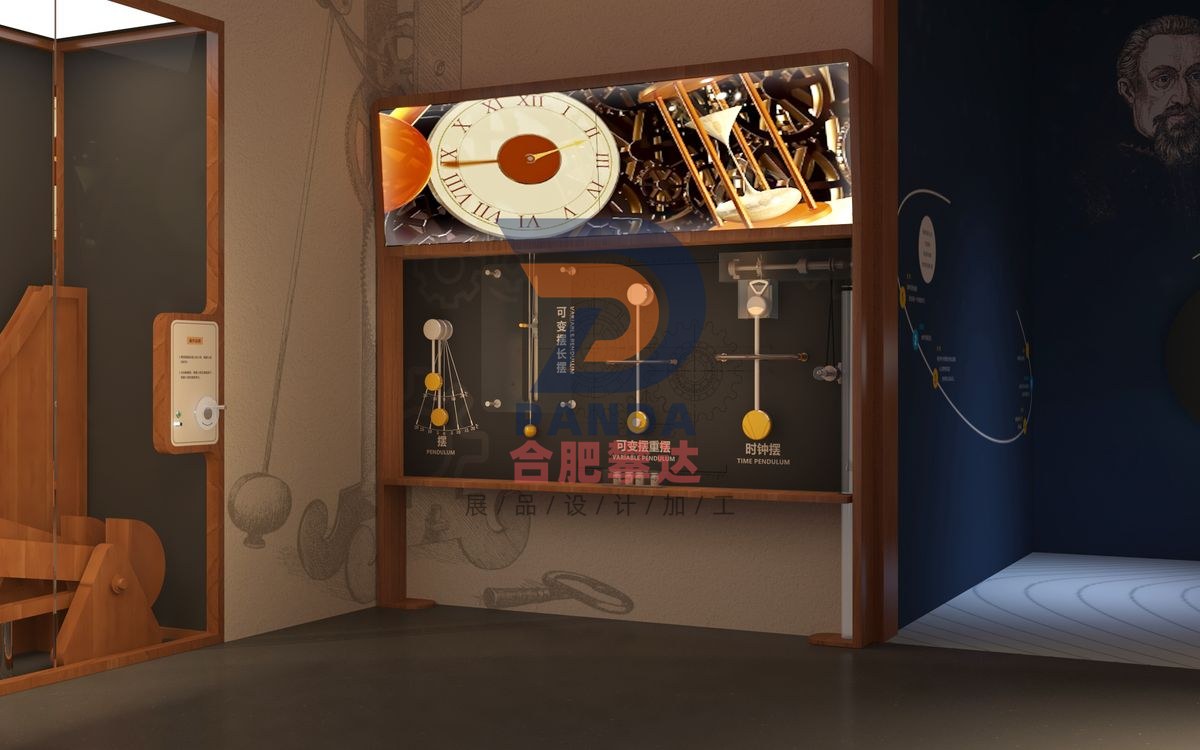
Galileo's clock pendulum
Mechanics in Motion · Interactive
- DimensionsSubject to on-site plan
- PresentationInteractive
- PricingQuoted by manufacture spec
Purpose & Scientific Principle
The law of isochrony of a simple pendulum is the first dynamic law discovered by mankind. The exhibition item aims to verify Galileo's isochronic law of the simple pendulum through simulation experiments.
How to Operate
In 1595, Galileo Galilei discovered a pattern of object swings from the back and forth swing of the chandelier in the Pisa church. He discovered that when a long rope hangs a heavy object and swings freely at a small angle, the period (the time it takes to swing once) has nothing to do with the amplitude of the swing or the mass of the object, and is inversely proportional to the square root of the length of the pendulum. The greater the gravity, the faster the swing. A swing system that obeys this law is called a "simple pendulum." His son Vincenzo drew a clock based on Galileo's theories, but the clock was never built.
Galileo discovered a pattern of swinging objects from the back and forth swing of a chandelier in a Pisa church. He discovered that when a long rope hangs a heavy object and swings freely at a small angle, the period (the time it takes to swing once) has nothing to do with the amplitude of the swing or the mass of the object, and is inversely proportional to the square root of the length of the pendulum. The greater the gravity, the faster the swing. A swing system that obeys this law is called a "simple pendulum."
Related Exhibits





Need a quote for this piece or a full exhibit configuration? Tell us your venue area, theme direction, and budget range.