
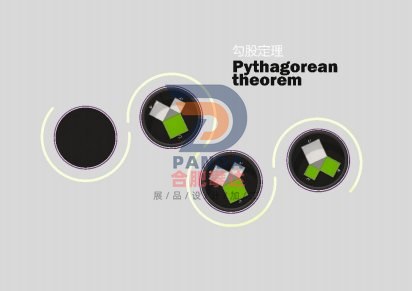
Intuitive Demonstration of the Pythagorean Theorem
Mathematics · Interactive
- Dimensions⌀0.45 (one of three)
- PresentationInteractive
- PricingQuoted by manufacture spec
Purpose & Scientific Principle
The exhibits consist of three sets of devices: right-angled triangle, obtuse-angled triangle and acute-angled triangle. Each device has a rotatable disk with a square in the center composed of three sides of a triangle. Rotate the disk and observe how the liquid fills the three squares. You can visually see the relationship between the three sides of the triangle. Why does the liquid in only the two small squares of the right triangle just fill the large square? Among the three squares formed by the three sides of a right triangle, according to the Pythagorean theorem, the sum of the areas of the squares formed by the two right-angled sides is exactly equal to the area of the square formed by the hypotenuse. So when you turn the disk, you can see that the liquid in the two small squares just fills the large square. According to this method, you can analyze the three-side relationship between acute triangles and obtuse triangles. The Pythagorean Theorem is widely used in engineering, such as building houses, repairing wells, building cars, etc.
How to Operate
Rotate the disk and observe the filling situation of the liquid in the three squares. You can visually see the relationship between the three sides of the triangle.
Related Exhibits





Need a quote for this piece or a full exhibit configuration? Tell us your venue area, theme direction, and budget range.