
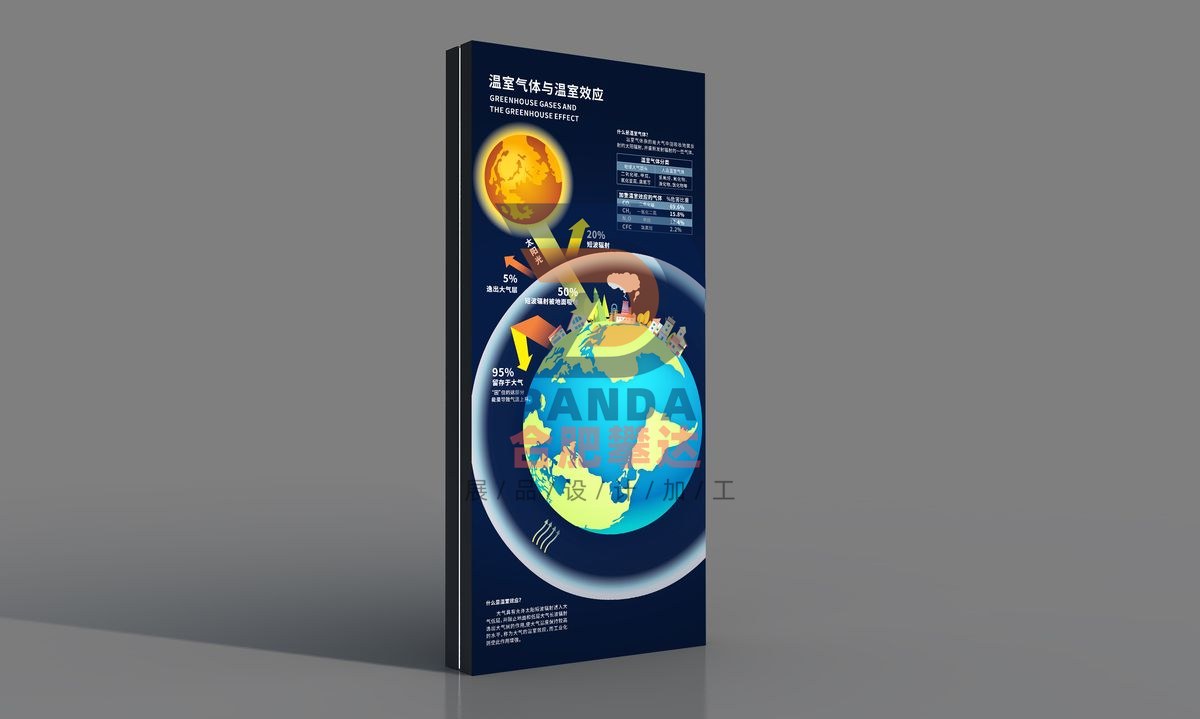
Greenhouse Gases and Greenhouse Effect
Earth & Planet · Interactive
- DimensionsSubject to on-site plan
- PresentationInteractive
- PricingQuoted by manufacture spec
Purpose & Scientific Principle
Through artistic light boxes and static displays of pictures and texts, important basic concepts related to carbon emissions were explained to the audience.
How to Operate
The global atmosphere and surface system is like a huge "glass greenhouse", which keeps the surface at a certain temperature and creates an environment suitable for the survival of humans and other organisms. In this system, the atmosphere not only allows solar radiation to pass through and reach the ground, but also prevents ground radiation from dissipating. This protective effect of the atmosphere on the ground is called the atmospheric greenhouse effect. The gases that cause the greenhouse effect are called "greenhouse gases". They allow short-wave radiation from the sun to pass freely, while strongly absorbing long-wave radiation emitted by the ground and the air. These gases include carbon dioxide, methane, nitrous oxide, hydrofluorocarbons, perfluorocarbons, and sulfur hexafluoride.
Carbon dioxide (CO₂), nitrous oxide (N₂O), methane (CH₄), perfluorocarbons, hydrofluorocarbons and sulfur hexafluoride are the six greenhouse gases controlled by the Kyoto Protocol.
CO2: Enters the atmosphere through the burning of fossil fuels (coal, natural gas, and oil), solid waste, trees, and other biological materials, and through certain chemical reactions (for example, making cement).
CH4: Methane is emitted during the production and transportation of coal, natural gas and oil. Methane emissions also come from livestock and other agricultural practices, land use, and the decay of organic waste in municipal solid waste landfills.
N2O: Nitrous oxide is emitted during agriculture, land use, industrial activities, the combustion of fossil fuels and solid waste, and wastewater treatment.
Fluorinated gases: Hydrofluorocarbons (HFCs), perfluorocarbons (PFCs), and sulfur hexafluoride (SF6) are synthetic, potent greenhouse gases emitted in various industrial processes.
Proportion of greenhouse gas emissions from human activities: (surface buildings and text data)
1) Production and manufacturing (cement, steel, plastics): 31%;
2) Electricity production and storage (electricity): 27%;
3) Planting and breeding (plants, animals): 19%;
4) Transportation (airplanes, trucks, cargo ships): 16%;
5) Heating and cooling: 7%;
The exhibits are in the form of artistic light boxes to interpret knowledge points about greenhouse gases and the greenhouse effect. It is adjacent to the main exhibition item of "Watching the Earth" and echoes the theme of the exhibition area - "Revealing the role of carbon in the evolution of the earth and the evolution of life, and showing the destiny choices of mankind behind the "double carbon" goal." Guide the audience to think deeply about the scientific connotation and strategic value of "carbon peaking and carbon neutrality".
Related Exhibits



Need a quote for this piece or a full exhibit configuration? Tell us your venue area, theme direction, and budget range.