
Human Crisis
Earth & Planet · Interactive
- DimensionsSubject to on-site plan
- PresentationInteractive
- PricingQuoted by manufacture spec
Purpose & Scientific Principle
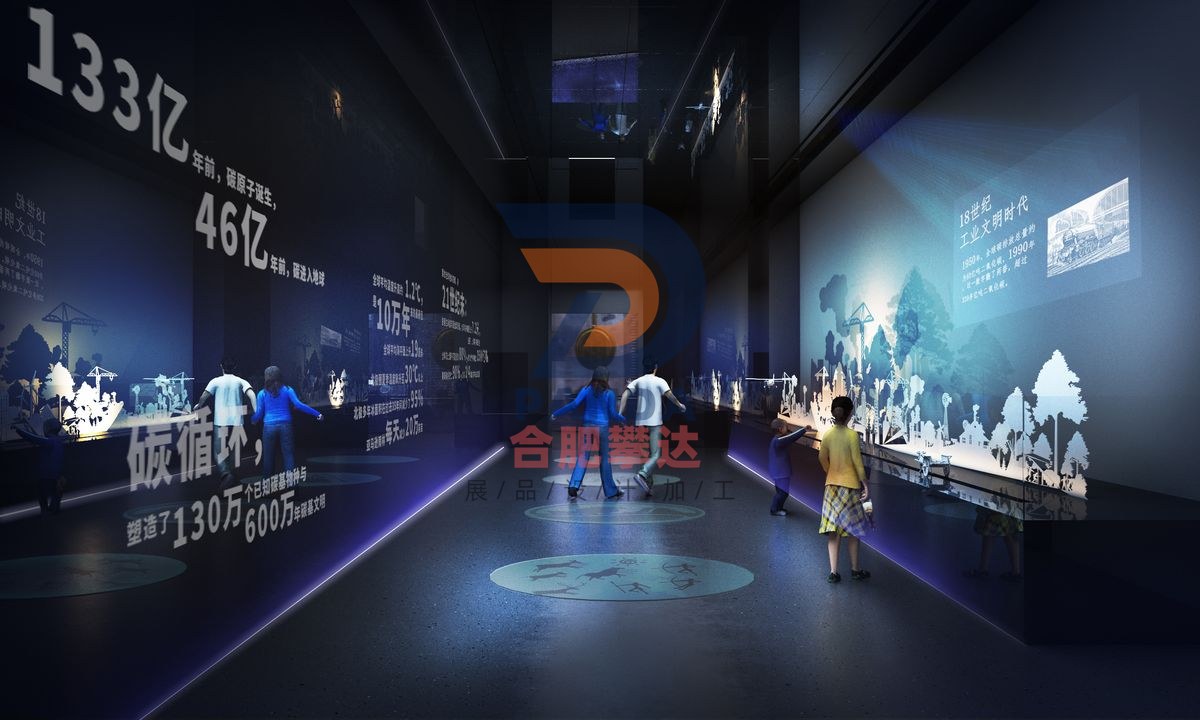
Through projection and light and shadow interaction, it shows the audience the changes in carbon emissions caused by human activities in the four eras, warning of the serious consequences of excessive emissions. It tells the story of the carbon imbalance that humans face between development and nature. At the same time, it creates a sense of crisis and urgency before entering the exhibition hall.
How to Operate
Carbon is one of the earliest elements utilized by humans. The utilization of carbon has brought humans into the civilized era. But human civilization has in turn become a new element of the earth's carbon cycle, changing the closed-loop path of the earth's carbon cycle.
Humans in the primitive civilization era were still members of the biosphere. Limited by the number of humans and the scale of fire use, the extra carbon dioxide emitted was quickly adjusted by the earth's carbon cycle. Men hunted and fished, while women gathered wild vegetables and dug roots. Until people discovered fire and cooked the food for fishing and hunting, the fuels used by humans were mainly wood, branches, etc. The carbon dioxide produced was converted into organic matter through the photosynthesis of marine and land plants. Human activities have left almost no trace of carbon emissions in nature.
After entering the era of agricultural civilization, the development of farming technology, the increase in population, and the use of firewood on the one hand caused the carbon that should have remained in the biosphere for hundreds of years to terminate the cycle in advance and be discharged into the atmosphere; on the other hand, the population increased. In order to solve the problem of food and clothing, humans have large-scale deforestation and land reclamation to increase farmland area. Cutting down trees and burning forests have resulted in the reduction of forest area. Land use changes have brought about carbon emissions, weakening the carbon storage capacity of forest carbon banks. Together with a small amount of carbon emissions from coal burning, they form the carbon emissions imprint of agricultural civilization. As a result, since 7,000 years ago, the concentration of carbon dioxide in the atmosphere began to rise, but the rate was very slow and did not completely change the earth's carbon cycle.
Since mankind entered the era of industrial civilization in the 18th century, mechanized mass production has dominated. The extensive use of fossil energy has accelerated the release of organic carbon in deep strata, and a large amount of carbon dioxide has entered the earth system. However, forests can only absorb about 30% of the carbon dioxide emitted by humans, and the ocean can only absorb about 30% of carbon dioxide. The remaining 40% of carbon dioxide enters the atmosphere and does not participate in the carbon cycle in the short term. This is a major problem faced by this carbon cycle model, which has not successfully closed the loop. As a result, the carbon dioxide content in the atmosphere in 2015 increased by 42.9% compared with before the industrial revolution (1760), and it will increase by 5.4 percentage points in 2021 compared with 2015.
In the period of ecological civilization, low-carbon energy is used on a large scale, the carbon sink capacity of the ecosystem is continuously improved, carbon supplementary utilization and storage technology is applied on a large scale, and the "carbon emission sources" and carbon absorption sinks of human activities reach a balance, achieving the goal of "carbon neutrality".
The exhibits extract representative buildings from the four stages of human civilization from an artistic perspective, and use light and shadow projection to interpret the production and life patterns of four different civilization eras: primitive civilization, agricultural civilization, industrial civilization and ecological civilization.
The exhibits allow young people to feel the charm of light, shadow and projection artistic expressions. At the same time, combined with changes in carbon emissions in the four stages of civilization, they show the relationship between people and carbon and help them understand the form of natural ecological protection work and its ecological significance.
Related Exhibits





Need a quote for this piece or a full exhibit configuration? Tell us your venue area, theme direction, and budget range.