
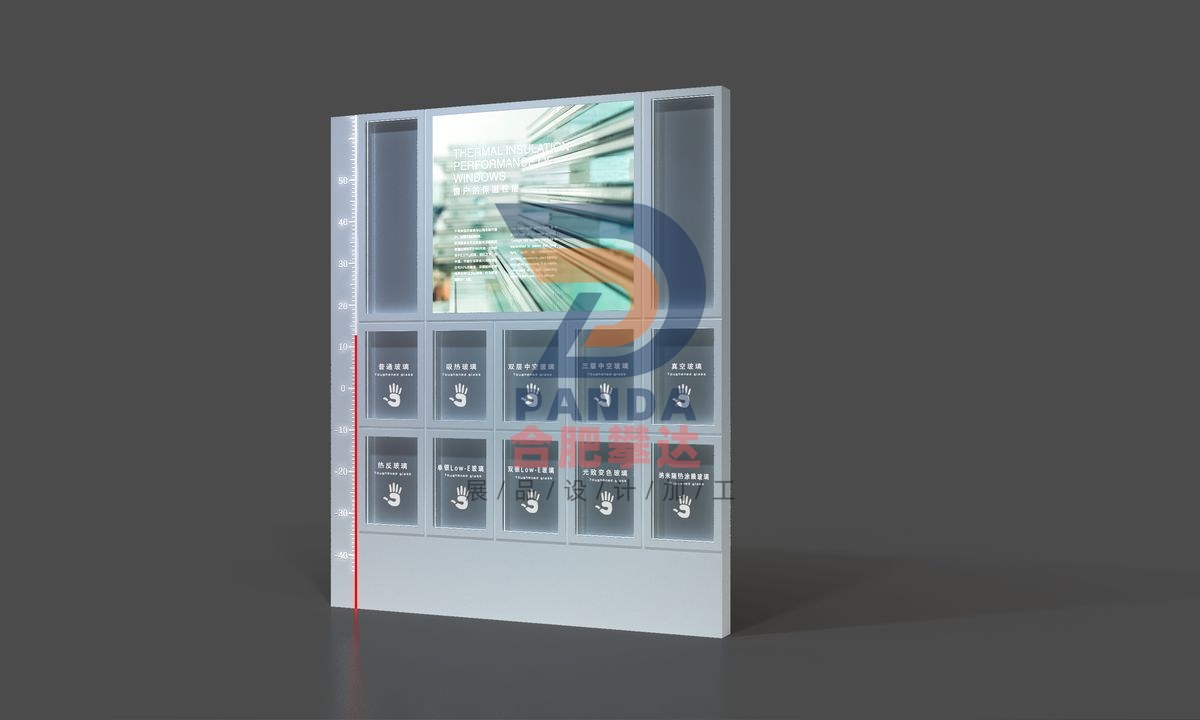
Thermal insulation properties of windows
Earth & Planet · Interactive
- DimensionsSubject to on-site plan
- PresentationInteractive
- PricingQuoted by manufacture spec
Purpose & Scientific Principle
Through comparative testing of thermal insulation of various types of glass on windows, the public can understand the thermal insulation performance of different building glasses.
How to Operate
Passive energy losses make windows one of the major factors affecting building heating and cooling costs. Different types of glass are used to make windows, with different properties and different energy-saving effects. Through the following 10 types of glass thermal insulation comparison tests, observe the thermal insulation effects of different glasses.
Ordinary glass
Ordinary glass is untinted and uncoated. It is generally colorless, transparent or slightly light green. It has certain properties such as light transmission, heat insulation, sound insulation, and wear resistance, but its thermal insulation properties are relatively average.
heat absorbing glass
Heat-absorbing glass, also known as colored glass, refers to glass that appears in different colors after adding colored art glass colorants. Colored glass can absorb visible light from the sun and weaken the intensity of sunlight. Different colors and thicknesses of colored glass have different degrees of absorption of solar radiation heat. When glass absorbs sunlight, its temperature increases and it is prone to thermal expansion and cracking.
Insulated glass
Insulating glass is double-layer insulating glass. A layer of air or other gases with low thermal conductivity is sandwiched between two layers of glass to form a layer of thermal insulation. Commonly used gases include krypton, neon, helium, etc., and their thermal conductivity is smaller than air. The two layers of insulating glass can be ordinary glass, tempered glass, laminated glass, etc.; the triple layer of insulating glass consists of two layers of air or other gases with low thermal conductivity sandwiched between the three layers of glass to form two layers of insulation, which can more effectively reduce heat transfer. Triple-layer insulated glass usually has a low-emissivity film in the middle layer.
vacuum glass
Vacuum glass is developed based on the principle of a thermos flask. Its structure is similar to that of vacuum glass. The difference is that the gas in the vacuum glass cavity is very thin, almost close to vacuum. Generally, at least one piece is a transparent low-emissivity coated glass, and its thermal insulation performance is much better than the insulating glass that is currently widely used. In addition to thermal insulation, it also has the characteristics of sound insulation and noise reduction, anti-condensation, and improved comfort.
coated glass
Coated glass, also known as reflective glass, is one or more layers of metal, alloy or metal compound films coated on the surface of the glass to change the optical properties of the glass and meet certain specific requirements. Coated glass can be divided into the following categories according to the different characteristics of the product: heat reflective glass, low-emissivity glass (Low-E), conductive film glass, etc.
heat reflective glass
Heat reflective glass scale Sunlight control coated glass is a kind of coated glass that reflects sunlight. Its film color makes the glass appear rich in color, and it also has the function of one-way transmission, that is, outdoor scenes can be seen indoors during the day, but indoor scenes cannot be seen outdoors. Its energy-saving principle is to produce a certain control effect on sunlight with a wavelength range of 350 to 1800 nm through coating, and control the reflection, transmission and absorption of direct sunlight according to the required ratio.
Low-e glass, also known as Low-E glass, is an upstart in coated glass. Low-E insulating glass has a transmittance of more than 60% for solar radiation of 0.3-2.5um. During the day, most of the radiant energy from the outdoors can be transmitted. However, at night and in rainy weather, more than 50% of the thermal radiation from indoor objects is reflected back indoors, which has the function of controlling the unidirectional flow of thermal energy to the outdoors. In addition, Low-E glass has a high transmittance of visible light in sunlight, up to more than 80%, creating a more transparent, clear, soft and comfortable light environment.
Single silver Low-E glass: usually only contains one functional layer (silver layer), plus other intermetallic compound layers, the total number of film layers reaches 5 layers.
Double silver Low-E glass: It has two functional layers (silver layers), plus other intermetallic compound layers, the total number of film layers reaches 9 layers.
photochromic glass
Photochromic glass is generally produced by introducing photosensitizers into ordinary glass components. Usually the photosensitizer is evenly dispersed in the glass in a microcrystalline state and decomposes under sunlight, reducing the transmittance of the glass. The decorative characteristic of photochromic glass is that the color and transmittance of the glass automatically change with the intensity of sunlight. When the intensity of sunlight is high, the color of the glass is dark and the light transmittance is low; conversely, when the intensity of sunlight is low, the color of the glass is light and the light transmittance is high.
Nano thermal insulation coated glass
It uses a shower coating or roller coating process to coat a layer of nano-insulating material on the glass surface. The infrared blocking rate is as high as over 95%, and it has obvious sun protection and heat insulation effects. It can reduce the energy consumption of air conditioning, heating and indoor lighting, lower the indoor temperature, and the temperature difference on the surface of the sun-exposed object can reach 6-15C.
The exhibit is set up with 10 independent closed squares. Different glasses are placed in front of each square. 10 sets of heating devices with the same power are placed inside the squares. The heating devices are turned on at the same time for the same heating time. The audience can touch the temperature of the outer surface of the glass with their hands and feel the temperature changes of different glasses.
Related Exhibits
Need a quote for this piece or a full exhibit configuration? Tell us your venue area, theme direction, and budget range.