
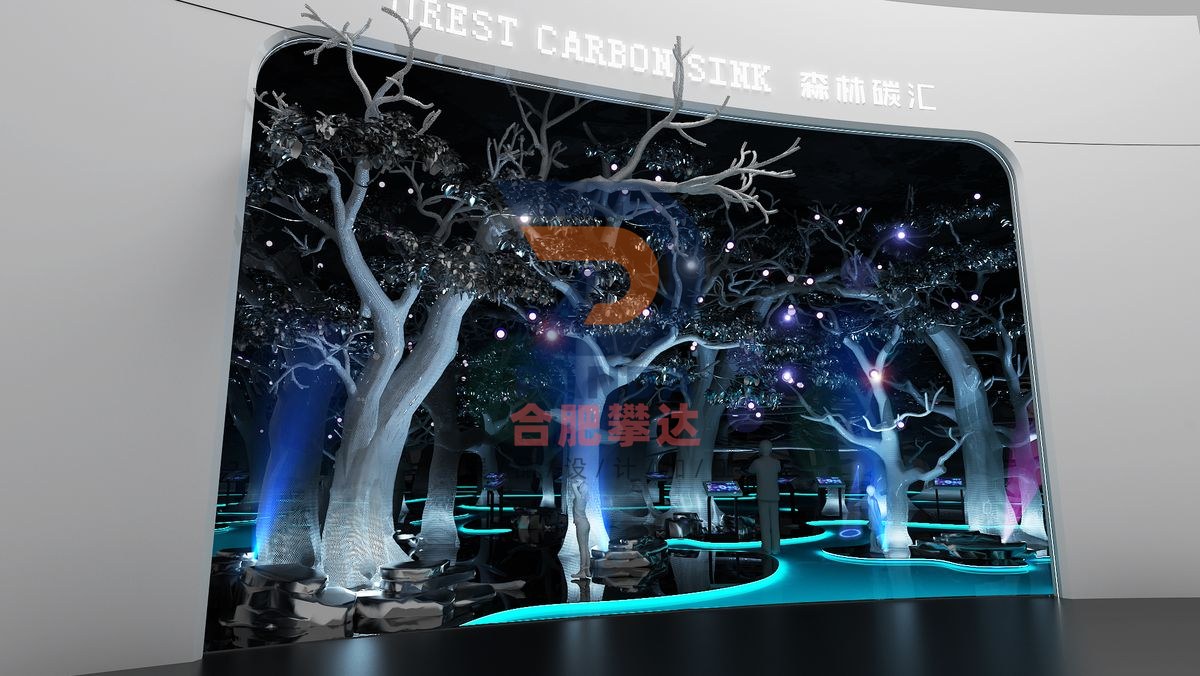
Forest Carbon Sinks
Earth & Planet · Interactive
- DimensionsSubject to on-site plan
- PresentationInteractive
- PricingQuoted by manufacture spec
Purpose & Scientific Principle
The exhibits create a forest ecological artistic conception by creating a walk-in art space, and let the public understand the role of forest carbon sinks through interaction with the installation.
How to Operate
Forest carbon sink refers to the process, activity or mechanism by which forest ecosystems absorb and store carbon dioxide in the atmosphere.
Forestry carbon sink refers to the process, activity or mechanism that utilizes the carbon storage function of forests to absorb and fix carbon dioxide in the atmosphere through activities such as afforestation, strengthening forest management, reducing deforestation, protecting and restoring forest vegetation, and combining it with carbon sink trading in accordance with relevant rules.
Forests account for about 31% of the land area, and the carbon storage in their vegetation areas accounts for more than 50% of the total terrestrial carbon pool.
Forest plants capture carbon dioxide in the air through photosynthesis and fix the carbon in plants or soil. This process is the forest carbon sink. According to the website of the United Nations Environment Program, an ordinary tree can absorb 12 kilograms of carbon dioxide a year. On average, each tree planted for 40 years can reduce more than 400 kilograms of carbon dioxide for the earth. Research shows that for every cubic meter of wood grown in a forest, it can absorb about 1.83 tons of carbon dioxide and release 1.62 tons of oxygen.
The 2020 "Global Forest Resources Assessment Report" of the Food and Agriculture Organization of the United Nations pointed out that the total carbon reserves of global forests reached 662 billion tons of carbon, which are mainly stored in forest biomass (about 44%), forest soil (about 45%), litter (about 6%) and dead wood (about 4%) carbon pools.
Global warming may turn natural "carbon sinks" into "carbon sources"
Forest ecosystems are one of the Earth's most important carbon sinks, but new research shows that with rapid global warming, these natural "carbon sinks" may be converted into "carbon sources" in just a few decades. According to the current trend of greenhouse gas emissions, tropical forests, which store the most carbon dioxide, may lose nearly 45% or more of their carbon sink capacity by the middle of the 21st century. By the end of this century, half of the plants in the earth's terrestrial ecosystems may release carbon into the atmosphere faster than they absorb carbon!
The exhibits allow the audience to deeply feel and understand the ecological role and value of the forest through the artistic forest area.
Related Exhibits






Need a quote for this piece or a full exhibit configuration? Tell us your venue area, theme direction, and budget range.