
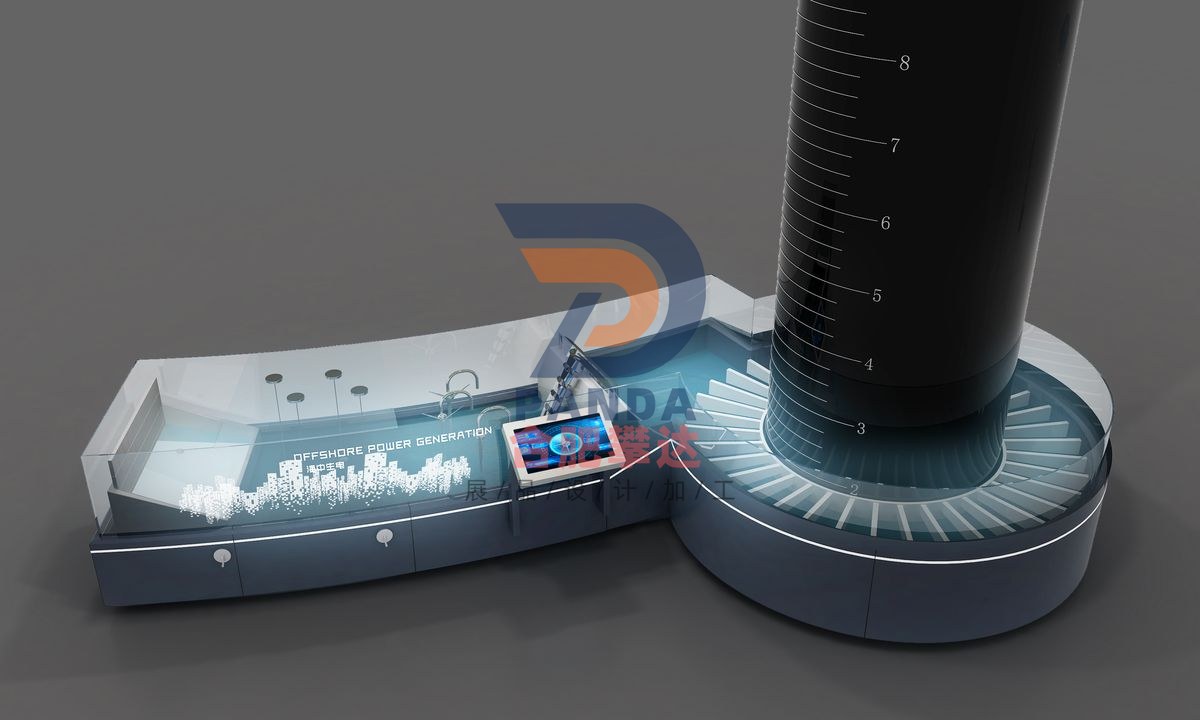
Generating electricity in the sea
Earth & Planet · Interactive
- DimensionsSubject to on-site plan
- PresentationInteractive
- PricingQuoted by manufacture spec
Purpose & Scientific Principle
The exhibits integrate various power generation device models into a comprehensive operating platform, allowing the public to experience various ways of using ocean energy to generate electricity.
How to Operate
With the rapid growth of global energy consumption, energy security issues and energy environment issues have increasingly become issues of great concern to all walks of life domestically and to the international community. Scientists from all over the world are working hard to research, develop and utilize new energy sources. The ocean has attracted the attention of many scientists with its unique charm. First of all, ocean energy is not only diverse in form but also has huge reserves. It includes tidal energy, tidal energy, ocean current energy, wave energy, temperature difference energy, salinity difference energy, etc. The global reserve of ocean energy reaches 150 billion kilowatts, of which 7 billion kilowatts are easily utilized. Secondly, ocean energy is a renewable energy source. Ocean energy is produced under the influence of solar energy heating seawater, the gravitational pull of the sun and moon on seawater, and the earth's rotation force. Therefore, it is an inexhaustible and renewable energy source. Moreover, developing the ocean will not produce waste water or waste gas, nor will it occupy large tracts of fertile land, nor will there be any radiation pollution. Because of the importance of the ocean, ocean energy is called the green energy of the 21st century and is favored by many energy experts. Many countries have accelerated research on the development and utilization of ocean energy. At present, with the increasing level of human science and technology, it has become more and more feasible to obtain energy from the sea. The development and comprehensive utilization of ocean energy has achieved obvious benefits, its scale has continued to expand, and it has reached or is close to the commercial application stage. A new ocean energy industry is forming and emerging. Some experts predict that after 2020, global ocean energy utilization will be hundreds of times higher than today. Scientists believe that in the 21st century, mankind will enter a new era of developing ocean energy.
my country's coastline is long and contains a large amount of tidal and other marine energy resources. It is estimated that my country's developable tidal energy is 110 million kilowatts, tidal energy is 100 million kilowatts, ocean current energy is 30 million kilowatts, wave energy is 100 million kilowatts, temperature difference energy is 150 million kilowatts, and salinity difference energy is 110 million kilowatts. The coastal areas have a developed economy, accounting for only 14% of the country's area, 40% of the population, and more than 60% of the country's GDP. They have a large demand for energy. The current supply of thermal power and hydropower cannot meet the requirements, and the contradiction of energy shortage is very prominent. In particular, our country has more than 6,500 large and small islands, covering an area of 80,000 square kilometers and a population of more than 30 million. Most of the islands lack conventional energy sources, and laying submarine cables to transmit electricity from nearby mainland would require huge investments. But these islands have ocean energy sources such as waves, currents and tides that can be easily harnessed. The development of ocean energy can not only make up for the energy shortage in coastal areas, but also open up an effective way to solve energy problems for islands far away from the mainland. Moreover, compared with other conventional energy power generation, the development of marine renewable energy has little impact on the ecological environment and is very conducive to the protection of the marine ecological environment. It can also be combined with aquaculture, sun salt, seawater chemical resource extraction, transportation, tourism and other industries to achieve numerous benefits.
•Offshore wind power: As the name suggests, offshore wind power refers to wind turbines installed in the sea. It does not occupy land and has less impact on the environment.
The wind at sea is steady and the key to whether the wind turbine is running well is the size of the wind. The wind at sea is generally stronger than on land. The terrain on land is undulating, which has a great slowing effect on the wind speed on the ground. Therefore, onshore wind turbines are set up higher to take advantage of the relatively strong winds at high altitudes. However, due to terrain problems, the wind speeds at various heights on land vary greatly, which results in larger wind shear (changes in wind speed in the vertical direction), causing the upper and lower forces on the wind wheel to be unbalanced and the transmission system to be easily damaged. There is no such problem at sea. The sea level is generally very flat, the wind has basically no resistance, the average wind speed is high, and the wind shear is smaller than on land. In addition, the frequency of wind direction changes at sea is also lower than on land, so the wind energy at sea is very stable.
The wind turbine utilization rate is higher. The power generated by the wind turbine is proportional to the cube of the wind speed. Generally speaking, the wind speed at sea is higher than on land, so the annual power generation of offshore wind turbines is more for the same power generation capacity. If the annual power generation utilization hours of onshore wind turbines are 2,000 hours, then the annual power generation utilization hours of offshore wind turbines can reach more than 3,000 hours.
•Wave power generation: The principle is to convert wave energy into compressed air to drive a generator to generate electricity.
•Tidal power generation: The principle is similar to that of ordinary hydropower. By leaving the reservoir, seawater is stored in the reservoir during high tide and stored in the form of potential energy. Then, seawater is released during low tide, and the difference between high and low tide levels is used to push the turbine to rotate and drive the generator to generate electricity.
•Water storage and energy storage: Use the electric energy during low power load periods to pump water to the upper reservoir, and then release water to the lower reservoir to generate electricity during peak power load periods.
The exhibit extracts ocean and urban elements and designs a large interactive water table. The interactive water table represents the ocean. Through electromechanical interaction, the interactive water table is set up to represent the four methods of offshore energy generation. The interactive water table is equipped with a glass guardrail for safety protection, and a city silhouette is set on the glass guardrail. Through combined relay interaction, a marine energy generation operation is operated, and the city pattern is finally lit up.
Related Exhibits
Need a quote for this piece or a full exhibit configuration? Tell us your venue area, theme direction, and budget range.