
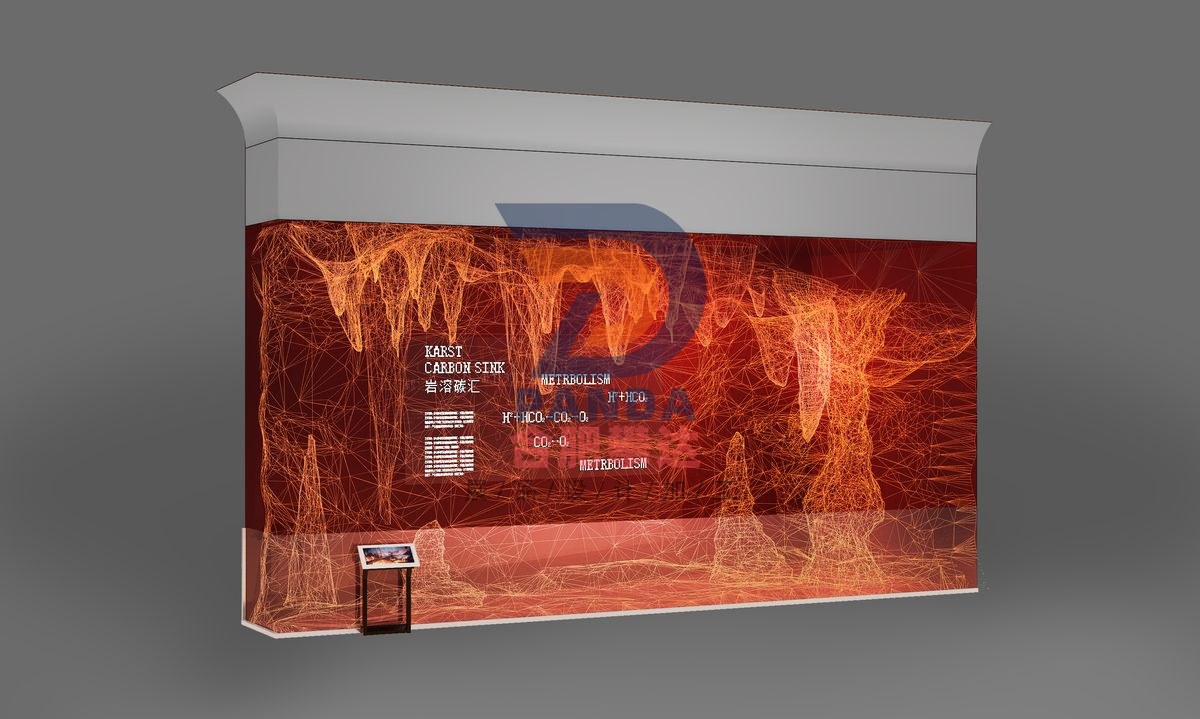
Karst Carbon Sink
Earth & Planet · Interactive
- DimensionsSubject to on-site plan
- PresentationInteractive
- PricingQuoted by manufacture spec
Purpose & Scientific Principle
The exhibits aim to introduce the concept and role of karst carbon sink in karst landform areas. By creating karst art landscaping and multimedia interaction, the audience can understand the unique landform and ecological environment of karst landform area, and learn the carbon storage and carbon sequestration principles of karst carbon sink.
How to Operate
Karst, also known as karst, is a general term for the landscape, phenomena and processes formed by the chemical dissolution of soluble rocks (mainly carbonate rocks) by water, accompanied by the erosion and sedimentation of water, and the gravity collapse of rock masses.
Why is the karst carbon cycle said to be silent?
Carbonate rock is a soluble rock, and its weathering and dissolution rate is dozens to hundreds of times that of silicate rock. Normally, rainwater dissolves CO2 in the atmosphere and soil to generate carbonic acid, which then dissolves carbonate rocks to generate karst water containing HCO3- and Ca2+. During this process, CO2 from the atmosphere is continuously removed and enters the hydrosphere in the form of HCO3-, which plays a corresponding carbon sink effect. Karst carbon sinks are very hidden. The fundamental reason is that carbonate rocks were formed in a warm, light-visible, and clean shallow sea environment during geological history, and their dissolution process is also shown through clear and transparent karst water. Therefore, the karst carbon cycle process is silent.
The basin-scale karst carbon cycle usually consists of three parts: occurrence, migration and transformation. Most of the karst carbon cycle occurs in the shallow karst surface zone, and only a small part occurs in underground rivers and underground caves. During the migration process of karst water rich in HCO3-, a small part of HCO3- is converted into CO2 and escapes into the cave air; more HCO3- flows out of the surface with the flow of groundwater in the form of springs and underground rivers, becoming surface rivers. These karst waters with high concentrations of inorganic carbon stimulate aquatic plants to perform photosynthesis, converting part of the inorganic carbon into organic carbon.
The exhibits will introduce the characteristics of karst landforms, including landform morphology, geological structure, ecological environment, etc., as well as the geographical distribution and ecological functions of karst landform areas. Through the form of karst art landscaping, the unique charm and beautiful scenery of karst landforms are displayed. At the same time, multimedia will be used to introduce knowledge points on karst formation, karst carbon sinks, improving karst carbon sink flux, and Chinese characteristic karst carbon sink plans.
The exhibits aim to combine karst art landscaping and multimedia interaction to allow the audience to have a deeper understanding of the concept and role of karst carbon sinks, recognize the importance of ecosystems, and stimulate their interest and actions in environmental protection.
In order to increase the interest and interactivity of the exhibits, the exhibits will be equipped with karst art landscaping. By simulating landform elements such as limestone and stone caves, and using artistic mesh materials for combination and design, the unique scenery and charm of the karst landform area will be created.
Related Exhibits




Need a quote for this piece or a full exhibit configuration? Tell us your venue area, theme direction, and budget range.