
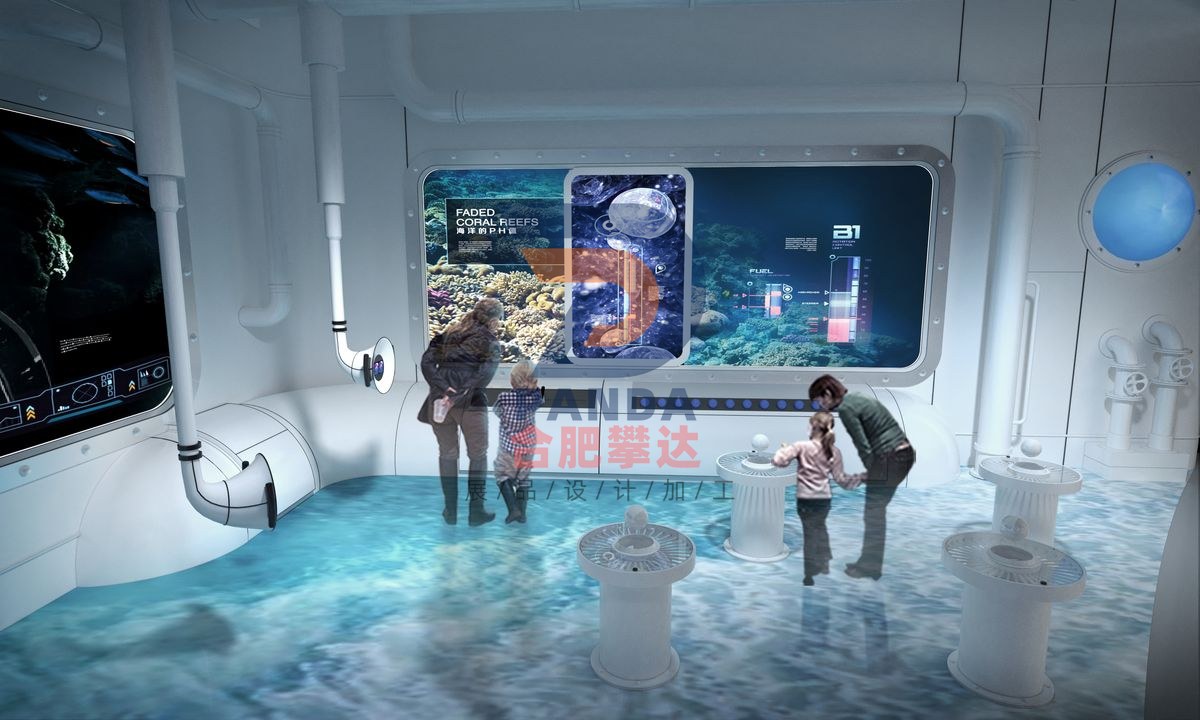
Faded Coral Reef
Earth & Planet · Interactive
- DimensionsSubject to on-site plan
- PresentationInteractive
- PricingQuoted by manufacture spec
Purpose & Scientific Principle
The exhibit uses a simulation experiment to place small balls representing coral reefs in areas where the temperature changes. Using the phenomenon of coral reefs fading as sea temperatures rise, it allows the public to reflect on the relationship between humans and nature, as well as the possibility of coexistence in the future.
How to Operate
Coral reef is an ecosystem in the ocean with extremely high biodiversity. Corals themselves are invertebrates that grow symbiotically with algae, forming a complex ecosystem. Many marine species, including fish, seaweed and other organisms, depend on the ecosystem of coral reefs.
Coral reef bleaching is a symptom of the effects of global warming on the planet itself. As the ocean absorbs too much carbon dioxide, its acidity increases, weakening the ability of corals to form reefs. Research on the Caribbean Gulf shows that a 0.1 degree Celsius increase in surface seawater temperatures will increase the occurrence of "coral bleaching" in 35% of the area. Over the past few decades, coral reefs around the world have experienced bleaching at some point.
Most corals themselves are colorless, and their beautiful color comes from the symbiotic algae in their bodies. Symbiotic algae can provide "food" for corals, which can be said to be one of the necessary conditions for coral survival. However, the harmonious coexistence of the two cannot be separated from the appropriate temperature. Due to global warming, the temperature of seawater gradually rises, causing these symbiotic algae to "run away from home". Corals that lose their symbiotic algae will fade visible to the naked eye and naturally appear white, also known as "bleaching".
If "bleaching" is severe, corals will be unable to repair themselves and will die. There are also some corals that have various pigments of their own, and these pigments are not affected by the "bleaching process". Therefore, some coral reefs that undergo "bleaching" will turn pink, yellow-green, purple or other colors instead of the typical white.
Coral bleaching has a huge impact on marine ecosystems and human society. Coral reefs are the foundation of marine ecosystems, and coral bleaching can lead to the death of marine life and the collapse of ecosystems. In addition, coral reefs are also very important to tourism, and coral bleaching can have a huge impact on local economies and societies.
This exhibit aims to educate visitors about coral reef bleaching. Viewers will learn about coral reef ecosystems, the causes of bleaching, and the importance of coral reefs and measures to protect them.
In order to increase the interest and interactivity of the exhibits, interactive links are set up to allow the audience to experience the charm of coral reefs and the impact of climate change. In order to fit the theme of the exhibits, small balls are set up to represent coral reefs in the ocean, and the color of the surface changes due to temperature. Through a set of driveable heating devices, the small balls are blown up, which will bring varying degrees of degradation to the surface of the sphere.
Related Exhibits





Need a quote for this piece or a full exhibit configuration? Tell us your venue area, theme direction, and budget range.