
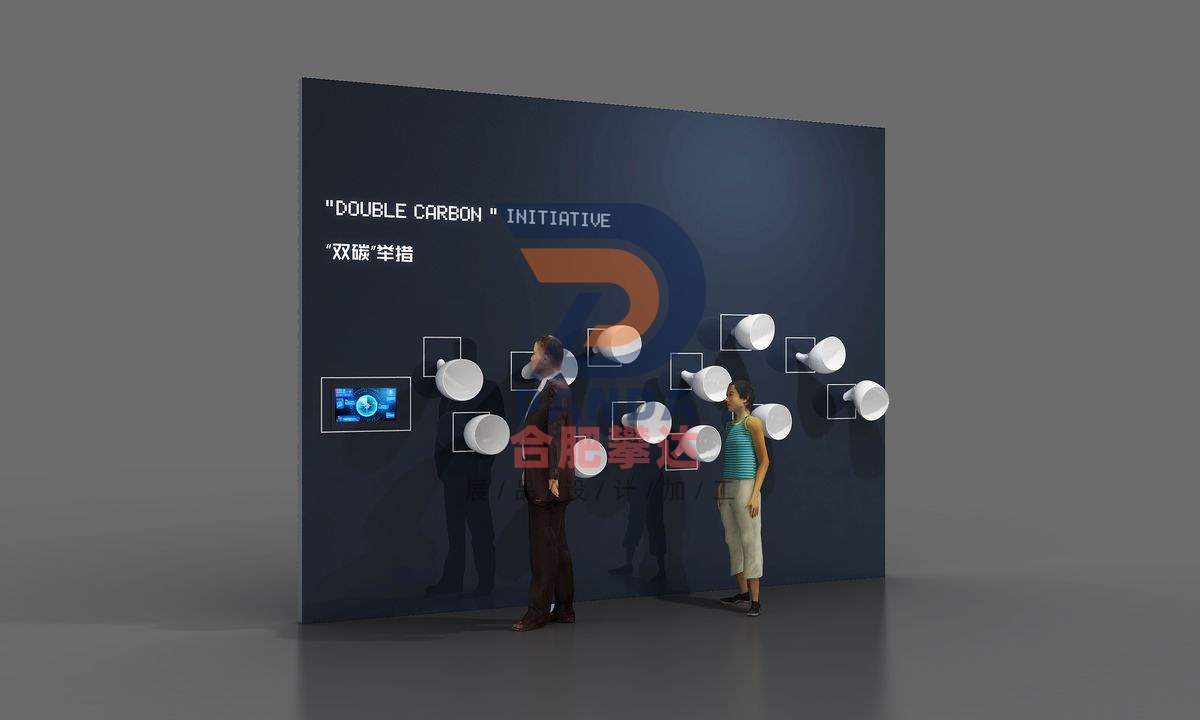
"Double Carbon" Initiative
Earth & Planet · Interactive
- DimensionsSubject to on-site plan
- PresentationInteractive
- PricingQuoted by manufacture spec
Purpose & Scientific Principle
The exhibits use audio interactive devices to let the public understand various policies and initiatives.
How to Operate
1. Clean and low-carbon energy transformation
Solar cells are widely used in the construction of various photovoltaic power stations such as rooftop and fishery-solar complementary. In the production workshop of Tongwei Solar's Hefei base, a single line can produce an average of 140,000 solar cells per day. Taking the Hefei area as an example, installing 1 MW of this kind of solar cell can generate about 1.8 million kilowatt-hours of clean electricity every year, reduce equivalent carbon dioxide emissions by up to 1,100 tons, and can meet the electricity needs of more than 1,200 households for one year. By 2023, Tongwei's battery production capacity will reach 80-100GW, providing more clean energy and promoting the achievement of the "double carbon" goal.
2. Actions to save energy, reduce carbon emissions and improve energy efficiency
In August 2021, Anhui Province launched the "Carbon Index" service among the first in the country, and it was launched on the enterprise online direct reporting platform of the province's statistics department. It provides online "diagnosis" of energy conservation and carbon reduction for industrial enterprises above designated size, and promptly warns and reminds enterprises of existing problems in energy conservation and emission reduction. This "carbon index" service, launched earlier in the country, builds a "clear account" of carbon emissions for enterprises' daily production and operations, and promotes the implementation of "double carbon" goals into the entire process of enterprise production and operation.
3. Economic structure optimization and upgrading actions
Anhui Dadixiong New Materials Co., Ltd. has replaced all high-energy-consuming motors within the company with Class II or higher and Class I high-efficiency motors. The electricity consumption saved throughout the year is about 500,000 kilowatt hours. On the development route of building a green factory, the company integrates internal resources to make up for its shortcomings and comprehensively enhance its awareness of green development. By establishing the ISO50001 energy management system, unit energy consumption has been reduced by 15%, waste recycling and reuse has reached more than 82%, and water recycling and reuse has reached 80%.
4. Green and low-carbon actions in transportation
Chengdu is the fourth rail transit city in the country. The "5+1" area in the central city has built 100% coverage of bus stations within 500 meters of the area, the public transportation motorized travel sharing rate has reached 60%, and the green travel sharing rate has reached 79%... The green transportation system integrating the three networks of "rail, bus, and slow transportation" not only improves commuting efficiency, but also makes people's "way to work" and "way home" more comfortable and beautiful. More Chengdu people travel green, experience the city, and experience life, realizing the transformation of urban transportation into green and low-carbon.
5. Green Development Actions for Urban and Rural Construction
China Construction Fourth Engineering Bureau Civil Engineering Company uses new technologies to create green and low-carbon construction sites. The China Resources Snow Science and Technology Innovation City project adopts the "dual-module" design concept of photovoltaic power generation and packaging boxes to achieve a perfect fit between photovoltaic and modular buildings. There are 145 sets of photovoltaic modules installed on the 1,200 square meters of usable temporary roof and parking shed, with a total power generation of 84.1 kilowatts, which can generate 9,000 kilowatt hours per month, successfully reducing 6,850 kilograms of carbon dioxide emissions, and at the same time fully meeting the daily power demand generated during the off-peak period of electricity consumption in the office area.
6. Actions to reduce emissions and sequester carbon in agriculture and rural areas
The Gansu Provincial Rural Energy Resources Service Station adopts a clean heating model with complementary and comprehensive utilization of solar photothermal and photovoltaic dual systems to realize that the masses mainly rely on solar photothermal heating, and to integratedly solve the daily bathing, hot water and water-heated Kang heat source supply problems. After the solar photovoltaic system generates electricity and is connected to the grid, the proceeds from the grid connection are used to purchase biomass fuel to solve the fuel problem of biomass stoves. A set of "solar and thermal complementary" heating equipment can save each rural household at least 3 tons of standard coal per year, and each household is expected to reduce carbon dioxide emissions by more than 5 tons. It has important demonstration and guidance significance for the realization of carbon emission reduction goals in rural areas of Gansu Province.
7. Actions to consolidate and improve ecosystem carbon sinks
Hefei City has deeply promoted the comprehensive management of Chaohu Lake, systematically implemented the "five major projects" of clear water, safe water, ecological restoration, green development, and enriching people's sharing, and vigorously promoted the "four-source treatment" of point sources, line sources, area sources, and endogenous sources. The average water quality of Chao Lake has changed from worse than Class V to Class IV in 2015, and once improved to Class III in 2020, the best level since monitoring records began in 1979. In addition to the continuous improvement of Chao Lake's water quality, Chao Lake's blue-green algae prevention and control has achieved remarkable results. In the summer of 2022, the number of blue-green algae occurrences in Chao Lake has decreased by 78.3%, the cumulative area has decreased by 84.4%, and the algae density has dropped by 58.9%. Chao Lake is basically free of blue-green algae odor.
8. Green and low-carbon actions for residents’ lives
The government canteen in Jingdezhen, Jiangxi Province implements the "Operation CD" incentive mechanism, using the backend data of the "Green Treasure Carbon Pool" mobile client to collect, record and quantify the carbon reduction amount of energy-saving and low-carbon behaviors in citizens' daily lives, and then convert the carbon reduction amount into "Green Coin" points to exchange for discounts and services. Since the implementation of the "CD-ROM check-in", the rice consumption in the canteen has been reduced by 10% year-on-year, and the amount of kitchen waste has been reduced by 15%. Since the launch of the "Green Treasure Carbon Sink", the city has registered 30,000 people, participated in the "CD-ROM check-in" 42,000 times, accumulated nearly 3.2 million "green coins", and driven a carbon emission reduction of 35.7 tons.
9. Green and low-carbon technological innovation actions
Harbin Normal University has created five discipline-oriented teams: "Carbon sequestration potential and policies of terrestrial ecosystems", "Energy storage and conversion", "Biological carbon sinks", "Clean energy technology and low-carbon conversion and utilization", "Carbon emission calculation and low-carbon optimization strategies". After about four years of construction, it strives to create multiple high-water-related teams. We have a discipline-oriented team with flat, core competitiveness and a group of top-notch talents to produce a large number of landmark scientific research results in the "dual carbon" field, and strive to transform them into scientific and technological products or key technologies that support the national "double carbon" development strategy, providing strong scientific and technological support and talent guarantee for China to achieve the "double carbon" goal.
10. Circular economy supports carbon reduction actions
Ms. Li, a resident of Modern Huacheng Community in Baqiao District, Xi'an City, will store the express cartons she receives separately. After accumulating a certain amount, she will take them to the smart recycling machine in the community for recycling. The machine immediately automatically weighs the cardboard and issues points to Ms. Li based on the weight. Once the points reach a certain number, she can withdraw them to her WeChat wallet. The entire process from delivery to points takes no more than 20 seconds. According to calculations based on public data, intelligent recycling of a package can reduce carbon emissions by more than 1,000 grams. Based on two parcels per person, a community with 1,000 people can reduce carbon dioxide by 2 tons.
11. Green finance supports carbon reduction actions
In 2022, Anhui Province's first special re-loan to support the clean and efficient utilization of coal was implemented. 60 million yuan has been issued by Bank of China Fuyang Branch to Fuyang China Resources Power Co., Ltd. to support the construction of ultra-supercritical secondary reheat coal-fired power generation units. After the completion of the project, based on an annual power supply of 6 billion kilowatt-hours, it will save 210,000 tons of standard coal throughout the year, which is equivalent to reducing carbon dioxide emissions by 558,600 tons.
12. Orderly carbon peaking actions
"Gasifying the Yangtze River" is an important measure to implement the concept of green development, promote ecological protection of the Yangtze River and high-quality development of Yangtze River shipping. On December 20, 2021, in the Gao'anwei operation area of Wuhu Sanshan Port, the Wuhu Yangtze River LNG ship bunkering station successfully completed the first ship bunkering, marking the completion and trial operation of the country's first shore-based LNG bunkering station on inland rivers, and a substantial step towards "gasifying the Yangtze River". The filling station has an annual designed filling capacity of 30,200 tons, which will provide Anhui Province, the Yangtze River Delta region and even the Yangtze River Economic Belt with continuous and stable clean energy, helping to transform the regional energy structure and promote green and low-carbon development.
The exhibits start from the comprehensive implementation of the low-carbon concept of new development and select relevant audio of some "dual carbon" policies and initiatives. Using light sensing technology, audio broadcast control technology, 3D printing technology, etc., 12 sets of highly artistic earpieces are set up to form an audio device array, which can automatically recognize the audience's approach and play audio at the same time.
Related Exhibits
Need a quote for this piece or a full exhibit configuration? Tell us your venue area, theme direction, and budget range.