
The Pythagoras Theorem
Mathematics · Interactive
- DimensionsSubject to on-site plan
- PresentationInteractive
- PricingQuoted by manufacture spec
Purpose & Scientific Principle
The exhibition aims to showcase Pythagoras’ most representative achievement in mathematics, which is the proposing of the Pythagoras Theorem, and uses fun interactions to allow the audience to explore the verification of the Pythagoras Theorem and experience the process of scientific theoretical research and proof.
How to Operate
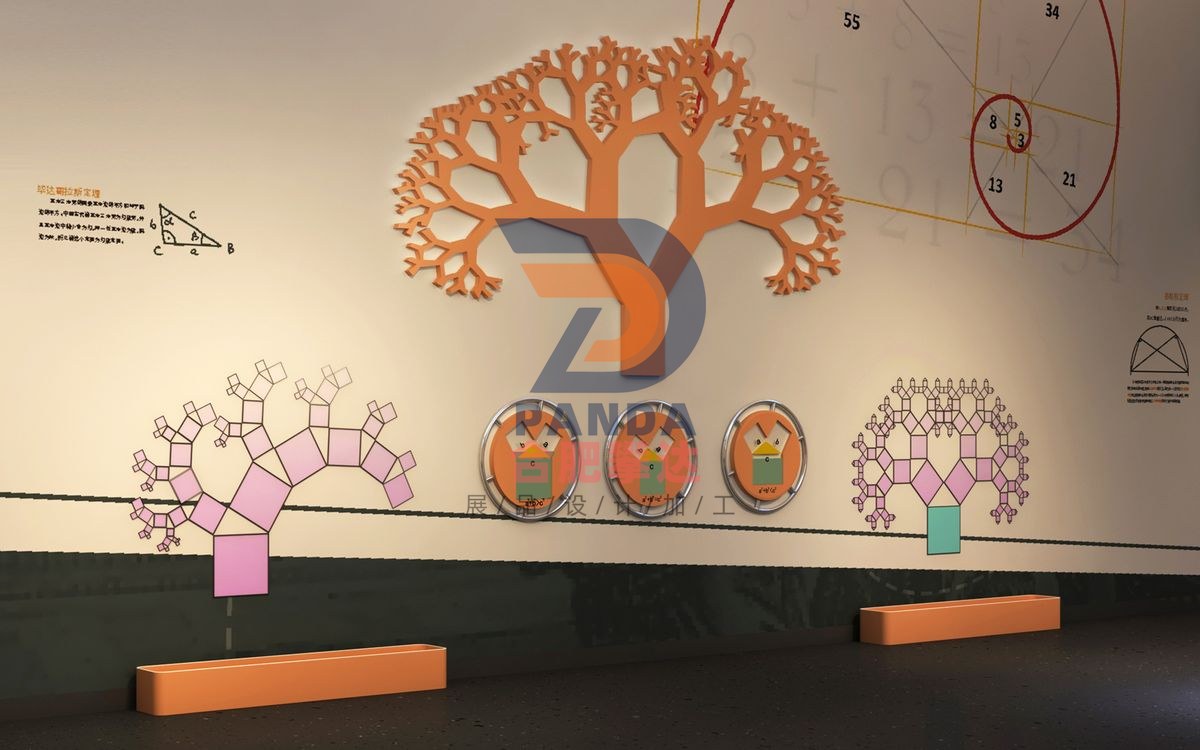
Pythagoras Theorem: The basic relationship between the three sides of a right triangle in Euclidean geometry. That is, the area of a square with a hypotenuse side (the side opposite the right angle) is equal to the sum of the areas of the other two squares. Proofs of theorems are diverse, including geometric and algebraic, and some date back thousands of years.
The root diagram of the "Pythagoras tree": The root diagram of the "Pythagoras tree" is an infinitely repeatable tree shape drawn by Pythagoras based on the Pythagoras theorem. The construction of the Pythagoras tree starts with a large square, and two congruent smaller squares are built above the square. An isosceles right triangle appears between the three squares, so the side length of the smaller square is √2/2 of the side length of the large square. Repeat this process with the two smaller squares, resulting in four smaller squares, and so on.
The exhibition aims to showcase Pythagoras' most representative achievement in mathematics, which is the proposing of the Pythagoras theorem, and uses fun interactions to allow the audience to explore the verification of the Pythagoras theorem and experience the process of research and proof of scientific theories.
Related Exhibits






Need a quote for this piece or a full exhibit configuration? Tell us your venue area, theme direction, and budget range.