
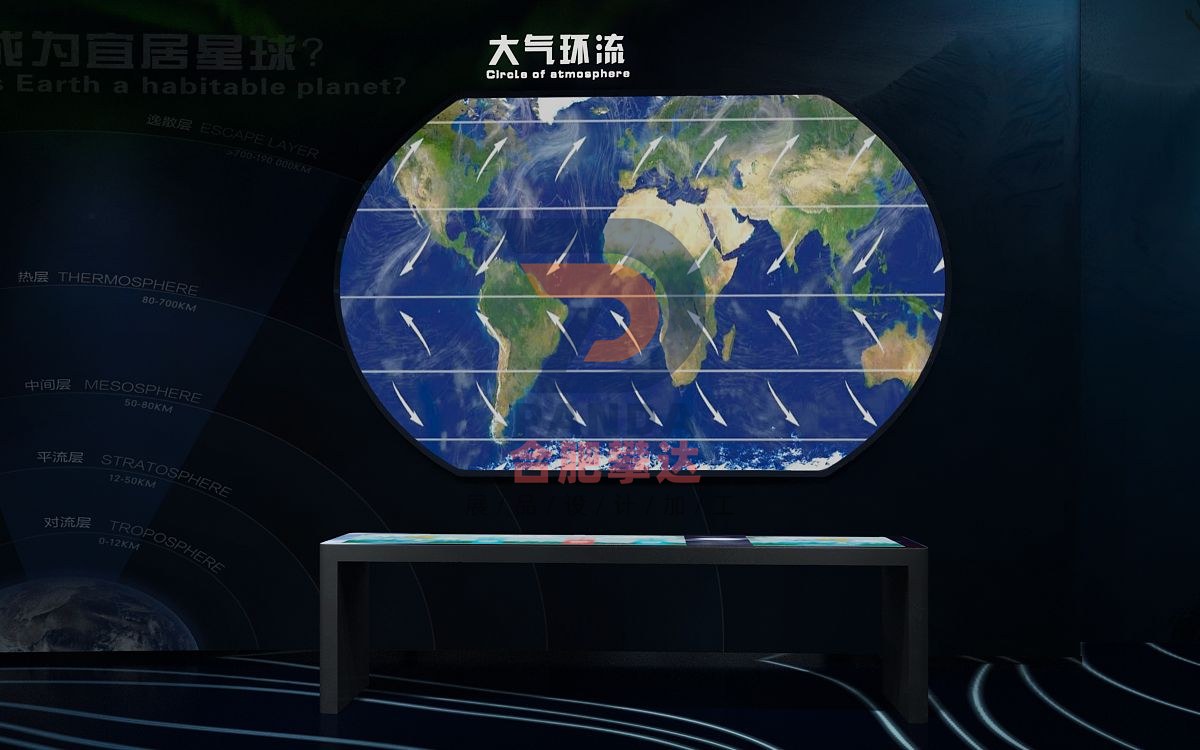
Atmospheric Circulation
Earth & Planet · Interactive
- DimensionsSubject to on-site plan
- PresentationInteractive
- PricingQuoted by manufacture spec
Purpose & Scientific Principle
This exhibit restores the global atmospheric circulation layout through dynamic light boxes, allowing the audience to observe and understand the atmospheric movement on the earth; an interactive platform is set up to lead the audience to learn the principles of atmospheric movement in the atmosphere through video interpretation, understand the role of temperature changes on atmospheric movement, and stimulate the audience's enthusiasm for exploring atmospheric movement.
How to Operate
Atmospheric circulation refers to a world-scale, large-scale atmospheric operation phenomenon. The average state of atmospheric movement in a large area (such as Eurasia, the hemisphere, the world), a certain atmospheric layer (such as the troposphere, stratosphere, middle layer, and the entire atmosphere) over a long period of time (such as months, seasons, years, and years) or the changing process of atmospheric movement in a certain period of time (such as a week, during a rainy season) can be called atmospheric circulation.
Thermodynamic circulation is an air circulation formed due to uneven cold and heat on the ground. It is the simplest form of atmospheric circulation and is embodied in three typical thermodynamic circulation phenomena: land and sea breeze, valley wind, and urban wind.
(1) Sea and land breeze - Due to the difference in the specific heat capacity of the ocean and the land, the thermal properties of the ocean and the land are different.
(2) Valley wind - due to topography, valley wind is reflected in the temperature difference between the hillside-valley and the mountain-plain during the alternation of day and night.
(3) Urban wind - due to the process of urbanization, there is a large difference in heat between rural areas and urban centers, causing a local thermal circulation.
The exhibits are composed of dynamic light boxes and multimedia interactive countertops, focusing on the scientific principles of atmospheric movement and global atmospheric movement. Through the dynamic light box image of the loop demonstration, the principles of the earth's atmospheric circulation can be more intuitively popularized.
Related Exhibits
Need a quote for this piece or a full exhibit configuration? Tell us your venue area, theme direction, and budget range.