
The rotation and revolution of the earth
Earth & Planet · Interactive
- DimensionsSubject to on-site plan
- PresentationInteractive
- PricingQuoted by manufacture spec
Purpose & Scientific Principle
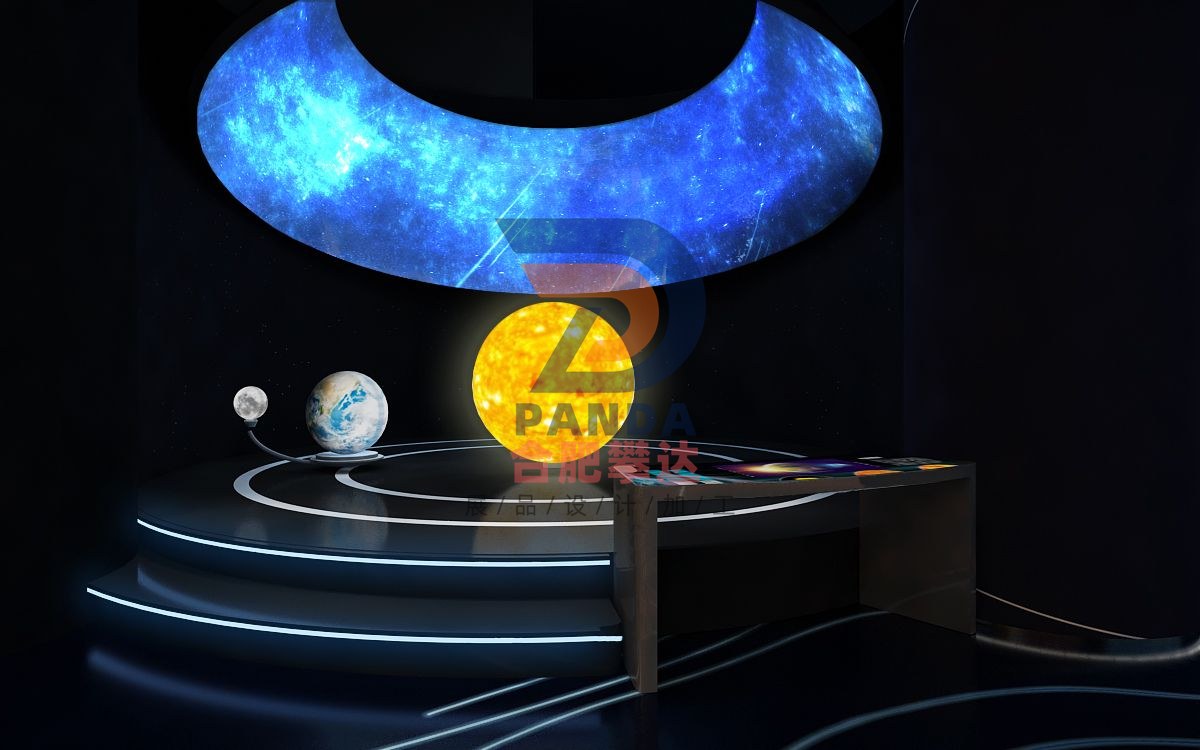
This exhibit uses multimedia combined with interactive devices to show the movement patterns of the sun, the earth, and the moon, as well as the positional relationship and mutual influence between the three. It allows the audience to further understand through interaction how natural phenomena and patterns such as the change of seasons, day and night, and lunar eclipse are formed.
How to Operate
Sun, earth and moon system: The earth revolves around the sun, the moon revolves around the earth, and all three have rotations.
(1) The solar rotation period is different at each latitude. The area near the solar equator rotates once in about 25 Earth days, and the area near the poles takes about 35 Earth days to rotate once;
(2) The Earth’s rotation period is 23 hours and 56 minutes, each Earth day is 24 hours, and its revolution period is approximately 365 Earth days and 5 hours. The orbital plane around the sun is called the ecliptic plane;
(3) The moon’s rotation period is the same as its revolution period, which is about 27 Earth days. The orbital plane of the earth and moon around the earth is called the ecliptic plane;
(4) Earth revolution: refers to the earth rotating around the sun in a certain orbit. Just like the Earth's rotation has its own unique laws, the Earth's revolution caused by the sun's gravitational field and rotation also has its own laws.
Phenomenon formed: the change of seasons;
(5) Earth rotation: The Earth's rotation is the rotation of the Earth from west to east around its axis of rotation. It rotates counterclockwise when viewed from the North Pole and clockwise when viewed from the South Pole. The earth's rotation axis forms an angle of 66°34° with the ecliptic plane and is perpendicular to the equatorial plane.
Phenomenon formed: alternation of day and night;
(6) Moon movement: The moon moves around the earth, causing the relative positions of the sun, earth, and moon to change regularly throughout the month. The relative position changes of the movement of the sun, earth, and moon form the lunar phases and tidal phenomena.
Phenomena formed: moon phase changes, tidal phenomena.
The exhibits are composed of a three-sphere model of the sun, earth and moon, and a ring-screen image. It focuses on displaying the movement patterns of the moon, the sun and the earth, as well as their positional relationships and mutual influences. Through the projection screen combined with the rotation of the electromechanical model, the audience can more vividly understand the positional relationship between the sun, the earth and the moon when natural phenomena such as day and night, four seasons, lunar eclipses, etc. occur, as well as the principles of the formation of various natural phenomena.
Related Exhibits


Need a quote for this piece or a full exhibit configuration? Tell us your venue area, theme direction, and budget range.