
The Evolution of the Earth
Earth & Planet · Interactive
- DimensionsSubject to on-site plan
- PresentationInteractive
- PricingQuoted by manufacture spec
Purpose & Scientific Principle
This exhibit uses a circular screen multimedia content playback combined with mechanical interactive operations to show the evolution of the Earth until the formation of the blue planet. The circular screen is linked with a momentary turntable to perform video interpretations of the four important stages of the Hadean Eon, the Archaean Eon, the Proterozoic Eon, and the Phanerozoic Eon, allowing the audience to understand where our earth home came from, and at the same time further understand the process of changes in the earth's ecological environment and living environment.
How to Operate
The Earth has been around 4.6 billion years since its birth, and has gone through four stages.
(1) The first stage: the Hadean Eon, about 4.6 billion to 4 billion years ago.
According to scientists' inference, the earth was initially formed as a hot ball composed of hot liquid material (mainly magma). As time goes by, the surface temperature continues to drop, and the solid core gradually forms. The denser materials move toward the center of the earth, and the less dense materials (rocks, etc.) float on the surface of the earth, forming an earth whose surface is mainly composed of rocks.
(2) The second stage: the Archean Eon, about 4 billion to 2.5 billion years ago.
The earth already has the basic conditions for the emergence of life, and the primitive atmosphere formed liquid water and oceans. Climate change has smaller ups and downs. The earth's magnetic field protects the earth from large-scale harm. The most primitive life appeared in the middle of the Archean Eon (prokaryotes such as bacteria and lower cyanobacteria existed). From inanimate to living things, this is a great leap in the history of biological evolution.
(3) The third stage: the Proterozoic Eon, about 2.5 billion to 500 million years ago.
During the 1.5 billion years that the earth has been building an ecosystem, the earth's ecological environment has been greatly improved throughout this period. Improvements in climate conditions, environmental conditions, and food conditions have allowed the earth to give birth to more complex life forms. At this time, plants, early animals and early fungi appeared, jointly shaping the earth's atmospheric environment and surface ecological environment.
(4) The fourth stage: the Phanerozoic period, about 541 million years ago to the present.
The Phanerozoic lasted for a relatively short time, but during this period organisms were extremely prosperous, geological evolution was very rapid, and geological processes were rich and colorful.
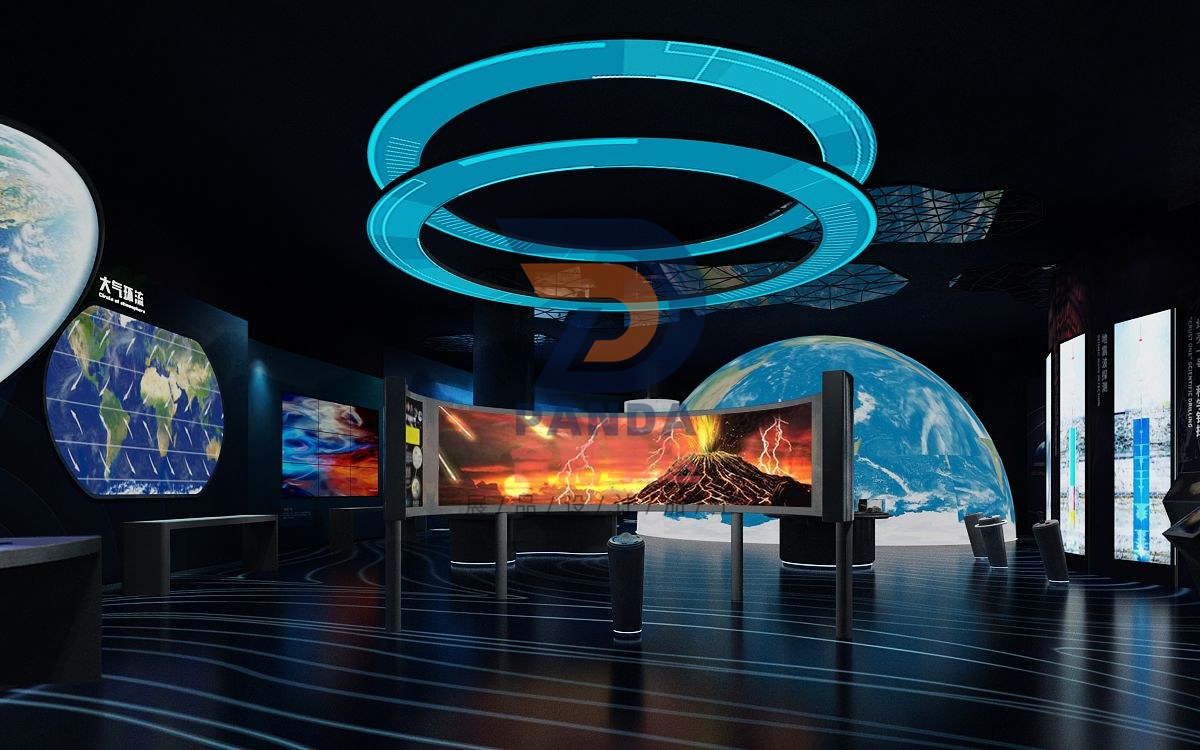
The exhibits focus on showing the continuous development and evolution of the earth after its birth. It uses hanging ultra-thin light boxes combined with ring-screen LED screens to interpret the earth's evolution through interactive devices in a more intuitive and visually shocking way, allowing the audience to fully understand the corresponding time period information and related knowledge content.
This exhibit is structurally designed in a ring-shaped multimedia display style based on several stages of the formation and evolution of the earth. The front end is spliced by soft-film LED modules to ensure the integrity of the display screen. The back end uses a curved light box for display. A set of spherical turntable interactive devices are set up in the middle. Two ultra-thin light boxes with changing colors are hung on the top to better render the environmental atmosphere.
The operation platform is designed with a hemispherical rotating mechanism. There is a signal detection device inside the platform body to accurately detect the audience's operation signals. The LED screen will simultaneously play the corresponding selected popular science videos.
Related Exhibits






Need a quote for this piece or a full exhibit configuration? Tell us your venue area, theme direction, and budget range.